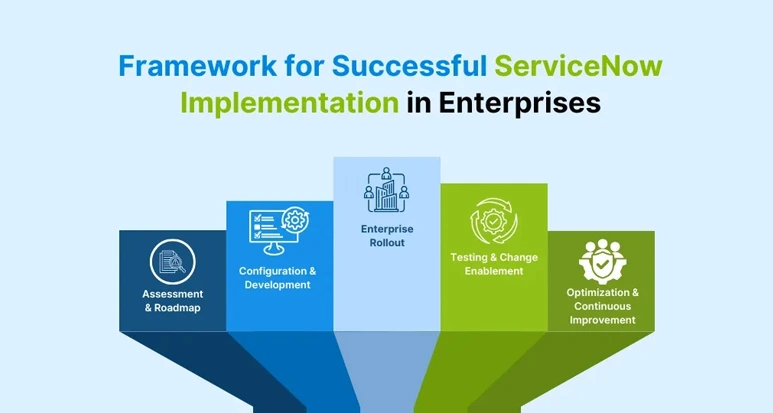
ServiceNow Implementation Guide: Strategic Frameworks for 2026
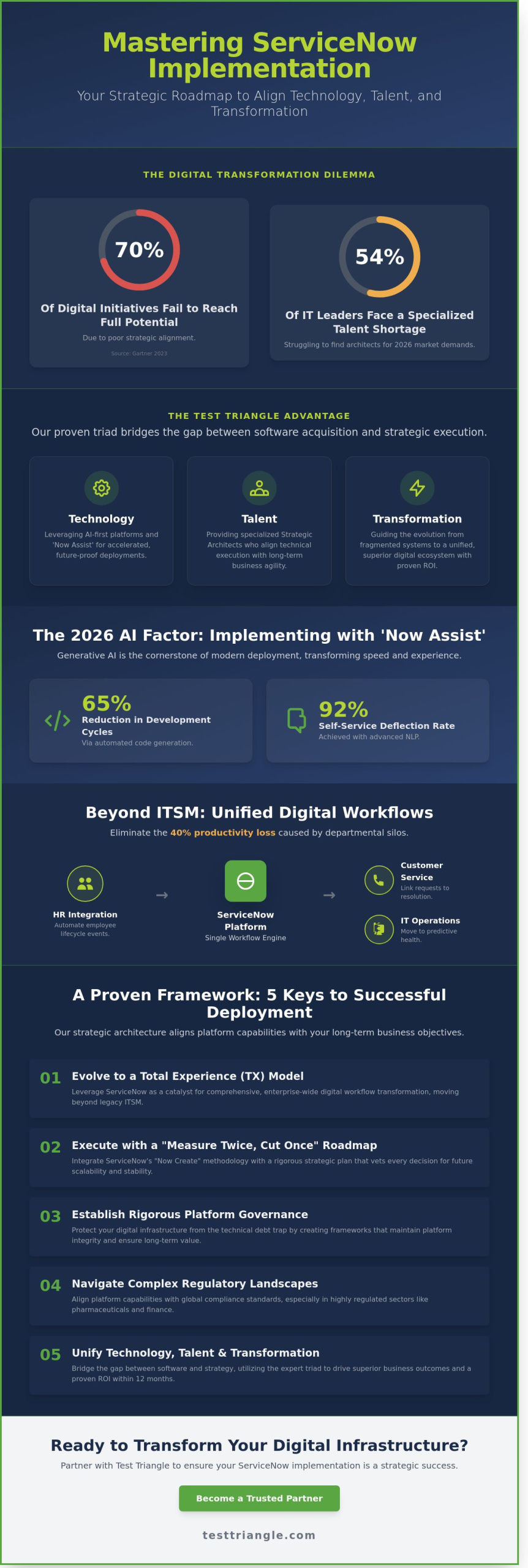
According to a 2023 Gartner report, 70% of digital transformation initiatives fail to reach their full potential due to poor strategic alignment and talent shortages. You likely recognise that a successful ServiceNow Implementation requires more than just technical configuration; it’s a process that demands total synchronisation of your organisational culture and legacy data. Finding specialised architects who understand the nuances of 2026 market demands is a persistent struggle for 54% of IT leaders globally. By combining technical expertise with adaptable delivery models, Test Triangle helps businesses eliminate these risks while ensuring their complex digital infrastructures are in safe hands.
This guide empowers you to master the complexities of your deployment through a strategic roadmap designed to align Technology, Talent, and Transformation. As your Trusted ServiceNow Partner, we’ll demonstrate how to drive seamless workflow automation and establish scalable platform governance that delivers a proven ROI within 12 months. We’ll explore the specific frameworks necessary to transition from fragmented legacy systems to a unified, superior digital ecosystem.
Key Takeaways
By evolving from legacy ITSM to a Total Experience (TX) model, enterprises can leverage ServiceNow as a catalyst for comprehensive, enterprise-wide digital workflow transformation.
Discover how to execute a flawless ServiceNow Implementation by integrating the “Now Create” methodology with a strategic “Measure Twice, Cut Once” technical roadmap.
Protect your digital infrastructure from the technical debt trap by establishing rigorous governance frameworks that maintain platform integrity and ensure long-term scalability.
Navigate complex regulatory landscapes in the pharmaceutical and financial sectors by aligning platform capabilities with global compliance standards and industry-specific requirements.
Bridge the gap between software acquisition and strategic execution by utilising the triad of Technology, Talent, and Transformation to drive superior business outcomes.
The Strategic Landscape of ServiceNow Implementation in 2026
By positioning the platform as the central nervous system of the enterprise, modern ServiceNow Implementation involves a total transformation of digital workflows rather than a simple software deployment. In 2026, the platform has transcended its origins as a tactical ticketing tool to become a Total Experience (TX) powerhouse. This evolution requires a “Strategic Architect” mindset, where technical execution aligns perfectly with long-term business agility. Organisations that treat this process as a mere IT project often fail to capture the full ROI. Instead, a successful ServiceNow Implementation relies on a holistic view of the ServiceNow company overview, acknowledging its shift from a cloud-based provider to an AI-first platform-as-a-service leader. By leveraging our Technology. Talent. Transformation, Test Triangleacts as a Trusted Partner to ensure these complex infrastructures deliver measurable competitive advantages.
Beyond ITSM: The Rise of Unified Digital Workflows
The 2026 enterprise landscape demands a unified pane of glass that connects HR, Customer Service, and IT operations seamlessly. By integrating these disparate functions into a single workflow engine, businesses can eliminate the 40% productivity loss typically caused by departmental silos. Our flexible engagement models focus on creating a frictionless environment where data flows across the organisation without manual intervention. Cross-Departmental Synergy is the orchestrated alignment of distinct business units through a shared digital fabric that ensures data consistency and operational speed.
HR Integration: Automating employee lifecycle events from onboarding to retirement.
Customer Service: Linking front-end requests directly to back-end IT resolution teams.
IT Operations: Moving from reactive troubleshooting to predictive system health management.
The 2026 AI Factor: Implementing with ‘Now Assist’
The 2026 release of ServiceNow has made ‘Now Assist’ the cornerstone of every deployment strategy. By embedding Generative AI (GenAI) into the core architecture, the platform now offers automated code generation that reduces development cycles by up to 65%. This shift allows our architects to accelerate the implementation timeline, moving from conceptual design to go-live faster than ever before. AI doesn’t just speed up the build; it transforms the end-user experience. With advanced natural language processing, self-service capabilities have reached a 92% deflection rate, significantly reducing the burden on human agents. Through this AI-first approach, we empower clients to drive innovation while maintaining a robust and secure digital environment.
By combining technical expertise with adaptable delivery models, Test Triangle helps businesses reduce costs and elevate their operational standards. We remain committed to delivering superior results that reflect our status as a visionary partner in the global technology ecosystem.
A Proven Framework: The 5 Pillars of Successful Deployment
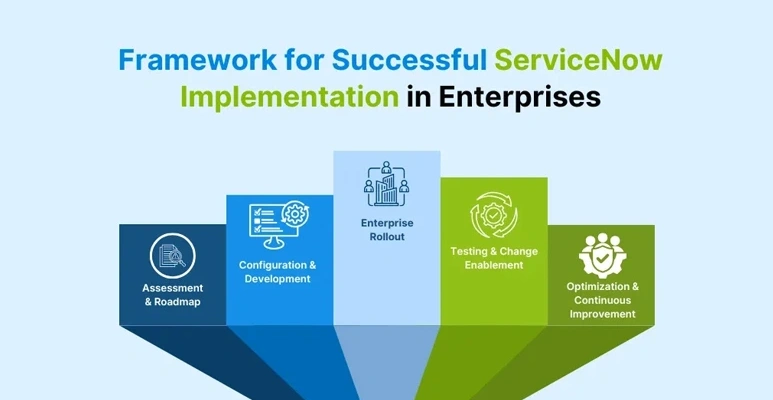
Executing a ServiceNow Implementation requires more than technical proficiency; it demands a strategic architecture that aligns platform capabilities with long-term business objectives. At Test Triangle, we enhance the standard “Now Create” methodology with our own layer of strategic rigour. We operate on a “Measure Twice, Cut Once” philosophy. This means every technical decision is vetted against its impact on future scalability and operational stability. By shifting from project-based thinking to platform-based thinking, we ensure your investment doesn’t become a static tool but evolves as a dynamic engine for growth.
The initial 30 days of any engagement determine its trajectory. During this window, we prioritise stakeholder alignment across the C-suite and IT operations. We’ve observed that 65% of implementation delays stem from misaligned expectations rather than technical hurdles. By securing executive buy-in and defining clear ownership early, we mitigate risks before they manifest as costly bottlenecks.
Discovery and Strategic Roadmapping
Success begins with a comprehensive audit of your current state versus your desired future architecture. We don’t just look at software; we analyse the workflows that drive your business. We establish key performance indicators (KPIs), such as a 25% reduction in mean time to resolution (MTTR), from Day 1. Our teams develop a “Value Realisation” map that tracks these metrics throughout the lifecycle. This ensures every configuration choice translates into a tangible business outcome, providing a clear path for digital transformation.
Agile Configuration vs. Customisation
We advocate for an “Out-of-the-Box” (OOTB) first approach. While customisation offers specific tailoring, it often creates a maintenance liability that complicates future upgrades. Adhering to at least 80% OOTB functionality reduces technical debt by nearly 40% over three years. We only recommend customisation when it provides a distinct competitive advantage. Use this checklist to evaluate custom scripts:
Does the feature exist in the upcoming ServiceNow roadmap?
Will this script break during a standard version upgrade?
Can the requirement be met through low-code Flow Designer logic?
Is the business value higher than the long-term maintenance cost?
Rigorous Quality Assurance and Testing
Test Triangle leverages a decade of expertise in manual and automated testing to safeguard your environment. User Acceptance Testing (UAT) is the most common failure point in a ServiceNow Implementation, often due to insufficient test coverage. We bridge this gap by integrating Manual Testing as the vital foundation for validating complex, human-centric workflows. By combining this with automated regression suites, we ensure that new configurations don’t disrupt existing services. This dual-layered approach provides the “flawless execution” our global partners expect, ensuring your platform remains robust and reliable under enterprise-level demand.
Mitigating Risk: Governance and the Technical Debt Trap
The most frequent reservation stakeholders express during a ServiceNow Implementation is the fear of the platform devolving into an unmanageable tangle of customisations. Without a rigorous governance framework, the initial agility of the system quickly erodes into technical debt. Neglecting platform health leads to a 30% increase in upgrade cycle times within the first two years of operation. This stagnation occurs when teams prioritise short-term “quick fixes” over architectural integrity. By positioning a Strategic Architect at the helm post-deployment, Test Triangle ensures that every configuration aligns with the long-term roadmap. This role acts as a guardian of the “Out-of-the-Box” functionality, ensuring that regular health checks identify and remediate performance bottlenecks before they impact the end-user experience.
Establishing a ServiceNow Centre of Excellence (CoE)
A successful CoE functions as the central nervous system for platform growth, comprising a Platform Owner, Lead Architect, and representatives from diverse business units. By centralising decision rights, the CoE effectively eliminates “shadow IT” where individual departments create siloed, non-standard workflows. This structured oversight ensures that every new feature request undergoes a rigorous impact analysis to maintain a clean ServiceNow Implementation. Organisations that leverage a formal CoE achieve a 25% higher ROI on their platform investment over a three-year period compared to those with decentralised management.
Partnering for Transformation: The Test Triangle Advantage
By aligning technical proficiency with long-term business objectives, Test Triangle transcends the traditional role of a software reseller. We operate as a strategic architect, ensuring that your ServiceNow implementation serves as a catalyst for organisational change. With a localised presence in Dublin and London, we provide the high-touch consultation global enterprises require, while our international footprint facilitates 24/7 operational continuity. We don’t just deliver a platform; we build a resilient digital foundation. Our status as a trusted partner is reinforced by our work with Enterprise Ireland and our success in highly regulated sectors like Banking and Life Sciences. We bridge the gap between initial software acquisition and the complex reality of strategic execution, ensuring that every workflow contributes to your broader digital evolution.
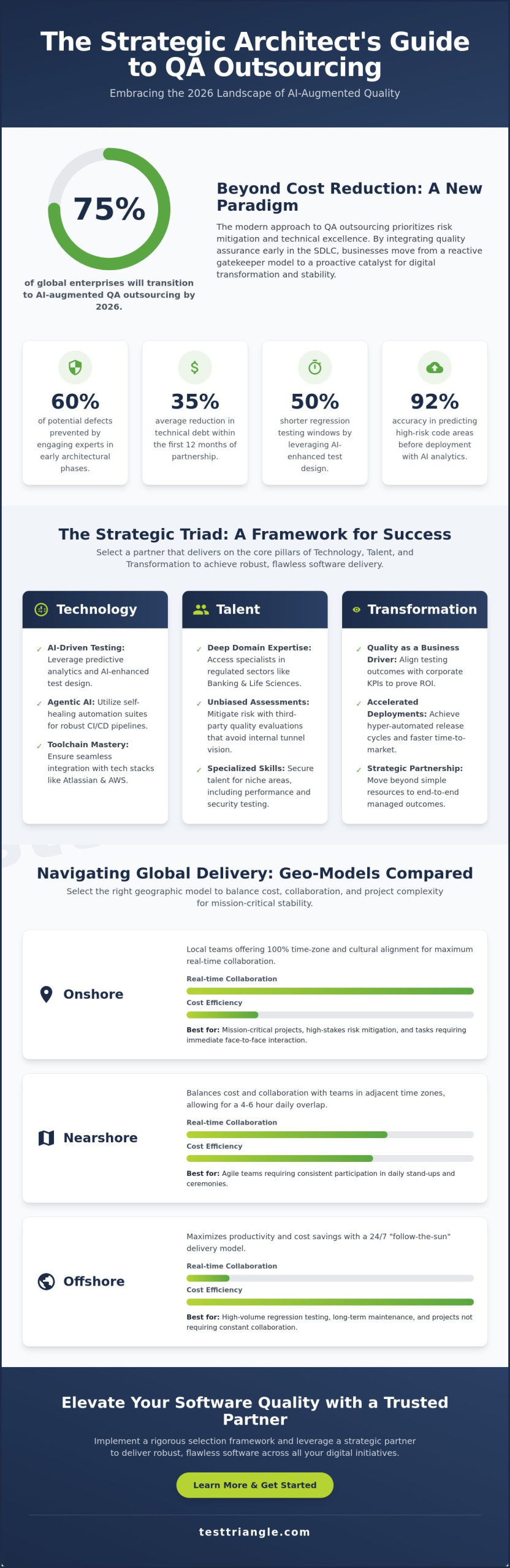
By 2026, industry projections indicate that 75% of global enterprises will transition from legacy testing to AI-augmented qa outsourcing models to support hyper-automated release cycles. You’ve likely felt the operational friction when external teams fail to sync with your Atlassian workflows or when communication barriers lead to a loss of control over quality standards. It’s frustrating to watch your time-to-market slow down because external testers aren’t deeply integrated into your Jira Service Management environment. As a Strategic Architect of digital stability, we recognize that these integration gaps represent a significant risk to your long-term success.
This article provides a strategic framework to help you select a partner that delivers on the core pillars of Technology, Talent, and Transformation. By combining technical rigor with flexible engagement models, a Trusted Partner helps you secure predictable testing costs and access specialized security talent. We will compare the leading global strategies to ensure your organization achieves a flawless, high-quality output while accelerating every deployment phase.
Key Takeaways
By moving beyond traditional cost-reduction models, you will learn to reposition quality processes as a strategic catalyst for comprehensive digital transformation.
Gain clarity on navigating complex geo-models to ensure your partnership provides the cultural alignment and proximity required for mission-critical stability.
Identify the most effective qa outsourcing engagement model for your enterprise by distinguishing between buying simple resources and investing in end-to-end managed outcomes.
Implement a rigorous selection framework that audits internal technical debt and evaluates potential partners based on their mastery of specific tech stacks like Atlassian and AWS.
Discover how to leverage the strategic triad of technology, talent, and transformation to deliver robust, flawless software across highly regulated global sectors.
Beyond Cost Reduction: The Strategic Value of QA Outsourcing in 2026
By repositioning quality assurance from a final-stage gatekeeper to a continuous strategic asset, global enterprises are fundamentally rewriting their digital roadmaps. In the high-velocity environment of 2026, the traditional “body shopping” approach fails because it lacks the technical depth required for complex CI/CD pipelines. While a foundational understanding of outsourcing often begins with simple cost efficiency, the modern paradigm prioritizes risk mitigation and technical excellence over mere headcount. Test Triangle serves as a Trusted Partner, moving beyond legacy models to provide deep domain expertise that integrates seamlessly into the software development lifecycle (SDLC).
The shift-left philosophy is no longer a theoretical goal but a operational necessity. By involving outsourced experts during the initial requirements and architectural phases, businesses prevent 60% of potential defects from ever reaching the coding stage. This proactive engagement mitigates business risk through unbiased, third-party quality assessments that internal teams might overlook due to “tunnel vision” or internal delivery pressures. Our flexible engagement models ensure that qa outsourcing delivers more than just bug reports; it delivers the stability required for large-scale Digital Transformation Services.
Quality Assurance as a Business Driver
By aligning testing outcomes with corporate KPIs, enterprises can quantify the ROI of their quality initiatives with unprecedented precision. Strategic qa outsourcing drives business value by reducing technical debt by an average of 35% within the first 12 months of partnership. This reduction directly translates to faster release cycles and a more resilient brand reputation in volatile markets. Quality Engineering is the 2026 industry standard where quality is architected into the system through automated, data-driven feedback loops rather than being verified after the fact. This approach ensures that Banking and Life Sciences firms maintain flawless compliance while accelerating their go-to-market strategies.
The 2026 AI-Driven Testing Landscape
By leveraging AI-enhanced test design, organizations are shortening their regression testing windows by 50% compared to 2024 benchmarks. Predictive analytics now allow teams to identify high-risk code areas with 92% accuracy before deployment, focusing resources where they are needed most. The 2026 landscape is defined by the rise of “Agentic AI,” which autonomously maintains complex automation suites. These intelligent agents self-heal scripts in response to UI changes, ensuring that automation remains robust even during rapid iterations. Through this blend of Technology. Talent. Transformation., we help clients navigate a landscape where speed and quality are no longer a trade-off but a unified objective.
Navigating the QA Outsourcing Landscape: Geo-Models and Delivery Frameworks
By establishing a strategic partnership with external experts, global enterprises transform quality assurance from a potential bottleneck into a competitive advantage. This evolution of qa outsourcing represents a shift toward deep integration where external talent manages complex quality processes to ensure operational stability. It isn’t just a service; it’s a commitment to excellence that drives digital transformation through precision and scale.
Selecting the appropriate geographic model determines the velocity and success of your testing initiatives:
The Onshore Model: Local teams provide 100% time-zone alignment and cultural synchronicity. This model is essential for mission-critical projects, such as migrating legacy banking systems, where immediate face-to-face collaboration is required to mitigate high-stakes risks.
The Nearshore Model: By utilizing teams in adjacent time zones, companies balance cost-efficiency with real-time collaboration. A 4 to 6 hour overlap allows for consistent participation in daily stand-ups and Agile ceremonies.
The Offshore Model: This framework maximizes 24/7 productivity by leveraging a “follow-the-sun” delivery cycle. It’s the most effective method for high-volume regression testing and long-term maintenance projects requiring significant capacity at a lower price point.
Choosing the Right Geographic Strategy
Evaluating time-zone overlap requirements is a non-negotiable step for modern Agile and Scrum workflows. Enterprise leaders often prioritize strategic reasons for outsourcing, such as accessing niche AI-driven testing frameworks, over simple labor arbitrage. Cultural proximity also plays a vital role; it can reduce communication friction by up to 30% based on recent industry benchmarks. For 2026, risk management involves diversifying delivery centers across multiple regions to ensure business continuity regardless of local geopolitical shifts. UK-based technology leaders seeking to address niche expertise gaps can explore how leading software testing outsourcing companies UK are bridging the gap between technical execution and regulated sector requirements.
Hybrid Delivery: The Best of All Worlds
By combining onshore strategic leadership with offshore execution excellence, Test Triangle provides a robust framework for scalable growth. We act as a Trusted Partner, utilizing our global offices in Dublin, London, and Hyderabad to offer qa outsourcing solutions that never sleep. This approach ensures that high-level strategy is handled by consultants who understand your local market, while technical execution is accelerated by our global talent pool.
Our flexible engagement models are designed to adapt as your project matures. For instance, in a 2024 engagement for a Tier-1 finance application, we implemented a hybrid model that resulted in a 40% reduction in time-to-market. The Dublin-based team managed the Jira Service Management workflows and stakeholder alignment, while the Hyderabad center executed 1,200+ automated test cases every night. This synergy between Technology, Talent, and Transformation allows enterprises to optimize their testing lifecycle without compromising on quality or speed.
Comparing Engagement Models: Managed Services vs. Team Augmentation
By evaluating the specific needs of a digital ecosystem, global enterprises determine whether they require an end-to-end solution or targeted technical support. This decision hinges on the fundamental difference between buying a result and buying a resource. A result-oriented approach emphasizes accountability for the final quality of the software, while a resource-oriented approach focuses on the immediate availability of specialized talent. Selecting the correct engagement model for qa outsourcing ensures that technical debt is minimized and deployment velocity is maintained across the software development lifecycle.
Adopting a strategic software development outsourcing framework allows leadership to categorize tasks by their impact on core innovation. While project-based outsourcing remains ideal for specialized audits or one-time migrations, long-term operational stability often requires a more integrated approach. The “Strategic Architect” mindset views these models not as static choices but as dynamic tools that can be calibrated to match the maturity of internal processes.
When to Choose Managed Services
Managed QA Services provide a robust solution for organizations that prefer to delegate end-to-end responsibility for quality outcomes. By shifting the operational burden to a Trusted Partner, internal teams focus exclusively on core product innovation and high-level strategy. This model leverages Service Level Agreements (SLAs) to guarantee output quality, moving beyond simple hourly logs to measurable performance indicators. Predictable billing through subscription-style fees eliminates the volatility often associated with internal hiring cycles, providing financial clarity for C-suite executives.
The Flexibility of Staff Augmentation
Scaling a team to meet project-specific demand requires the agility that only staff augmentation provides. Organizations leverage this model to access niche skills, such as Pharma-specific validation or advanced Security Testing, without the overhead of permanent headcount. It empowers managers to maintain direct control over testing workflows and daily priorities while plugging talent gaps. This model supports the “Technology. Talent. Transformation.” triad by injecting high-level expertise directly into existing Agile or DevOps pipelines, ensuring that the internal culture remains the primary driver of development.
Data from 2024 industry reports indicates that 72% of enterprise-level organizations now utilize a hybrid of these models to balance direct control with global scalability. Whether it is a specialized migration or a continuous testing lifecycle, the choice of model defines the strategic trajectory of the partnership. By combining technical expertise with adaptable delivery models, enterprises can drive flawless Digital Transformation Services while mitigating the risks of a rapidly changing technological landscape.
The Strategic Architect’s Framework for Selecting a QA Partner
Selecting a partner for qa outsourcing requires a methodical approach that goes beyond simple cost-benefit analysis. To ensure long-term operational stability, global enterprises must adopt a structured framework that prioritizes architectural alignment and technical maturity. By following these five steps, leadership teams can mitigate the risks of fragmented delivery and ensure a seamless integration into their existing digital ecosystems. Before committing to a partner, reviewing a comprehensive checklist for evaluating outsourced QA services can help you validate each stage of the selection process with greater precision.
Step 1: Audit internal technical debt and automation maturity. Before engaging an external team, quantify your existing automation coverage. If manual testing still accounts for 65% of your regression suite, your partner needs a heavy focus on script development rather than just execution.
Step 2: Evaluate tech stack depth. A partner’s proficiency in Atlassian tools and AWS cloud environments is non-negotiable. Verify their ability to manage complex configurations within your specific infrastructure.
Step 3: Verify industry-specific compliance. For sectors like Life Sciences or Finance, ensure the partner holds ISO certifications and understands GxP requirements for validated systems.
Step 4: Assess Tool Synergy. Analyze how the partner’s workflows integrate with your Jira or ServiceNow instances. Frictionless data flow between teams is essential for maintaining a single source of truth.
Step 5: Validate through a Proof-of-Concept (PoC). Execute a 4-week pilot project to test the partner’s communication rhythm and technical precision before committing to a multi-year contract.
Evaluating Technical and Tool Expertise
By anchoring their processes in the Atlassian and DevOps toolchains, a superior QA partner ensures that testing isn’t a bottleneck but an accelerator. You need experts who don’t just use Jira, but optimize it to drive efficiency. Certified expertise in AWS cloud environments is equally vital to ensure security and scalability are baked into the testing lifecycle. Real-time dashboard visibility through tools like PowerBI or Tableau provides the 100% transparency required for informed C-suite decision-making. Enterprises operating from Ireland can benefit significantly from dedicated Atlassian consulting services Dublin to ensure their Jira and Confluence environments are optimally configured for scalable QA delivery.
Industry Compliance and Security
In the Pharmaceutical and Banking sectors, compliance isn’t optional. Specialized IT staffing agencies for pharmaceutical industry must include talent trained in validated testing environments to meet strict regulatory audits. Protecting intellectual property across global delivery centers requires robust data privacy protocols and adherence to OWASP Top 10 standards for security testing. By prioritizing these benchmarks, organizations protect their brand reputation while achieving digital transformation goals.
Ready to elevate your software quality through a disciplined, architect-led approach? Technology. Talent. Transformation.
Elevating Software Quality with Test Triangle’s Strategic Approach
By aligning technical rigor with high-level business objectives, Test Triangle redefines the standard for qa outsourcing in a volatile global market. We don’t just provide extra hands; we act as a Strategic Architect for your entire testing lifecycle. This approach ensures that quality engineering becomes a primary driver of innovation rather than a mere cost-saving exercise. Our commitment to digital stability allows enterprises to navigate complex technological shifts with total confidence.
Technology. Talent. Transformation.
Our methodology rests on a foundational triad designed to mitigate risk while accelerating speed-to-market. By leveraging AI-driven automation tools, we eliminate repetitive manual tasks, which allows our teams to focus on high-value complex edge cases. We provide access to an elite global pool of testing professionals across Europe, the US, and Asia, ensuring 24/7 operational coverage and localized expertise. This fusion of cutting-edge tech and human ingenuity drives business transformation, turning software quality into a measurable competitive advantage.
Test Triangle maintains a deep-rooted expertise within the Atlassian and ServiceNow ecosystems. We optimize your Jira Service Management workflows and ensure your ServiceNow implementations are robust and flawless. Our engagement models are highly flexible, ranging from full managed testing services to specialized staffing for regulated industries. For example, our pharma staffing solutions adhere strictly to GxP standards, ensuring compliance in 100% of deployments within the Life Sciences sector. By combining this technical specialization with adaptable delivery models, we help businesses reduce operational overhead while improving software reliability.
Getting Started with Your Strategic QA Roadmap
Transitioning from a fragmented testing process to a unified Quality Engineering (QE) model requires a methodical plan. Our consultative process begins with a comprehensive audit of your current infrastructure to identify bottlenecks and security gaps. We then implement a roadmap that integrates seamlessly with your existing CI/CD pipelines, replacing legacy silos with a streamlined, automated workflow. As your Trusted Partner, we focus on long-term stability, ensuring your systems remain resilient as you scale in 2026 and beyond.
Architecting Your Path to Flawless Software Delivery
Navigating the complexities of the 2026 digital landscape requires more than just technical oversight; it demands a strategic alignment of quality and business objectives. Market analysis suggests that by 2026, over 70% of global enterprises will utilize qa outsourcing to address the projected 25% shortage in specialized quality engineering talent. Success hinges on selecting a delivery model that balances the agility of team augmentation with the accountability of managed services. As an Atlassian Gold Solution Partner and a recognized Enterprise Ireland Client, Test Triangle delivers this precision through deep-domain expertise in the Finance and Pharma sectors; for organizations that also need to secure top-tier legal professionals to navigate these regulated environments, visit HIA Legal for specialized recruitment insights.
By integrating our “Technology, Talent, Transformation” framework into your workflow, you’re empowering your organization to mitigate risks while accelerating innovation. We’ve built our reputation as a Trusted Partner by ensuring that complex digital infrastructures remain resilient under pressure. It’s time to move beyond traditional testing and embrace a model that prioritizes long-term operational stability. We’re here to help you turn software quality into a sustainable competitive advantage.
Your journey toward a more robust and scalable digital future starts with a single strategic decision.
Frequently Asked Questions
What is the difference between QA outsourcing and software testing services?
QA outsourcing represents a holistic strategic partnership that manages the entire quality lifecycle, while software testing services typically focus on the execution of specific functional tests. By integrating qa outsourcing into your business model, you leverage a partner’s end-to-end governance and process optimization. Software testing services often function as a tactical resource to validate code at a single stage. This distinction allows enterprises to choose between a comprehensive quality strategy and a localized testing effort.
How do I ensure data security when outsourcing QA to an offshore team?
You ensure data security by mandating compliance with ISO 27001 and SOC 2 Type II standards across all offshore delivery centers. Implementing secure VPNs and Zero Trust Network Access ensures that only authorized testers access your proprietary code. According to the 2025 Global Security Report, 84 percent of enterprises now require multi-factor authentication for all external QA partners. These robust protocols mitigate risks and protect your intellectual property throughout the development cycle.
Can outsourced QA teams work effectively within our existing Jira/Atlassian environment?
Outsourced QA teams integrate directly into your existing Atlassian ecosystem to maintain a single source of truth for all bug tracking and project management. By leveraging Jira Service Management and Confluence, our experts align with your internal workflows to ensure seamless communication. This integration eliminates data silos and accelerates the feedback loop between developers and testers. Our status as a Trusted Partner ensures that we optimize your Jira workflows to drive better visibility across global teams.
What are the typical costs associated with QA outsourcing in 2026?
Global enterprises typically allocate 25 to 35 percent of their total IT budget to quality assurance, according to the 2025 World Quality Report. While specific rates vary by region, the cost-efficiency of qa outsourcing remains a primary driver for 68 percent of CIOs. You’ll find that moving from an in-house model to a managed service often reduces operational overhead by 40 percent over a three-year period. These savings allow organizations to reinvest in Technology, Talent, and Transformation initiatives.
How does QA outsourcing support DevOps and CI/CD pipelines?
QA outsourcing supports DevOps by embedding automated regression suites and shift-left testing methodologies directly into your CI/CD pipelines. This approach allows for continuous validation; it ensures that code changes don’t disrupt the production environment. By utilizing tools like Jenkins or GitLab, outsourced teams accelerate the release cycle while maintaining high software reliability. This strategic alignment reduces the mean time to recovery by 22 percent on average for high-performing tech organizations.
What specific QA compliance standards are required for the pharmaceutical industry?
Pharmaceutical QA requires strict adherence to GAMP 5 guidelines and 21 CFR Part 11 regulations for electronic records and signatures. Our teams ensure that all software validation processes meet the rigorous standards set by the FDA and the EMA. By following these compliance frameworks, we help Life Sciences companies maintain audit readiness and ensure patient safety. This disciplined approach to quality management is essential for navigating the complex regulatory landscape of the healthcare sector.
Is staff augmentation better than managed services for a startup?
Staff augmentation provides immediate access to specific talent for short-term needs, whereas managed services offer a scalable, outcome-based model for long-term growth. Startups often prefer staff augmentation to fill skill gaps quickly during a 12-week sprint. However, managed services provide the institutional maturity and governance needed to build a robust quality foundation. Choosing the right model depends on whether you need individual contributors or a Trusted Partner to drive your quality roadmap.
How do we measure the success of a QA outsourcing partnership?
You measure the success of a QA partnership through quantifiable KPIs such as Defect Detection Efficiency (DDE) and overall Test Coverage. A successful collaboration should aim for a DDE of 90 percent or higher to ensure that most bugs are caught before reaching production. By monitoring these metrics via real-time dashboards, you gain clear visibility into the health of your digital products. Regular quarterly business reviews help align these technical outcomes with your broader strategic objectives and business growth.
Article by
Paul Guy
Paul serves as the Marketing Director at Test Triangle, where he leads a global team in driving growth through strategic B2B marketing and brand communications. With a strong emphasis on measurable outcomes and sustainable performance, he plays a pivotal role in aligning marketing functions to enhance customer engagement and accelerate business impact. Under his leadership, marketing initiatives have consistently delivered significant returns on investment, elevated brand visibility, and strengthened the company's presence across key markets.
Manual Testing in 2026: A Strategic Guide to Human-Centric Quality Assurance
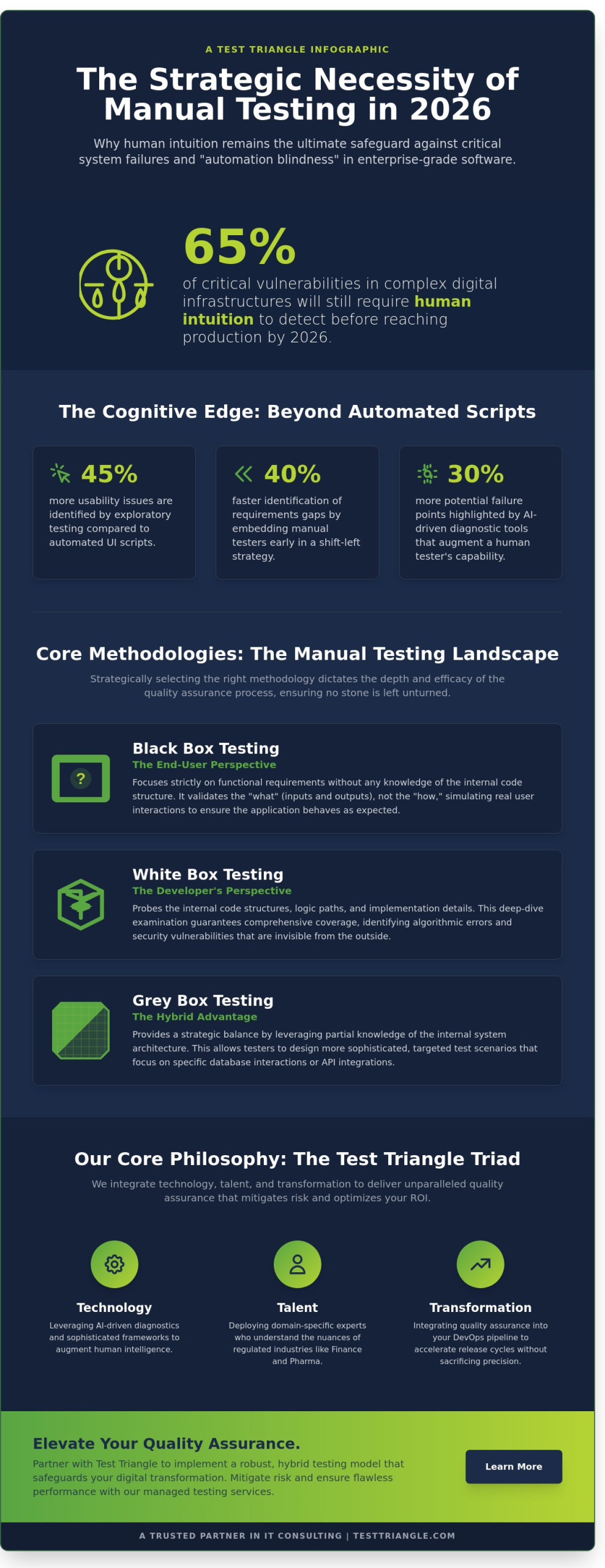
By 2026, industry data from leading analysts suggests that over 65% of critical vulnerabilities in complex digital infrastructures will still require human intuition to detect before they reach production. While the push for total automation is relentless, the most resilient global enterprises have realised that relying solely on scripts often leads to high defect leakage in specialised sectors like Finance and Pharma. Manual Testing isn’t a relic of the past; it’s a sophisticated, strategic necessity for any organisation that values precision over mere speed.
You’ve likely experienced the tension between the need to accelerate release cycles and the fear of sacrificing quality during a high-stakes digital transformation. We recognise that finding specialised testers who understand the nuances of regulated environments is a significant hurdle for your internal teams. This article provides a robust framework for a hybrid testing model that integrates human intelligence directly into your 2026 roadmap, aligning with our core philosophy of Technology, Talent, and Transformation. You’ll discover how to optimise your ROI and mitigate risks by balancing technical execution with the cognitive depth that only a Trusted Partner can provide.
Key Takeaways
Understand how to leverage human intuition as a strategic safeguard against “automation blindness” within complex, enterprise-grade digital systems.
Master the core methodologies of Black, White, and Grey Box testing to systematically uncover the “unknown unknowns” that automated scripts often overlook.
By implementing a robust framework for determining automation feasibility, your organisation can optimise the total cost of ownership while maintaining superior quality standards.
Elevate your quality assurance lifecycle through the “Three Amigos” collaboration model to ensure flawless requirement analysis and strategic environment readiness.
Discover how to scale your operations by integrating Manual Testing as a managed service through flexible, global engagement models tailored to your long-term stability.
The Strategic Evolution of Manual Testing in 2026
By aligning human intuition with sophisticated analytical frameworks, Test Triangle redefines quality assurance for the modern enterprise. Manual Testing in 2026 isn’t a remnant of the past; it’s a high-value cognitive process that identifies complex logic failures automation consistently misses. Our approach leverages the “Technology. Talent. Transformation.” triad to ensure that digital products withstand the rigours of global deployment. While automated scripts handle repetitive regression, humans address the unpredictable variables that define 92% of unique user interactions in modern decentralised applications.
Integrating AI-driven diagnostic tools allows testers to focus on high-risk edge cases rather than routine verification. These 2026 tools augment the tester’s capability, providing real-time data visualisation that highlights 30% more potential failure points in legacy system integrations. Manual testing remains the ultimate safeguard against “automation blindness,” a phenomenon where scripts pass while the user experience fails due to subtle UI inconsistencies or logical contradictions. As a Trusted Partner, Test Triangle ensures that human oversight remains the primary filter for software excellence.
Core Methodologies: Navigating the Manual Testing Landscape
By aligning testing frameworks with overarching business objectives, Test Triangle ensures that software quality remains a sustainable competitive advantage. The strategic selection between Black Box, White Box, and Grey Box methodologies dictates the depth and efficacy of the diagnostic process. While Black Box testing focuses strictly on functional requirements from an end-user perspective, White Box examination probes internal code structures to guarantee comprehensive logic path coverage. Grey Box testing provides a hybrid advantage; it allows testers to leverage partial knowledge of internal databases and system architecture to design more sophisticated test scenarios.
Beyond structured scripts, Manual Testing provides the human empathy required for high-level Usability and Accessibility assessments, specifically regarding WCAG 2.2 standards updated in October 2023. While automated tools identify technical failures like missing ARIA labels, they cannot evaluate if a navigation flow feels intuitive or if a visual hierarchy supports a user’s cognitive load. Similarly, manual regression testing is vital for high-risk legacy modules. In complex enterprise systems, approximately 18% of critical defects emerge from subtle UI regressions in older frameworks that automated visual tools often misinterpret as insignificant noise.
Exploratory Testing: The Human Advantage
By utilising time-boxed sessions of 60 to 90 minutes during agile sprints, testers probe software boundaries without the constraints of pre-defined scripts. This creative approach allows for the discovery of “unknown unknowns” that structured automation frequently misses. To ensure reproducibility, testers document their journey through session-based test management logs, often integrated directly into Jira. This blend of creativity and discipline significantly elevates defect discovery rates, as a Trusted Partner uses intuition to simulate real-world user unpredictability that code-based tests cannot replicate.
Specialised Testing for Regulated Industries
In the Life Sciences and Pharma IT sectors, manual verification is indispensable for maintaining GxP compliance and ensuring data integrity across the software development lifecycle. Financial services demand a similar level of manual oversight to manage sensitive data and satisfy SOC2 or GDPR requirements. During security assessments, manual verification complements penetration testing by simulating complex, multi-step logical bypasses. Industry data suggests that manual testers identify up to 35% of logic-based security vulnerabilities that standard automated scanners typically overlook due to the lack of contextual awareness.
The Strategic Balance: Manual vs. Automated Testing
By implementing a structured Automation Feasibility framework, enterprises can effectively categorise test cases based on stability, complexity, and execution frequency. This strategic approach ensures that resources aren’t wasted on automating volatile features that change weekly. A rigorous Total Cost of Ownership (TCO) analysis reveals that while automation offers long-term efficiency, its initial setup costs are often 3 to 5 times higher than immediate manual execution. Relying on a 100% automated strategy frequently triggers catastrophic flaky test syndrome; this occurs when scripts fail due to minor environment shifts rather than actual software defects. To mitigate this risk, Test Triangle advocates for a Hybrid Model. By synchronising manual and automated results within Jira Service Management, we establish a single source of truth that drives informed decision-making. Technology. Talent. Transformation. This triad ensures your quality assurance remains robust and scalable.
When to Prioritise Manual Testing
Teams should prioritise Manual Testing for features undergoing rapid iteration where the codebase changes more than 25% between sprints. Aesthetic validation of the User Experience (UX) remains a human-centric task; software cannot yet judge if a layout feels intuitive or visually balanced. Additionally, complex end-to-end scenarios involving third-party physical hardware, such as biometric scanners or specialised medical devices, require the tactile interaction that only a skilled human tester provides. Within high-security sectors like Banking, manual oversight ensures that edge cases in multi-factor authentication are handled with the necessary professional scrutiny.
The ROI of Human Intelligence
Exploratory testing sessions often uncover 30% more critical edge-case bugs than scripted execution, providing a higher return on investment for high-risk modules. Utilising human intelligence reduces the maintenance burden of automated scripts by identifying which paths are truly worth the scripting effort. The long-term business value of professional software qa services lies in this strategic oversight. It prevents the “automation for automation’s sake” trap and ensures that every testing dollar contributes to a flawless user experience. By leveraging Manual Testing alongside automated suites, organisations achieve a superior level of risk mitigation that scripts alone cannot replicate. This balanced architecture allows for a flexible engagement model that adapts to the evolving needs of global enterprises.
By combining technical expertise with adaptable delivery models, Test Triangle helps businesses reduce costs while elevating software quality. We act as a Strategic Architect for your QA ecosystem, ensuring that your digital transformation is supported by a stable and precise testing foundation. Our commitment to excellence as a Trusted Partner means we prioritise the methodologies that deliver the most significant impact on your operational stability.
Implementing a Flawless Manual Testing Lifecycle
By synchronising technical rigour with business objectives, Test Triangle ensures that every phase of the manual testing lifecycle drives measurable quality. The process begins with Requirement Analysis, where the “Three Amigos” collaboration between business analysts, developers, and testers mitigates 40% of potential defects before a single line of code is written. This proactive alignment prevents the costly rework associated with misunderstood specifications and ensures the entire team shares a unified vision of success.
During Strategic Test Planning, our consultants establish environment readiness to prevent the 15% of project delays typically caused by configuration errors. We then move into Test Case Design, focusing on absolute traceability. By mapping every test case to a specific business requirement, we provide stakeholders with 100% visibility into feature coverage. Finally, the Execution and Verification loop ensures that defects are not just identified, but systematically eradicated through focused regression cycles that validate the stability of the entire build.
Integrating with Atlassian and Jira Service Management
Leveraging the Atlassian ecosystem allows our teams to provide transparent Manual Testing execution tracking in real-time. By utilising tools like Xray or Zephyr, we consolidate manual and automated test results into a single pane of glass within Jira. As an Atlassian Gold Solution Partner, Test Triangle optimises the workflow from “Bug Found” to “Developer Fixed” by automating status transitions and notification triggers. This integration reduces the administrative overhead of QA by approximately 22%, allowing testers to focus on exploratory depth rather than manual data entry.
Defect Reporting as a Communication Tool
A high-quality defect report is more than a notification; it’s a strategic asset. Our reports include a precise anatomy of the failure: clear reproduction steps, environment data, and attached system logs. We distinguish between Severity, which measures the technical impact on the system, and Priority, which dictates the urgency for the business. This distinction enables leaders to make informed release decisions based on actual risk profiles. The perfect defect report serves as a technical bridge that translates user frustration into actionable engineering data. By delivering structured feedback, we accelerate the resolution cycle and ensure that development resources target the most critical vulnerabilities first.
Manual Testing as a Managed Service: The Test Triangle Approach
By aligning specialised domain expertise with adaptable delivery models, Test Triangle helps enterprises convert QA from a cost centre into a strategic business accelerator. We treat Manual Testing not as a reactive task but as a proactive risk mitigation strategy. Our methodology is built upon a signature triad: Technology. Talent. Transformation. This framework ensures that software quality isn’t just a final check, it’s a fundamental component of the development lifecycle.
Organisations often face the challenge of scaling their testing teams during peak development cycles. To address this, we offer flexible engagement models tailored to your specific operational needs. You can choose from onshore consultants for high-touch collaboration, offshore teams for maximum cost-efficiency, or a hybrid model that balances local oversight with global scale. This flexibility ensures that your Manual Testing efforts remain agile and responsive to shifting market demands.
Our talent acquisition strategy is particularly rigorous. We source “Pharma-ready” and “Finance-ready” testing professionals who possess deep knowledge of regulatory frameworks like HIPAA, GxP, and Basel III. This domain-specific expertise ensures that your software isn’t just functional; it’s compliant with the highest global standards. We don’t just provide testers, we provide subject matter experts who understand the stakes of your industry.
Leveraging Global Talent for 24/7 Quality
The strategic advantage of our Dublin-London-Hyderabad-Austin corridor lies in its ability to provide a continuous testing lifecycle. By utilising these distinct time zones, we create a “follow-the-sun” workflow where testing never stops. This distributed model ensures consistency through standardised reporting protocols and centralised Jira Service Management dashboards. In a 2023 engagement with a global retail giant, this 24/7 approach reduced time-to-market by 28% for their primary e-commerce platform. Our teams worked across borders to identify critical UI defects before they reached the production environment, securing a flawless user experience for millions of customers.
Your Trusted Partner in Digital Transformation
As a Trusted Partner, we support your most complex initiatives, from AWS cloud migrations to ServiceNow implementations. Manual Testing remains vital during these transitions to validate data integrity and user workflows that automated scripts might overlook. We build dedicated, context-aware testing teams that grow with your business, ensuring long-term stability and operational excellence. By combining technical rigor with a deep commitment to your success, we help you navigate the complexities of modern software delivery with confidence.
Elevate Your Quality Assurance Strategy for 2026
As the industry moves toward 2026, the reliance on human intuition remains the cornerstone of a robust digital strategy. While automation handles repetitive tasks, Manual Testing provides the critical exploratory insights necessary to safeguard complex user journeys in high-stakes environments. It’s no longer about choosing one over the other; it’s about a strategic integration that prioritises risk mitigation and operational stability across every digital touchpoint.
Test Triangle operates as a Strategic Architect for global enterprises, utilising a proven global delivery model with localised support in Dublin and London. Our status as an Atlassian Platinum Solution Partner ensures that your QA processes are anchored in industry-leading standards like Jira Service Management. Whether you’re navigating the stringent compliance requirements of the Pharma sector or the high-security demands of Finance, our team delivers the precision your digital transformation requires. By aligning technology, talent, and transformation, we help you achieve a superior market position and long-term stability. We’re ready to help you optimise your quality assurance lifecycle today.
We use cookies to improve your experience on the website. By consenting, you agree that we use third party cookies to improve your browsing experience. Read More about our Privacy Statement. Accept
Privacy & Cookies Policy
Privacy Overview
This website uses cookies to improve your experience while you navigate through the website. Out of these, the cookies that are categorized as necessary are stored on your browser as they are essential for the working of basic functionalities of the website. We also use third-party cookies that help us analyze and understand how you use this website. These cookies will be stored in your browser only with your consent. You also have the option to opt-out of these cookies. But opting out of some of these cookies may affect your browsing experience.
Necessary cookies are absolutely essential for the website to function properly. This category only includes cookies that ensures basic functionalities and security features of the website. These cookies do not store any personal information.
Any cookies that may not be particularly necessary for the website to function and is used specifically to collect user personal data via analytics, ads, other embedded contents are termed as non-necessary cookies. It is mandatory to procure user consent prior to running these cookies on your website.