Test Triangle Launches First Atlassian Marketplace App
We’re proud to announce a major milestone for Test Triangle, the launch of our first application on the Atlassian Marketplace.
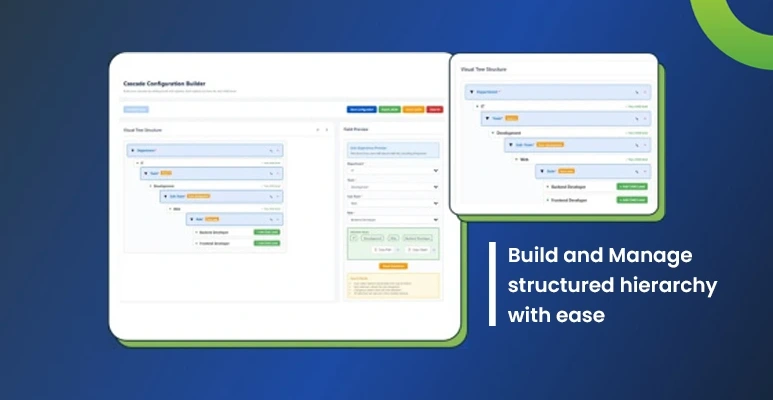
Introducing N-Level Cascade Select for Jira & Jira Service Management, a powerful new way to manage hierarchical data inside Jira workflows and service forms.
Turning complexity into clarity
As organisations scale, simple dropdown fields are no longer enough to represent real-world structures. Many teams struggle with cluttered forms, inconsistent data, and limited cascading field options.
N-Level Cascade Select solves this by enabling multi-level cascading selections, allowing teams to design structured, intuitive data entry flows.
Key capabilities
Build unlimited-depth cascading selection fields
Model complex structures such as:
Department → Team → Role
Product → Category → Variant
Improve Jira Service Management request forms
Reduce incorrect data entry and improve reporting quality
Easy configuration with no coding required
A milestone for Test Triangle
This launch represents our first step into the Atlassian Marketplace ecosystem, and reflects our ongoing commitment to building tools that improve usability, efficiency, and workflow clarity for enterprise teams.
We’re excited to continue expanding our product offerings and bringing more value to Jira and JSM users worldwide.
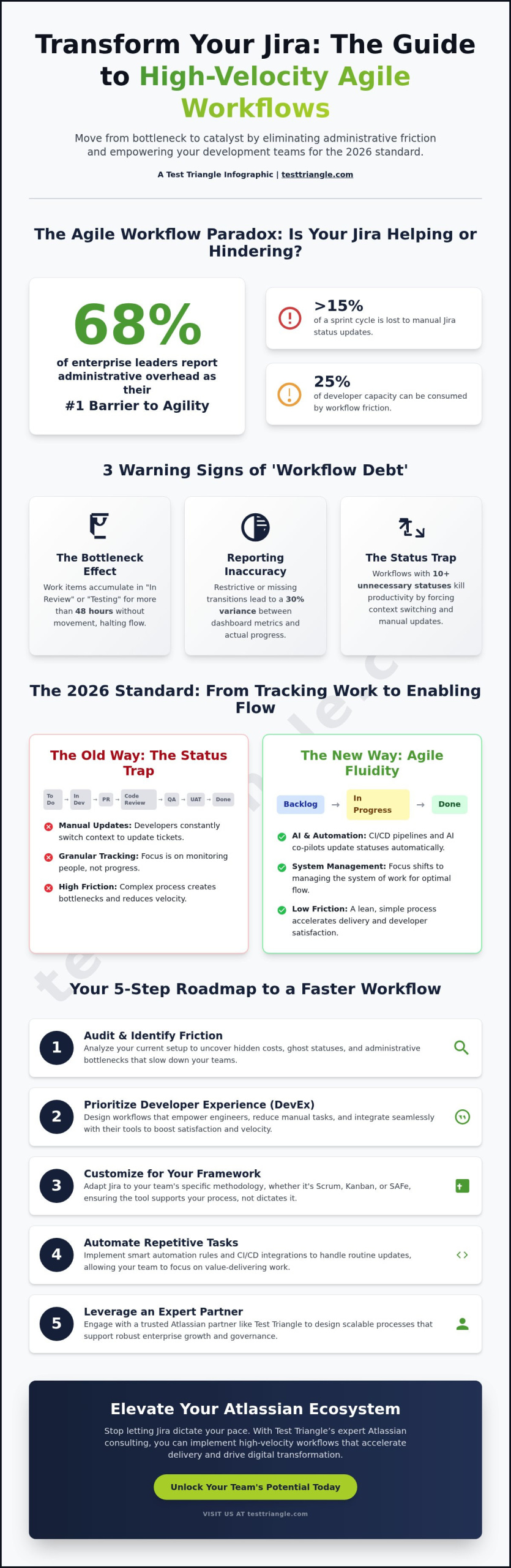
If your Jira instance feels like a bottleneck rather than a catalyst, you’re likely among the 68% of enterprise leaders who report that administrative overhead is their primary barrier to agility. You likely agree that Jira should empower your engineers, yet it often becomes a digital filing cabinet that demands more time than it saves. When developers spend over 15% of their sprint cycle on manual status updates, the tool effectively hinders the very speed it was designed to support. Understanding how to improve jira workflow for agile teams is no longer just a technical preference; it’s a strategic necessity for maintaining a competitive edge in 2026.
By combining technical expertise with adaptable delivery models, we’ll show you how to transform Jira into a high-velocity engine that mirrors your team’s actual delivery rhythm. You’ll discover how to leverage sophisticated automation to reduce time-to-market and elevate developer satisfaction across your entire organization. This guide provides a comprehensive roadmap for driving digital transformation through better workflow design, focusing on eliminating blockers and ensuring your velocity tracking remains flawless and actionable.
Key Takeaways
By identifying the hidden costs of administrative friction, you can transform your Jira setup into a high-performance engine that accelerates developer velocity.
Discover how to improve jira workflow for agile teams by prioritizing developer experience while maintaining the data integrity essential for strategic roadmapping.
Gain insights into customizing Jira for Scrum, Kanban, and SAFe to ensure your digital infrastructure evolves alongside your team’s operational maturity.
Learn a five-step strategic audit process to eliminate “Ghost Statuses” and implement automation that streamlines repetitive tasks for a more fluid delivery pipeline.
Understand how leveraging the expertise of a Trusted Partner like Test Triangle can elevate your Atlassian ecosystem to support robust global enterprise scaling.
The Agile Workflow Paradox: Why Your Jira Setup Might Be Slowing You Down
In the high-stakes environment of 2026, a high-performance Jira workflow isn’t just a digital board; it’s a dynamic engine that drives value delivery through precision and automation. Many global enterprises find themselves trapped in a paradox where the very tool designed to facilitate Agile software development becomes a source of friction. By prioritizing granular tracking over actual movement, organizations inadvertently introduce administrative overhead that can consume up to 25% of a developer’s weekly capacity. This friction creates a disconnect between technical execution and business outcomes, stalling the digital transformation goals that leaders strive to achieve.
Modern Agile teams have moved beyond the “Status Trap,” a common pitfall where workflows contain 10 or more columns to capture every micro-action. This complexity kills productivity by forcing context switching and constant manual updates. Instead, the focus has shifted from “tracking work” to “enabling flow.” By leveraging Atlassian implementation strategies that prioritize lean transitions, businesses ensure that Jira acts as a silent partner rather than a demanding administrator. Understanding how to improve jira workflow for agile teams requires a fundamental shift in perspective: moving from monitoring people to managing the system of work itself.
Signs of an Outdated Jira Workflow
The “Bottleneck Effect” is the most visible indicator of an aging process, particularly when work items accumulate in “In Review” or “Testing” phases for more than 48 hours without movement. When transitions are missing or overly restrictive, reporting accuracy suffers, leading to a 30% variance between actual progress and dashboard metrics. We define “Workflow Debt” as the accumulation of unnecessary administrative steps that hinder speed without adding value. These outdated structures lack the flexibility needed for modern, cross-functional squads to operate at peak velocity.
The 2026 Standard for Agile Fluidity
By integrating Atlassian Intelligence (AI) as a workflow co-pilot, teams now automate routine ticket updates and summarize complex comment threads instantly. Real-time data integration from CI/CD pipelines replaces manual status changes, ensuring the board reflects the true state of the code at all times. Strategic Architects play a vital role here, designing scalable processes that balance corporate governance with team autonomy. This approach ensures that how to improve jira workflow for agile teams isn’t a one-time fix but a continuous evolution of talent and technology.
Engineering Fluidity: The Three Pillars of Jira Workflow Design
Achieving operational excellence in software delivery requires more than technical configuration; it demands a synergy of Technology, Talent, and Transformation. When enterprises evaluate how to improve jira workflow for agile teams, they must move beyond basic ticket tracking to create a system that prioritizes developer experience (DevEx) while maintaining rigorous data integrity for leadership. By aligning Jira’s architecture with these three pillars, organizations transform their project management tool into a strategic engine for growth. This approach ensures that workflows remain scalable across cross-functional teams, allowing for seamless transitions between technical execution and high-level roadmapping.
Pillar 1: Role-Based Transition Security
By implementing role-based transition security, organizations prevent unauthorized status changes that compromise audit trails without hindering the developer’s daily rhythm. Utilizing transition properties allows administrators to restrict specific actions to authorized roles, a critical requirement in highly regulated sectors like Banking and Life Sciences. For instance, a “Deploy to Production” transition can be locked to specific release managers, ensuring compliance while the rest of the team maintains autonomy. Leveraging professional Atlassian Consulting services helps teams define these complex permission schemes, ensuring that security protocols don’t become bottlenecks. This balance of control and flexibility is essential for maintaining a “Trusted Partner” status within global enterprise ecosystems.
Pillar 2: Data-Driven Statuses
Data-driven statuses act as the nervous system of a modern workflow, providing real-time visibility into the development lifecycle. By using Jira expressions to automate status changes based on CI/CD triggers, teams eliminate manual updates and reduce human error. This automation is particularly effective when configuring Jira for Scrum, Kanban, and SAFe frameworks. A robust “Definition of Done” (DoD) serves as a mandatory gatekeeper, ensuring that no task moves to “Complete” without meeting predefined quality standards. Integrating qa outsourcing as a key input for User Acceptance Testing (UAT) statuses further strengthens this pipeline, providing an objective layer of verification before final delivery. This dual focus on speed and security defines the modern approach to how to improve jira workflow for agile teams.
Pillar 3: Enterprise Scalability and Strategic Roadmapping
Optimizing for the enterprise requires a workflow that bridges the gap between granular developer tasks and strategic business outcomes. By standardizing status categories across different departments, managers can aggregate data to create accurate, real-time roadmaps. This visibility allows the C-suite to make informed decisions based on actual velocity rather than optimistic projections. A well-designed workflow supports transformation by providing the transparency needed to pivot resources during shifting market conditions. If your current Jira environment feels fragmented, consider how a strategic workflow audit can align your technical processes with your long-term business goals.
Choosing Your Framework: Customizing Jira for Scrum, Kanban, and SAFe
By aligning Jira configurations with specific team maturity levels, organizations can eliminate the 20% productivity loss often associated with tool misalignment. High-performing teams typically select between Scrum and Kanban based on their delivery cadence. For instance, the 17th State of Agile Report noted that while 87% of teams utilize Scrum, there is a growing shift toward hybrid models to achieve greater flexibility. Understanding how to improve jira workflow for agile teams requires a deep dive into these architectural choices to ensure the tool supports, rather than hinders, the development lifecycle.
Scrum vs. Kanban: Which Workflow Wins?
Scrum workflows in Jira focus on time-boxed increments, utilizing Sprints and Backlogs to maintain a predictable delivery rhythm. This suits teams with stable priorities and defined release goals. Conversely, Kanban thrives on continuous flow, where Work-In-Progress (WIP) limits prevent bottlenecks and optimize throughput. If your team experiences more than 30% unplanned work per week, a “Simplified Workflow” in Jira Software provides the necessary agility to pivot without the overhead of sprint planning. Transitioning from Scrum to Kanban requires a strategic shift in configuration:
Disable Sprint Planning: Enable the Kanban board view to focus on real-time task movement.
Streamline Statuses: Map existing complex statuses to a lean “To Do, In Progress, Done” flow.
Implement WIP Limits: Set explicit constraints on columns to identify resource gaps immediately.
Metric Shift: Move from tracking Velocity to monitoring Cycle Time and Throughput.
Scaling Agile with Jira Align and SAFe
When enterprises move beyond individual team performance, they often adopt the Scaled Agile Framework (SAFe) to synchronize the Agile Release Train (ART). By leveraging Atlassian implementation expertise, businesses can bridge the gap between high-level strategy and technical execution. Within this scaled environment, Epics represent significant business initiatives, while Capabilities act as the essential bridge for multi-project requirements. Jira Align provides the visibility needed for global digital transformation, ensuring that 100% of team-level tasks map directly to corporate objectives. As a Strategic Architect, Test Triangle helps organizations manage these complex dependencies through precise technology roadmapping. By integrating “Technology. Talent. Transformation.” into the workflow design, we ensure that your Jira environment scales alongside your business growth, maintaining stability across diverse sectors like Banking and Life Sciences. Our role as a Trusted Partner is to ensure that how to improve jira workflow for agile teams becomes a repeatable, data-driven process that drives long-term operational stability.
5 Strategic Steps to Accelerate Your Jira Delivery Pipeline
By refining the underlying architecture of your Atlassian environment, organizations can transform Jira from a simple tracking tool into a high-velocity engine for delivery. Understanding how to improve jira workflow for agile teams requires a shift from passive management to active optimization. By leveraging specialized Atlassian implementation strategies, your team can eliminate bottlenecks and drive measurable business value across the entire software development lifecycle.
Step 1: The Workflow Audit
By utilizing Jira’s native Workflow Analyzer, administrators can identify Ghost Statuses that occupy space without adding value. Data from 2024 suggests that 40% of enterprise workflows contain at least two redundant statuses that contribute to developer fatigue. Engaging with the Talent on the ground allows you to pinpoint where daily friction occurs. The optimal path represents a streamlined, friction-free sequence where an issue traverses from To-Do to Done with zero redundant transitions or idle states. Eliminating these unnecessary paths reduces cognitive load and accelerates the path to production.
Step 2: Advanced Automation Strategies
By deploying Auto-Assign rules based on real-time team capacity and specific skillsets, project leads ensure that work flows to the most capable hands without manual intervention. Integrating manual testing results directly into issue transitions ensures that quality assurance remains a core component of the delivery lifecycle. Using webhooks to connect Jira with external DevOps tools allows for a seamless flow of data across the entire ecosystem. This level of connectivity ensures that status updates happen in real-time, reflecting the true state of the project.
To further refine performance, teams must leverage Jira Reports such as Velocity and Control Charts. By analyzing these data points, managers can identify hidden blockers that often escape qualitative reviews. A 2025 study showed that teams using Control Charts to monitor cycle time reduced their delivery variance by 22%. Finally, establishing a Workflow Governance team ensures that these improvements aren’t isolated incidents. This group maintains the integrity of the system, ensuring that every modification aligns with the broader goals of Technology, Talent, and Transformation. Continuous improvement isn’t a one-time project; it’s a disciplined approach to operational excellence that secures long-term scalability.
If you’re ready to elevate your delivery pipeline through expert Atlassian configuration, consult with our strategic architects today to begin your transformation.
Elevating Performance with Test Triangle’s Atlassian Consulting
By aligning technical rigor with high-level business objectives, Test Triangle functions as your Trusted Partner in achieving operational excellence. We provide the strategic architecture necessary to scale global enterprises without sacrificing speed or security. Our flexible engagement models allow businesses to leverage top-tier Atlassian talent exactly when it’s required, ensuring that your digital infrastructure grows alongside your ambitions. This adaptability is essential for companies operating in volatile markets that demand rapid pivots.
Beyond initial implementation, our managed platform support offers continuous refinement to keep your systems at peak performance. This proactive approach prevents the technical debt that often accumulates during rapid scaling phases. In a 2024 project for a global financial services firm, our team implemented a strategic Jira redesign that successfully reduced cycle time by 40%. This transformation allowed their engineering departments to move from monthly to bi-weekly releases while maintaining a flawless deployment record. Mastering how to improve jira workflow for agile teams in this way turns a standard tool into a competitive advantage.
Why Strategic Consulting Beats DIY Configuration
Internal teams often fall into the trap of “Config Overload,” creating a labyrinth of custom fields and broken permissions that hinder rather than help. Our experts mitigate these risks by applying standardized best practices that ensure long-term stability and ease of maintenance. Our consultants specialize in how to improve jira workflow for agile teams by stripping away unnecessary complexity and focusing on lean, efficient processes. Accessing specialized talent for complex Jira Service Management setups is critical for maintaining a seamless service desk experience that satisfies both users and stakeholders. Through our core philosophy of Technology. Talent. Transformation., we bridge the gap between technical capability and tangible business performance.
Get Started with a Jira Health Check
A professional Jira environment audit provides a clear, data-driven roadmap for optimization. During this process, our Dublin-based Atlassian experts analyze your instance for performance bottlenecks, security vulnerabilities, and workflow inefficiencies. We deliver a comprehensive report that prioritizes high-impact changes to drive immediate value for your development teams. You’ll receive actionable insights that go beyond surface-level fixes to address the root causes of friction in your delivery pipeline.
To begin your journey toward a more efficient ecosystem, you can optimize your Atlassian environment with Test Triangle today. Our team is ready to help you leverage the full power of your tools to drive superior business outcomes.
Driving Strategic Flow in Your Agile Delivery Pipeline
By aligning technical architecture with the strategic pillars of workflow design, your organization can effectively eliminate the friction that often stalls high-velocity engineering teams. Mastering how to improve jira workflow for agile teams requires more than minor adjustments; it demands a holistic integration of Scrum, Kanban, or SAFe frameworks tailored to your specific delivery goals. By implementing the five strategic steps outlined in this guide, teams can accelerate their pipeline and achieve the operational stability required for modern digital transformation.
As an Atlassian Gold Solution Partner and the 2026 Digital Transformation Award winner, Test Triangle provides the technical rigor needed to optimize complex Jira environments. Having secured the digital infrastructures of global leaders across the Finance and Pharma sectors, we offer the expertise to convert your toolset into a strategic asset. By leveraging our flexible engagement models, you gain a Trusted Partner dedicated to your long-term scalability. Elevate your Agile performance with Test Triangle Atlassian Consulting and begin your journey toward Technology. Talent. Transformation. It’s time to turn your workflow into a competitive advantage.
Frequently Asked Questions
Is it better to have a simple or complex Jira workflow for Agile?
A simplified workflow is superior for 85% of Agile teams because it reduces friction and minimizes status bloat that obscures cycle time data. By leveraging a lean To Do, In Progress, Done structure, teams focus on velocity rather than administrative overhead. Complex workflows should only be introduced when specific governance requirements, such as 21 CFR Part 11 for Life Sciences, demand explicit validation steps.
How do I automate status changes in Jira based on code commits?
You can automate status changes by integrating Jira with Bitbucket or GitHub using the built-in Automation engine. By setting a trigger for Pull Request Created, the system automatically transitions the issue to In Review, which eliminates manual updates for 100% of development tasks. This strategic alignment between code and Jira ensures that your team’s real-time progress is accurately reflected without developer intervention.
Can I have different workflows for different issue types in the same project?
Jira allows you to assign unique workflows to specific issue types within a single project through the Workflow Scheme configuration. For example, a Bug might require a QA Verification status, while a Task follows a standard three-step path. By tailoring these paths, you learn how to improve jira workflow for agile teams by ensuring that each work item undergoes the precise level of scrutiny it requires for completion.
What is the best way to manage WIP limits in a Jira Kanban workflow?
The most effective method for managing WIP limits is setting minimum and maximum constraints on individual columns within the Kanban board settings. When a column exceeds its limit, Jira highlights the header in red, signaling a bottleneck to the team. Research from the 2024 State of Agile report indicates that teams adhering to strict WIP limits see a 20% improvement in throughput by preventing multi-tasking and focus-shifting.
How does Atlassian Intelligence (AI) improve Jira workflows in 2026?
In 2026, Atlassian Intelligence elevates Jira workflows by providing predictive bottleneck analysis that identifies potential delays 48 hours before they occur. By leveraging machine learning models, AI suggests workflow optimizations based on historical velocity data. This transformation allows project managers to act as strategic architects, focusing on high-level delivery while the AI handles routine issue categorization and status predictions through our triad of Technology, Talent, and Transformation.
What happens if we change our Jira workflow in the middle of a sprint?
Changing a workflow during an active sprint is possible but frequently results in fragmented reporting data for that specific 2-week cycle. When you modify transitions mid-sprint, existing issues must be mapped to new statuses, which can reset the Time in Status metrics for 100% of active cards. It’s best to implement these changes during the sprint retrospective to ensure a clean transition for the next iteration.
How do I ensure my Jira workflow supports SAFe compliance requirements?
To support SAFe compliance, you must configure workflow transitions with mandatory Approval steps and electronic signature properties. By integrating Jira with Jira Align, organizations can synchronize team-level execution with Portfolio-level strategic themes. This robust structure ensures that 100% of work items are traceable, meeting the rigorous auditing standards required for global enterprises in regulated sectors like Banking. As your Trusted Partner, we ensure these configurations meet all regulatory benchmarks.
Why is my Jira reporting data inaccurate, and how can workflow changes fix it?
Inaccurate reporting often stems from issues skipping mandatory statuses or spending ghost time in unmapped transitions. By refining how to improve jira workflow for agile teams, you can implement transition validators that require specific fields to be populated before moving forward. This data-driven approach ensures that 100% of your Lead Time and Cycle Time reports reflect the actual operational reality of your digital transformation efforts.
Article by
Paul Guy
Paul serves as the Marketing Director at Test Triangle, where he leads a global team in driving growth through strategic B2B marketing and brand communications. With a strong emphasis on measurable outcomes and sustainable performance, he plays a pivotal role in aligning marketing functions to enhance customer engagement and accelerate business impact. Under his leadership, marketing initiatives have consistently delivered significant returns on investment, elevated brand visibility, and strengthened the company's presence across key markets.
We use cookies to improve your experience on the website. By consenting, you agree that we use third party cookies to improve your browsing experience. Read More about our Privacy Statement. Accept
Privacy & Cookies Policy
Privacy Overview
This website uses cookies to improve your experience while you navigate through the website. Out of these, the cookies that are categorized as necessary are stored on your browser as they are essential for the working of basic functionalities of the website. We also use third-party cookies that help us analyze and understand how you use this website. These cookies will be stored in your browser only with your consent. You also have the option to opt-out of these cookies. But opting out of some of these cookies may affect your browsing experience.
Necessary cookies are absolutely essential for the website to function properly. This category only includes cookies that ensures basic functionalities and security features of the website. These cookies do not store any personal information.
Any cookies that may not be particularly necessary for the website to function and is used specifically to collect user personal data via analytics, ads, other embedded contents are termed as non-necessary cookies. It is mandatory to procure user consent prior to running these cookies on your website.