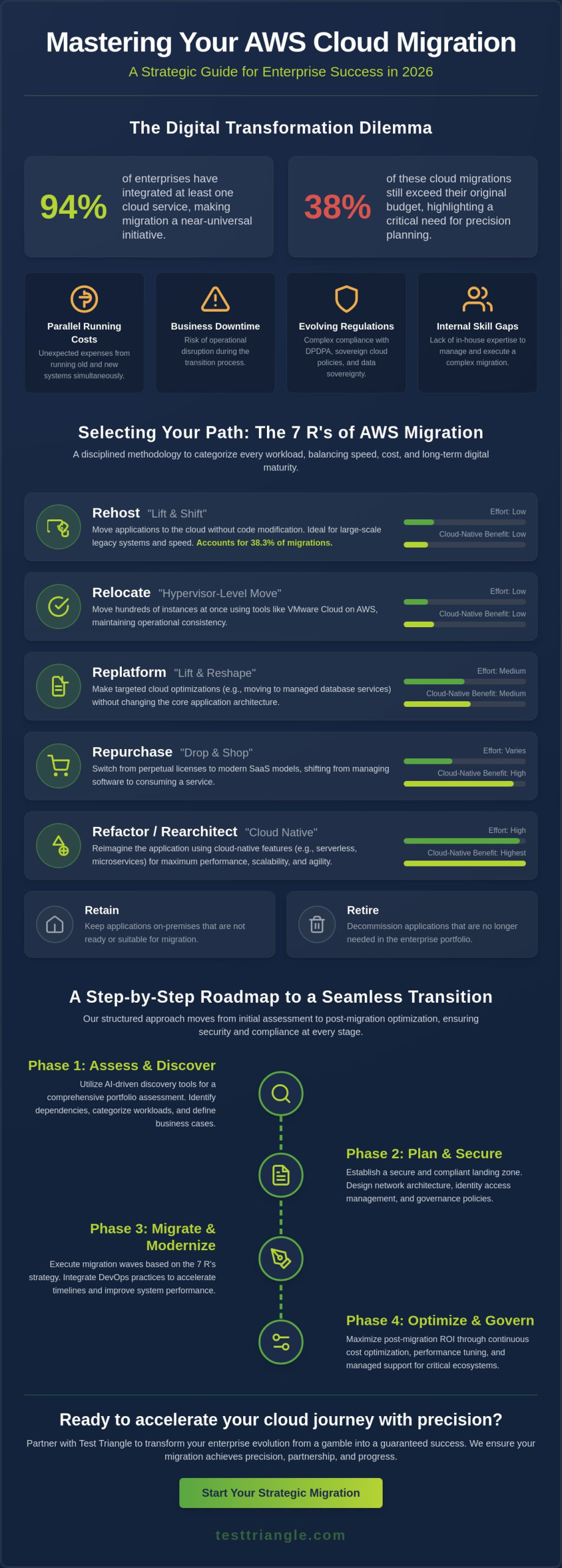
Did you know that while 94% of enterprises have integrated at least one cloud service by 2026, 38% of these migrations still exceed their original budget? This fiscal friction often stems from parallel running costs or unforeseen complexities in data sovereignty. For global leadership, the prospect of an AWS Cloud Migration shouldn’t feel like a gamble with your operational stability or a test of your team’s existing skill gaps. It’s natural to feel uneasy about potential business downtime or the tightening grip of regulations like India’s DPDPA 2025 updates and Canada’s 2026 sovereign cloud policies.

You deserve a transition that prioritizes precision over guesswork. We’ve designed this strategic guide to help you master the complexities of enterprise evolution; providing a professional roadmap that ensures security, scalable growth, and a significant reduction in technical debt. By exploring the 7 Rs of migration and the latest AI-driven discovery tools, we’ll outline a clear path to improved system performance that aligns with your 2026 digital transformation goals. This approach ensures your organization achieves precision, partnership, and progress throughout the entire lifecycle.

Key Takeaways

  • Identify how the “7 Rs” framework provides a disciplined methodology for categorizing workloads, ensuring each application follows the most efficient path toward modernization.
  • Learn to navigate a structured AWS Cloud Migration roadmap that moves from initial portfolio assessment to the establishment of a secure, compliant landing zone.
  • Address the critical human element of technological change by bridging internal skill gaps and overcoming cultural resistance within highly regulated enterprise environments.
  • Discover how to maximize post-migration ROI by optimizing ServiceNow and Atlassian ecosystems through specialized DevOps consulting and managed support.
  • Shift your operational focus from simple relocation to systemic evolution, utilizing agentic AI to accelerate modernization timelines and improve long-term system performance.

The Strategic Imperative: Why AWS Cloud Migration Defines Enterprise Success in 2026

In 2026, the concept of cloud migration has moved far beyond simple data transfer. It’s now a fundamental catalyst for systemic enterprise evolution and digital maturity. An effective AWS Cloud Migration represents a shift from static infrastructure to a dynamic, machine-speed environment where agentic AI and predictive analytics define the pace of business. Modern organizations don’t view this transition as a one-time technical task. Instead, they recognize it as a strategic opportunity to rebuild their operational core for a future that demands constant adaptation. It’s about building a foundation that supports continuous improvement, operational stability, and long-term resilience.

By moving from rigid capital expenditure (CapEx) models to a performance-driven operational (OpEx) framework, enterprises gain the agility to respond to market shifts in real-time. This isn’t just about reducing costs; it’s about optimizing value across the entire digital ecosystem. We approach every migration through a specific “Test Triangle” perspective: Strategy, Security, and Scalability. This trifecta ensures that your technological evolution is grounded in practical business outcomes. When you align your high-level mission with technical execution, you create a steady hand in a fast-changing landscape.

Beyond Cost Savings: The Modern Drivers of Migration

Modern migration is fueled by a need for operational resilience. In a volatile global market, the ability to maintain business continuity through AWS’s distributed infrastructure is a competitive necessity. Innovation velocity has also become a primary driver. The cloud allows for rapid prototyping and the deployment of AI-driven applications that would be impossible in legacy environments. Additionally, AWS’s carbon-efficient infrastructure helps organizations meet increasingly strict corporate sustainability mandates. This turns technical decisions into environmental, social, and governance (ESG) victories by utilizing real-time carbon footprint reporting.

The Risks of Inertia: What Happens When You Delay?

Delaying your cloud journey creates a compounding burden of technical debt. Aging on-premises data centers become increasingly expensive to maintain and lack the modern cloud-native protections required to thwart sophisticated security threats. There is also a significant human cost. The widening talent gap means that top IT professionals actively seek out cloud-native environments. If you aren’t evolving, you’ll struggle to attract the experts needed to run your business. Our staffing solutions can help bridge this gap, but the underlying infrastructure must be modern to sustain a high-performing team.

Selecting Your Path: The 7 Rs of AWS Migration Strategy

Successful cloud evolution requires more than just moving data; it demands a disciplined methodology to categorize every workload within your enterprise portfolio. The “7 Rs” framework serves as this strategic compass, allowing leadership to balance speed, cost, and long-term digital maturity. By assigning a specific migration path to each application, you avoid the “complexity trap” that often stalls large-scale transitions. Whether your goal is immediate data center exit or a complete overhaul for AI readiness, selecting the right path is the most critical decision in your AWS Cloud Migration journey. It’s about matching technical execution to specific business outcomes, ensuring that every move contributes to operational stability and scalable growth.

Tactical Execution: Rehost, Relocate, and Repurchase

For organizations prioritizing speed and risk reduction, tactical strategies offer the path of least resistance. Rehosting, or “lift-and-shift,” remains the most common approach, accounting for 38.3% of migrations according to 2026 industry data. It allows you to move applications to the cloud without modifying the core code, making it ideal for large-scale legacy environments. Relocating leverages VMware Cloud on AWS to move hundreds of instances simultaneously at the hypervisor level, maintaining operational consistency. Meanwhile, repurchasing involves shifting from perpetual licenses to modern SaaS models. This is an excellent opportunity to transition legacy service desks to a modern ServiceNow implementation or move project management to the cloud with expert Atlassian consulting.

Strategic Transformation: Replatform and Refactor

When the objective is systemic improvement rather than simple relocation, strategic transformation becomes the priority. Replatforming involves making targeted optimizations, such as migrating to managed database services, to boost performance without a full architectural rewrite. Refactoring, however, is the gold standard for 2026. This approach re-architects applications to be cloud-native, enabling full integration with agentic AI and serverless computing. While it requires more upfront investment, refactoring delivers the highest levels of scalability and long-term ROI. If you’re unsure which path aligns with your fiscal year goals, our team can help you evaluate your portfolio architecture to find the optimal balance.

Finally, a robust AWS Cloud Migration strategy must include portfolio hygiene through Retaining and Retiring. Retaining involves keeping specific workloads on-premises to meet strict sovereign cloud procurement policies, such as Canada’s 2026 data residency requirements. Retiring focuses on decommissioning redundant or obsolete systems, which can significantly reduce technical debt and streamline your security perimeter. By rigorously applying these seven categories, you transform a chaotic move into a structured, predictable evolution that empowers your entire organization.
AWS Cloud Migration: A Strategic Step-by-Step Guide for Enterprise Evolution in 2026

A Step-by-Step Roadmap to a Seamless AWS Transition

Transitioning to a cloud-native ecosystem requires a methodical, phase-gated approach that prioritizes operational stability over sheer speed. A successful AWS Cloud Migration isn’t a single event but a journey that demands technical precision, organizational readiness, and expert partnership. By following a structured roadmap, enterprises can navigate the complexities of 2026’s digital landscape while mitigating the risks of business downtime and regulatory non-compliance. This process moves logically from broad portfolio assessment to specific service optimization, ensuring that your technological evolution is both intentional and well-organized.

Phase 1 & 2: Preparation and Foundation

The journey begins with a Comprehensive Portfolio Assessment and Business Case Validation. During this stage, conducting an Optimization and Licensing Assessment (OLA) is essential to right-size your cloud footprint, preventing the over-provisioning that often leads to budget overruns. Establishing a Cloud Center of Excellence (CCoE) ensures cross-functional alignment, bringing together leadership from IT, finance, and security to drive a unified vision. We then move into the Mobilisation Stage, where we build your AWS Landing Zone. This involves designing a multi-account structure that enforces strict security guardrails and compliance foundations, providing a steady hand for your complex digital infrastructure.

Phase 3 & 4: Migration and Quality Assurance

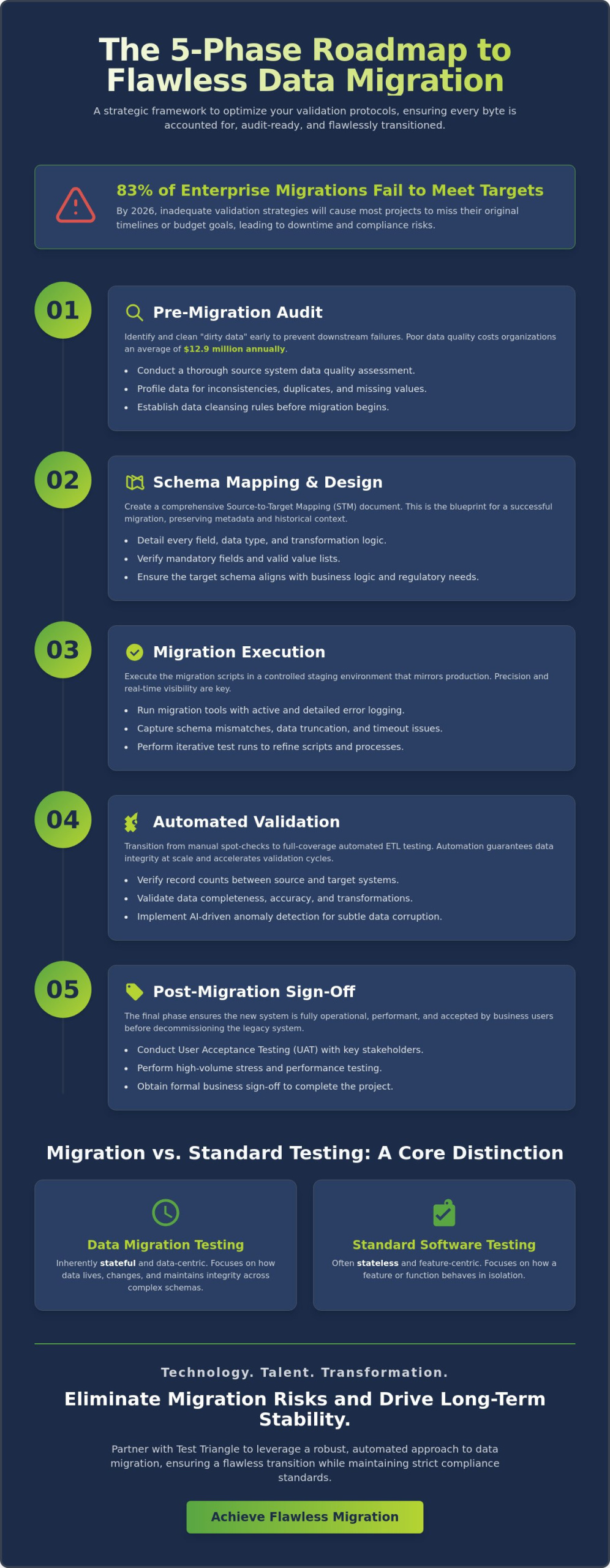
In the Execution phase, we implement automated waves of workload transfers. In 2026, we utilize tools like AWS Migration Hub, which now incorporates predictive analytics to map application dependencies. This intelligence can reduce the discovery phase by months, allowing for a more efficient and disciplined move. However, the migration is only complete once it passes through rigorous validation. Data Migration Testing plays a critical role here, ensuring that data integrity is maintained and that no business logic errors are introduced during the transition. By focusing on precision and human expertise, we confirm that all performance benchmarks are met before the final cutover.

To minimize operational impact, final cutover strategies often employ blue-green deployments or canary releases. These methodologies allow for a seamless transition by running the new environment alongside the old, providing the peace of mind that comes from risk reduction. After the cutover, we shift our focus to post-migration validation, where we continuously monitor system performance and scalability. This methodical rhythm ensures that your organization doesn’t just reach the cloud but thrives within it, achieving the operational efficiency and scalable growth promised at the start of the journey.

Overcoming Enterprise Migration Challenges: People, Process, and Security

While technical frameworks provide the architecture, the primary friction points of an AWS Cloud Migration frequently reside within organizational culture and human capital. Addressing the internal skills gap while managing cultural resistance to change is a prerequisite for leadership teams pursuing long-term operational stability. In highly regulated sectors such as Finance and Pharmaceuticals, organizations often fall into a “complexity trap” where legacy processes conflict with cloud-native agility. Navigating these hurdles requires a composed, solution-oriented approach that prioritizes precision, partnership, and progress. By treating the transition as a human-centric evolution rather than a mere server move, you ensure that your digital infrastructure remains resilient and your workforce remains empowered.

The Human Element: Staffing and Training

Executing a large-scale evolution requires a specialized workforce, including Cloud Architects, DevOps engineering professionals, and Security Specialists. Many organizations find that their existing IT teams possess deep institutional knowledge but lack the specific cloud-native expertise required for a seamless transition. To bridge these immediate project needs, savvy enterprises leverage professional IT Staffing Services to inject high-level expertise into their migration waves. Additionally, integrating remote offshore resources allows for continuous delivery cycles and significant cost-efficiency without compromising technical rigor. This dual approach empowers your organization to maintain momentum while simultaneously upskilling your internal workforce for the new operational reality.

Security and Compliance in the Cloud

Security isn’t a peripheral concern; it’s a foundational pillar of the “Test Triangle” methodology. Implementing Zero Trust architectures within your AWS environment from day one ensures that every access request is verified, regardless of its origin. In highly regulated industries, automating compliance monitoring is the only way to consistently meet evolving standards like GDPR, HIPAA, or GxP. Staying current with OWASP Top 10 2025 news is equally critical, as emerging vulnerability categories directly inform the security guardrails you must enforce within your cloud environment. The AWS Shared Responsibility Model defines cloud security as a collaborative effort where AWS manages the security of the cloud, while the customer remains responsible for security in the cloud. By clearly defining these boundaries, you achieve the peace of mind that comes from comprehensive risk reduction and systemic protection.

If your internal teams are facing a skills bottleneck that threatens your timeline, contact us to discuss strategic staffing solutions that align with your migration goals. This collaboration ensures your transition remains on track while building the institutional maturity needed for long-term success.

Maximizing Post-Migration ROI: Modernization and Managed Support

The successful completion of an AWS Cloud Migration is not the final destination; it’s the foundation for systemic enterprise evolution. While many organizations focus purely on the technical cutover, the most successful global players shift their focus toward modernization to unlock the full potential of their cloud environment. This evolution involves moving beyond simple workload management to embracing cloud-native architectures that support agentic AI and predictive analytics. By partnering with a reliable Managed Service Provider, leadership teams can maintain system health while exercising rigorous cost control. Utilizing tools like AWS Cost Explorer on a monthly basis ensures that your cloud spend remains optimized, preventing the budget creep that historically affects nearly 38% of enterprise migrations.

Integrating Your Enterprise Ecosystem

Integrating your established enterprise tools into the AWS ecosystem creates a “single pane of glass” view for your IT Service Management (ITSM) across complex hybrid environments. Enhancing your Atlassian implementation with cloud-native scalability allows your development teams to operate with greater agility and precision. Similarly, by integrating ServiceNow consulting services with AWS data lakes, you can streamline workflows and derive deeper insights from your operational data. This synergy ensures that your infrastructure remains manageable, secure, and fully aligned with your high-level business outcomes; providing the peace of mind that comes from a well-organized digital estate.

The Path to DevOps Maturity

A successful AWS Cloud Migration serves as the critical starting line for advanced DevOps consulting initiatives that drive long-term digital maturity. Implementing Infrastructure as Code (IaC) allows for repeatable, error-free environment provisioning, which is essential for maintaining stability as your organization scales. This methodical approach to automation reduces technical debt and empowers your workforce to focus on high-value innovation rather than routine maintenance. Ultimately, your cloud journey is a process of constant refinement where human expertise and technical tools combine to drive organizational progress. Understanding the evolving landscape of DevOps engineering in 2026 can help enterprise leaders avoid common misconceptions that stall automation efforts and prevent technical investments from translating into measurable business outcomes. Migration is never a static destination; it is the catalyst for continuous digital innovation and sustainable growth in a fast-changing technological landscape.

Secure Your Digital Future Through Strategic Evolution

Transitioning to the cloud in 2026 is no longer a matter of simple technical feasibility; it’s a strategic necessity for enterprises aiming to lead in an increasingly machine-speed economy. We’ve explored how a disciplined approach to modernization empowers organizations to shed technical debt while embracing agentic AI and cloud-native scalability. By aligning your application portfolio with the 7 Rs framework and prioritizing human-centric staffing, you transform potential operational risks into clear competitive advantages. This journey requires a steady hand and a commitment to long-term digital maturity.

As an AWS Consulting Partner with specialized expertise in highly regulated sectors like Pharma and Finance, Test Triangle acts as a reliable long-term collaborator for your digital journey. Our global delivery model and 24/7 managed support ensure your infrastructure remains resilient, secure, and optimized long after the initial cutover. Partner with Test Triangle for your strategic AWS Cloud Migration roadmap today to achieve the precision, stability, and growth your enterprise deserves. Your path to a modernized, high-performance future starts here.

Frequently Asked Questions

What is the average timeline for an enterprise AWS cloud migration?

The average timeline for an enterprise AWS Cloud Migration typically ranges from six to twenty-four months, depending on the complexity of your application portfolio and the chosen strategy. While small-scale proof-of-concept projects can be executed in weeks, large-scale systemic evolution requires a methodical approach that accounts for discovery, foundation building, and validation. Factors like data volume, regulatory requirements, and internal team readiness significantly influence the overall duration.

How much does AWS cloud migration cost for a mid-sized organization?

Costs for a mid-sized organization vary based on the scale of the workloads and the selected 7 Rs strategy. Major expenses often include parallel running costs, where organizations maintain both on-premise and cloud environments for three to eighteen months. Additionally, data transfer fees and underlying infrastructure provisioned during replication contribute to the total investment. Utilizing a professional roadmap helps identify these hidden expenses early, ensuring fiscal transparency and long-term ROI.

Can I migrate legacy applications to AWS without rewriting the code?

You can certainly migrate legacy applications without rewriting code by utilizing the Rehosting or “Lift-and-Shift” strategy. This approach is the most common path for data center exits, as it moves applications directly to AWS infrastructure with minimal modification. While this provides a rapid transition, it won’t immediately unlock cloud-native benefits like auto-scaling or AI integration. It serves as a practical first step before pursuing deeper modernization in subsequent phases.

What are the most common risks associated with AWS cloud migration?

The most common risks associated with an AWS Cloud Migration include unexpected business downtime, internal skill gaps, and complex regulatory compliance hurdles. Without a disciplined transition plan, organizations may face data integrity issues or security vulnerabilities in their new environment. Mitigating these risks requires a combination of robust testing methodologies and strategic staffing to ensure that technical execution aligns with operational stability and security benchmarks.

How does AWS migration impact my existing Atlassian or ServiceNow licences?

Migration offers a strategic opportunity to optimize your existing Atlassian or ServiceNow ecosystem by transitioning from perpetual licenses to modern SaaS models. While the underlying business logic remains consistent, moving these platforms to the cloud often requires a licensing assessment to ensure compliance and cost-efficiency. Our experts help align these tools with your new AWS environment, providing a single pane of glass view for your IT service management operations.

Is AWS cloud migration secure for highly regulated industries like healthcare?

AWS migration is highly secure for regulated sectors like healthcare, provided organizations implement a Zero Trust architecture and follow the Shared Responsibility Model. AWS provides specialized services and infrastructure that comply with global standards such as HIPAA, GDPR, and GxP. By automating compliance monitoring and enforcing strict data residency guardrails, enterprises can achieve a level of security that often surpasses traditional on-premise data centers.

What is the difference between cloud migration and cloud modernization?

Cloud migration focuses on moving workloads from on-premise infrastructure to the cloud, whereas modernization involves re-architecting applications to utilize cloud-native features. Migration is the initial step that establishes the foundation, while modernization unlocks advanced capabilities like serverless computing and agentic AI integration. Both are essential components of a digital transformation journey, but modernization is what ultimately drives maximum scalability and long-term performance improvements.

How do I choose between a Lift-and-Shift and a Refactoring strategy?

Choosing between Lift-and-Shift and Refactoring depends on your application’s criticality and your digital maturity goals. Lift-and-Shift is ideal for organizations needing a fast data center exit with low risk and minimal upfront investment. In contrast, Refactoring is the preferred choice for core applications that require maximum scalability or AI integration. A balanced approach often involves rehosting non-critical systems while refactoring high-value workloads to ensure optimal ROI.

Paul Guy

Article by

Paul Guy

Paul serves as the Marketing Director at Test Triangle, where he leads a global team in driving growth through strategic B2B marketing and brand communications. With a strong emphasis on measurable outcomes and sustainable performance, he plays a pivotal role in aligning marketing functions to enhance customer engagement and accelerate business impact. Under his leadership, marketing initiatives have consistently delivered significant returns on investment, elevated brand visibility, and strengthened the company's presence across key markets.

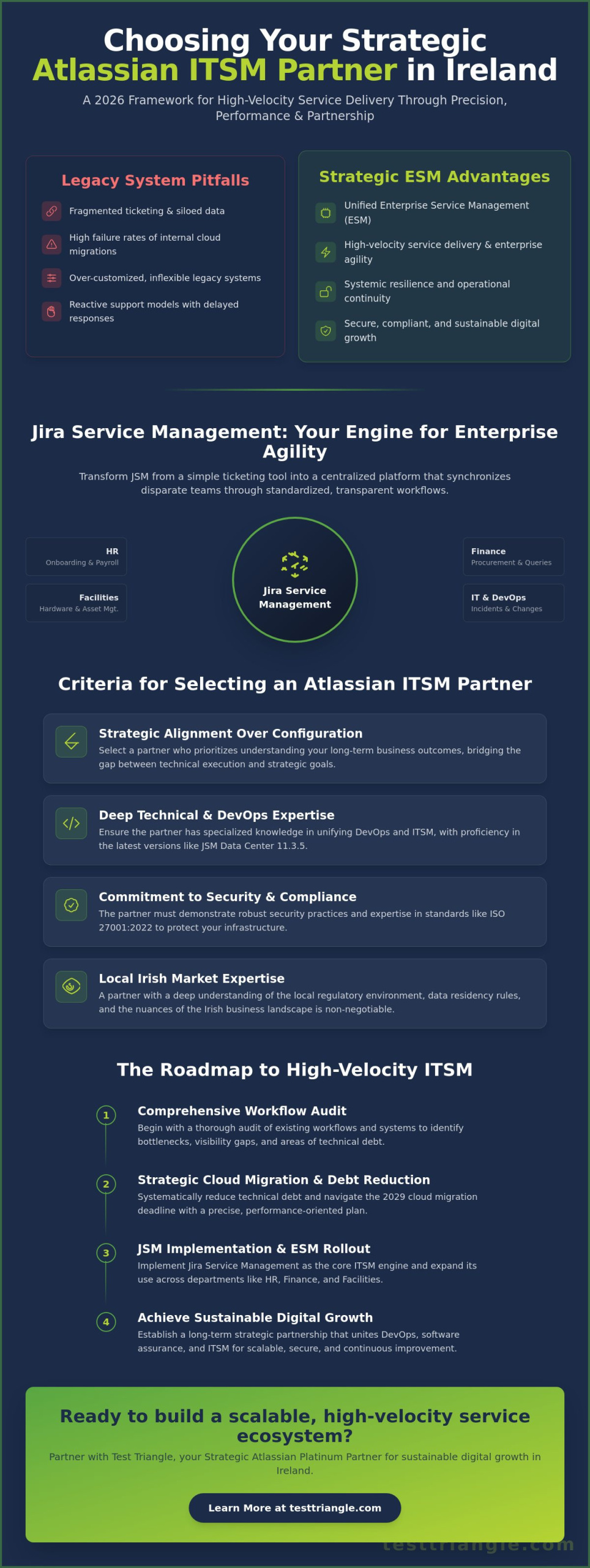

The most sophisticated software in the world won’t save your organization if your implementation partner prioritizes technical configuration over long-term strategic alignment. For many Irish enterprises, the transition to high-velocity service delivery is often stalled by over-customized legacy systems and the high failure rates of internal cloud migrations. Selecting a strategic Atlassian ITSM partner Ireland requires looking beyond mere licensing to identify a collaborator who understands the critical intersection of DevOps, ITSM, and organizational agility through precision, performance, and partnership.

You likely recognize that visibility into cross-departmental workflows isn’t a luxury but a fundamental requirement for operational excellence. This guide clarifies how to select a strategic partner who can deliver seamless integration between your development and service teams while ensuring your infrastructure remains secure and compliant with standards like ISO 27001:2022. We’ll examine the specific specializations that define the Irish market in 2026, including the latest Jira Service Management Data Center updates like version 11.3.5, and provide a framework for building a scalable, high-velocity service ecosystem through strategy, stability, and scalability.

Key Takeaways

  • Transition from fragmented ticketing systems to unified Enterprise Service Management frameworks to maintain operational continuity and alignment within hybrid work environments.
  • Transform Jira Service Management into a high-visibility engine for enterprise agility through the strategic integration of assets and service configuration management.
  • Select a high-level Atlassian ITSM partner Ireland capable of bridging the gap between technical execution and business outcomes through specialized, solution-oriented consulting.
  • Navigate the 2029 cloud migration deadline with precision and performance by prioritizing comprehensive workflow audits and the systematic reduction of technical debt.
  • Establish a long-term strategic partnership that unites DevOps engineering, software assurance, and ITSM for sustainable, scalable, and secure digital growth.

Precision, Performance, Partnership: The 2026 ITSM Landscape in Ireland

The evolution of enterprise infrastructure in Ireland has reached a critical juncture where traditional, reactive support models no longer suffice. As organizations transition toward digital-first service delivery, the limitations of siloed ticketing systems become apparent, often resulting in fragmented data and delayed response times. Achieving operational stability in this complex environment requires more than software; it demands a strategic alignment of technology and process. For many leading firms, identifying a qualified Atlassian ITSM partner Ireland becomes the first step toward achieving systemic resilience and high-velocity output.

Modern service delivery has moved beyond the simple resolution of technical glitches to a broader framework of IT Service Management (ITSM) that encompasses every facet of the business. This shift toward Enterprise Service Management (ESM) allows departments like HR, Facilities, and Finance to adopt the same disciplined workflows used by IT teams. By centralizing these operations within the Atlassian ecosystem, enterprises can eliminate the visibility gaps that typically plague large-scale hybrid work environments. This synchronized approach ensures that every request, from a hardware procurement to a payroll query, follows a predictable, audited path to resolution.

Local expertise remains a non-negotiable factor for Irish enterprises, particularly those operating within highly regulated sectors. Navigating the specificities of data residency and national compliance standards requires an Atlassian ITSM partner Ireland that possesses a deep understanding of the local regulatory environment. Whether it’s adhering to the latest security protocols or managing the nuances of the Irish business landscape, a partner with local roots provides the steady hand necessary to guide complex digital transformations without compromising on security or performance.

The Move Toward High-Velocity Service Delivery

In 2026, high-velocity service delivery is defined by the ability to synchronize development and operations teams into a single, cohesive unit. By utilizing Jira Service Management, organizations can break down the historical walls between IT and other business units. These tailored IT Service Management solutions bridge the gap between technical execution and business value, ensuring that service desks aren’t just cost centers but drivers of efficiency. This methodology prioritizes rapid feedback loops and continuous improvement, allowing teams to pivot quickly as market demands shift.

Navigating the 2026 Digital Transformation Agenda

The integration of AI and automation into standard workflows has become a cornerstone of the 2026 digital agenda. Modern service desks now leverage intelligent automation to handle routine inquiries, freeing up human experts for high-value strategic tasks. For the Irish financial and healthcare sectors, this evolution must be balanced with rigorous data residency requirements. Maintaining a sustainable digital infrastructure involves more than just speed; it requires the precision of tools like Jira Service Management Data Center version 11.3.5 to ensure that performance never comes at the expense of compliance or stability.

Beyond Basic Ticketing: Leveraging Jira Service Management for Enterprise Agility

Jira Service Management (JSM) operates as the engine of modern organizational agility, transcending its historical role as a simple ticketing portal. In the context of a broader digital transformation, JSM serves as a centralized platform that synchronizes disparate teams through standardized, transparent workflows. For enterprises seeking to eliminate the friction of legacy systems, an experienced Atlassian ITSM partner Ireland provides the technical rigor necessary to transform JSM into a strategic asset that supports both rapid innovation and operational stability.

The true power of JSM lies in its ability to provide deep visibility through the integration of Assets and Service Configuration Management. By maintaining a comprehensive registry of hardware, software, and cloud resources, IT leaders gain an immediate understanding of how individual components impact the wider service ecosystem. This level of insight reduces the risk of failed changes and allows for more precise impact analysis during incidents. When combined with Confluence as a dynamic knowledge base, organizations can effectively drive self-service deflection, empowering users to resolve routine issues independently and freeing technical staff for higher-value initiatives.

Establishing this level of maturity requires a methodical approach to tool configuration and process design. To ensure your infrastructure is optimized for these advanced capabilities, you might consider how a specialized implementation strategy can accelerate your time-to-value. Professional guidance ensures that your deployment isn’t just a software installation but a strategic evolution of your service culture.

Unified Workflows: Connecting Development and Operations

Modern DevOps teams require a seamless flow of information to maintain high-velocity delivery. By integrating JSM with Bitbucket and Jira Software, organizations create a transparent audit trail from the initial bug report to the final code deployment. This connectivity allows for automated incident response and significantly reduces the Mean Time to Resolution (MTTR). Automated change requests, triggered directly from CI/CD pipelines, ensure that governance remains intact without slowing down the development cycle.

Expanding ITSM into Enterprise Service Management (ESM)

The principles of ITIL 4 are increasingly applied beyond the IT department to departments such as Legal, Finance, and HR. Standardizing service delivery across the entire national organization ensures a consistent employee experience and improves cross-departmental accountability. With the introduction of Atlassian Rovo and advanced AI features, request fulfillment is further accelerated through intelligent categorization and automated routing, allowing non-technical teams to manage complex request volumes with the same precision as IT professionals.

Strategic, Scalable, Secure: Criteria for Selecting an Atlassian ITSM Partner

The selection of an Atlassian ITSM partner Ireland represents a pivotal investment in your organization’s operational future. It’s a choice that moves beyond simple procurement and into the realm of strategic collaboration. While many providers can install software, few possess the institutional maturity to align that software with complex, cross-departmental business processes. To ensure a return on investment, enterprises must evaluate potential partners through a lens that prioritizes strategic, scalable, and secure outcomes.

A common pitfall in digital transformation is the failure to distinguish between a technical vendor and a strategic consultant. Technical certification is the baseline, but the true value lies in a partner’s ability to audit current workflows, identify technical debt, and design a roadmap that supports sustainable growth. When vetting an Atlassian ITSM partner Ireland, consider the following criteria during your RFP process:

  • Proven Local Track Record: Documentation of successful migrations within the Irish market, particularly for organizations with similar regulatory pressures.
  • Business Process Depth: Evidence that the partner understands ITIL 4 frameworks and can apply them to non-technical business units.
  • Managed Service Capability: The infrastructure to provide ongoing support, training, and system optimization rather than just a one-off delivery.
  • Scalable Resource Pool: The ability to provide specialized talent through integrated staffing solutions when project demands fluctuate.

Selecting a partner that can provide ongoing managed services is often more beneficial than a one-off implementation. This approach ensures that your Atlassian ecosystem evolves alongside your business, preventing the accumulation of technical debt and ensuring that your team stays updated on the latest platform enhancements.

Why Platinum Solution Partner Status Matters

Platinum Solution Partner status is the highest tier of recognition within the Atlassian ecosystem, signifying a partner who has met the most rigorous standards for technical expertise and customer success. In 2026, maintaining this status requires a continuous commitment to advanced training and the successful execution of large-scale enterprise deployments. By engaging with these high-level experts, organizations gain early access to product roadmaps and a direct line to Atlassian’s own internal support teams. Leveraging specialized Atlassian consulting services ensures that your implementation is handled with the precision and performance required for global-scale operations.

Assessing Industry-Specific Expertise

Irish enterprises in the pharmaceutical, healthcare, and financial sectors face unique challenges regarding data integrity and security compliance. A partner with experience in these fields will prioritize risk reduction, ensuring that every configuration adheres to frameworks like ISO 27001:2022. This industry-specific knowledge is vital for navigating the nuances of data residency and audit trails. Verifying a partner’s case studies in these sectors provides the peace of mind that your digital infrastructure is built on a foundation of reliability and regulatory excellence.

The Strategic Roadmap: Transitioning to High-Velocity ITSM and Cloud Excellence

The 2029 deadline for Atlassian Data Center support marks a definitive shift in the technological landscape, requiring Irish enterprises to accelerate their journey toward Cloud excellence. A failed migration often stems from a “lift and shift” mentality that ignores the underlying technical debt accumulated over years of over-customization. By engaging a specialized Atlassian ITSM partner Ireland, organizations can navigate this transition through a structured roadmap that prioritizes long-term operational stability over short-term technical fixes. This methodical approach ensures that your service delivery model isn’t just moved to a new environment but is fundamentally optimized for high-velocity output.

Discovery and assessment form the bedrock of this roadmap, involving a comprehensive audit of current workflows and configuration complexities. This phase isn’t merely about inventory; it’s about evaluating the business value of every existing process to determine what should be migrated, retired, or redesigned. Design and governance follow, establishing a scalable architecture that ensures security and compliance remain intact as the organization grows. Finally, implementation and training ensure that the technical transition is matched by cultural alignment, driving user adoption and ensuring that your teams are empowered to leverage the full potential of the Atlassian ecosystem.

Navigating the Cloud Migration Journey

In 2026, the choice between Cloud, Data Center, and hybrid deployment models depends heavily on your specific security and performance requirements. While Cloud offers the most rapid access to innovation and AI capabilities, some highly regulated sectors may still utilize Data Center versions like 11.3.5 for specific jurisdictional needs. A risk-free Atlassian implementation requires a partner who understands the nuances of data residency within the Irish jurisdiction, ensuring that your migration strategy adheres to both global benchmarks and local regulations. This precision in planning prevents the common pitfalls that lead to project delays and budget overruns.

Post-Implementation Optimization and Support

The conclusion of a migration project is actually the beginning of a cycle of continuous improvement. Transitioning from a project-based delivery to long-term managed outsourcing services allows your organization to maintain peak performance through regular system health checks and quarterly business reviews. An Atlassian ITSM partner Ireland provides the ongoing expertise needed for sophisticated license management and cost optimization, ensuring that your investment continues to deliver measurable business value. This steady hand in a fast-changing landscape ensures that your infrastructure remains secure, scalable, and strategically aligned with your growth objectives.

If you’re ready to secure your infrastructure against the 2029 deadline and drive operational excellence, reach out to our strategic consultants today for a comprehensive audit of your Atlassian ecosystem.

Atlassian ITSM Partner Ireland: A Strategic Guide to Enterprise Service Management in 2026

Test Triangle: A Strategic Atlassian Platinum Partner for Sustainable Digital Growth

Test Triangle occupies a unique position in the Irish technological ecosystem, serving as a global IT leader with deep institutional roots in Dublin and beyond. While many providers focus solely on tool implementation, our methodology integrates software assurance, DevOps engineering, and ITSM into a unified framework for enterprise transformation. This holistic approach ensures that digital infrastructures are not only functional but resilient and optimized for high-velocity delivery. As a recognized Atlassian ITSM partner Ireland, we embody the principles of precision, performance, and partnership, providing the strategic visionary leadership required to navigate the complexities of 2026 and beyond.

Our identity is built on the foundation of being a reliable long-term collaborator, a concept that dictates every engagement from initial discovery to ongoing managed services. We recognize that the “Test Triangle Advantage” lies in our ability to combine technical rigor with practical business strategy. By connecting our methodology to specific actions and subsequent results, we deliver a framework that prioritizes clarity and comprehensive detail, allowing technical managers and executive leadership to find common ground in their digital transformation goals. This synchronized approach ensures that your organization doesn’t just adopt new tools but evolves its entire service culture for long-term operational stability.

A Comprehensive Portfolio of IT Excellence

Achieving superior ITSM outcomes requires a deep understanding of the entire software lifecycle. Our expertise in software and digital assurance testing ensures that every deployment meets the highest standards of quality and security before it reaches the end-user, significantly reducing the risk of post-implementation failures. This commitment to quality is further strengthened by our strategic partnerships with AWS and our specialized ServiceNow consulting, allowing us to manage complex multi-platform environments with ease. To support your internal IT evolution, we offer tailored staffing models that provide the necessary talent to scale projects rapidly without compromising on technical excellence or strategic alignment.

Your Partner for the Future of Work

Global enterprises trust Test Triangle with their most critical digital infrastructures because we prioritize risk reduction and operational stability above all else. Our focus remains on the peace of mind derived from knowing that your systems are managed by a steady hand in a fast-changing landscape. As you look toward the 2029 cloud migration deadline and the continued expansion of ESM, having a disciplined, globally-minded Atlassian ITSM partner Ireland becomes a fundamental requirement for success. We invite you to partner with Test Triangle for Atlassian Excellence and secure your organization’s digital future through strategy, stability, and scalable growth.

Securing Your Digital Future Through Strategic Alignment

The transition toward high-velocity service delivery is no longer a choice but a prerequisite for staying competitive in the Irish market. As we’ve explored, the journey involves more than just software configuration; it requires a deep integration of DevOps, ITSM, and enterprise-wide agility. By prioritizing technical rigor and strategic vision, you can transform your service desk from a cost center into a powerful engine for growth. Selecting a qualified Atlassian ITSM partner Ireland is the most critical decision in this evolution, ensuring your infrastructure remains secure, scalable, and compliant with evolving standards.

With over 10 years of enterprise IT consulting experience and a global reach that respects local Irish expertise, Test Triangle provides the steady hand your organization needs. As an Atlassian Platinum Solution Partner, we’re dedicated to helping you navigate the 2029 cloud migration deadline through strategy, stability, and scalability. Don’t let legacy systems hold back your operational excellence. It’s time to build a foundation that empowers your teams and delights your customers. Consult with our Atlassian Platinum Experts Today and take the first step toward a more resilient digital landscape.

Frequently Asked Questions

What are the benefits of hiring an Atlassian ITSM partner in Ireland?

Engaging an Atlassian ITSM partner Ireland ensures that your enterprise transformation is guided by experts who understand the local regulatory environment and business standards. Local partners provide the necessary proximity for high-touch consulting while ensuring that data residency requirements within the Irish jurisdiction are met with precision. This partnership accelerates your time-to-value by aligning technical configuration with the specific operational needs of Irish financial, healthcare, and pharmaceutical sectors.

How does Jira Service Management compare to legacy ITSM tools in 2026?

By 2026, Jira Service Management has outpaced legacy tools by offering a unified platform that bridges the gap between development and operations. Unlike traditional siloed ticketing systems, JSM leverages advanced AI features like Atlassian Rovo to automate request fulfillment and categorize incidents with superior accuracy. This modern framework reduces technical debt and provides the visibility required for Enterprise Service Management, allowing non-technical departments to adopt high-velocity workflows without the complexity of over-customized legacy software.

What is the difference between an Atlassian Gold and Platinum Solution Partner?

The primary distinction lies in the level of technical expertise and the scale of the partner’s operations. Platinum Solution Partners represent the highest tier of the Atlassian ecosystem, requiring a larger number of certified individuals and a proven track record of managing complex enterprise-level deployments. While Gold partners provide reliable service, Platinum partners offer advanced access to product roadmaps and direct support from Atlassian, ensuring the highest standards of quality and security for global organizations.

How long does a typical Jira Service Management implementation take?

An enterprise-grade Jira Service Management implementation typically spans between three to six months, depending on the complexity of your current infrastructure and the scope of the migration. This timeline includes a thorough discovery phase to audit existing workflows and identify technical debt before moving into configuration and user training. A phased approach ensures that your team can achieve high-velocity service delivery without disrupting critical business operations during the transition.

Can an Atlassian partner help with Cloud migration from Jira Data Center?

Yes, a specialized Atlassian ITSM partner Ireland is essential for managing the complex transition from Data Center to Cloud. With the 2029 support deadline approaching, partners provide a structured roadmap that prioritizes data integrity and security during the migration process. They handle the heavy lifting of auditing over-customized systems and redesigning workflows to leverage the full suite of Cloud-native features, ensuring a risk-free transition that supports long-term growth and scalability.

Does Test Triangle provide ongoing support after the initial ITSM implementation?

Test Triangle prioritizes long-term collaboration through comprehensive managed outsourcing services that extend far beyond the initial implementation. Our team provides continuous improvement through quarterly business reviews, system health checks, and proactive license management to ensure your Atlassian ecosystem remains optimized. This ongoing support model allows your internal IT teams to focus on strategic initiatives while we maintain the stability, precision, and performance of your digital infrastructure through dedicated technical expertise.

How does Atlassian ITSM support compliance with Irish data regulations?

Atlassian ITSM solutions are designed to adhere to rigorous security frameworks, including ISO 27001:2022 and GDPR, which are critical for the Irish jurisdiction. Strategic partners configure your environment to ensure data residency requirements are met, particularly for highly regulated sectors like finance and healthcare. By implementing standardized audit trails and robust governance models, we provide the peace of mind that your enterprise data remains secure and compliant with both national and international regulations.

What is the cost structure for Atlassian consulting services in Ireland?

The cost structure for Atlassian consulting services is typically tailored to the specific scope and complexity of your project. Most engagements follow either a project-based fixed fee for defined implementations or a time-and-materials model for ongoing strategic consulting and managed services. This flexible approach ensures that the investment remains aligned with your organizational goals, focusing on delivering tangible business value and operational efficiency rather than just technical execution.

Paul Guy

Article by

Paul Guy

Paul serves as the Marketing Director at Test Triangle, where he leads a global team in driving growth through strategic B2B marketing and brand communications. With a strong emphasis on measurable outcomes and sustainable performance, he plays a pivotal role in aligning marketing functions to enhance customer engagement and accelerate business impact. Under his leadership, marketing initiatives have consistently delivered significant returns on investment, elevated brand visibility, and strengthened the company's presence across key markets.
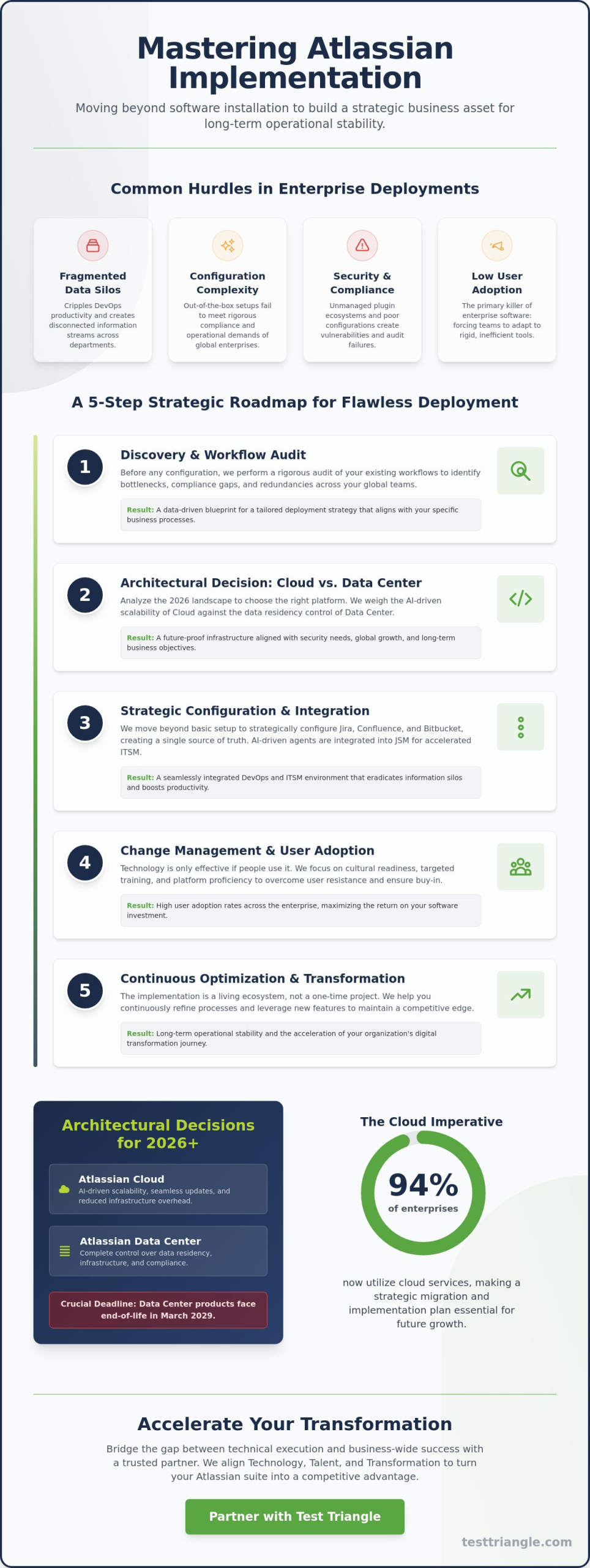

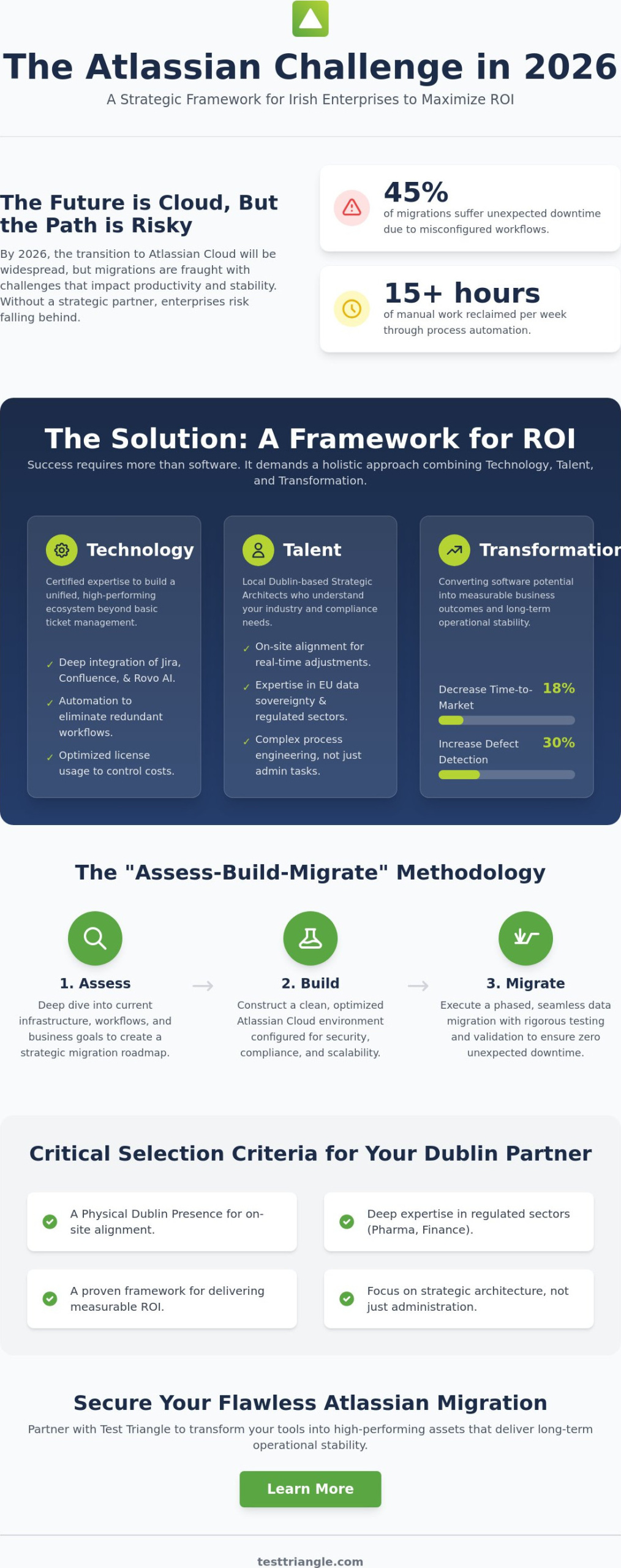
If you view your upcoming Atlassian Implementation as a mere software installation, you’ve already compromised your enterprise’s operational stability for the next decade. With 94% of enterprises now utilizing cloud services and Atlassian Data Center products facing a definitive end-of-life in March 2029, the stakes for a flawless deployment have never been higher. You’re likely struggling with fragmented data silos and the high complexity of Jira Service Management configurations, all while trying to mitigate security risks during a high-pressure migration.

We understand that the true challenge isn’t just technical; it’s about overcoming resistance among legacy teams and ensuring your infrastructure supports global growth. By combining technical expertise with a focus on long-term operational stability, Test Triangle helps you align Technology, Talent, and Transformation to turn these hurdles into a competitive advantage. This guide promises a comprehensive roadmap to master the complexities of your deployment, helping you achieve a seamlessly integrated DevOps and ITSM environment.

We’ll examine how to leverage the latest Jira 11.3 LTS features and AI-driven agents to drive a higher ROI from your software investments and ensure robust, scalable growth for your global organization.

Key Takeaways

  • Discover how to move beyond basic configurations by treating your Atlassian Implementation as a holistic business asset tailored for the rigorous demands of regulated industries.
  • Apply a 5-step strategic roadmap built on the Method-Action-Result framework to ensure your deployment is grounded in a comprehensive workflow audit.
  • Analyze the 2026 architectural landscape to determine whether the AI-driven scalability of the Cloud or the residency control of Data Center best serves your global infrastructure.
  • Secure long-term operational stability by prioritizing change management and platform proficiency to overcome the primary killer of enterprise software: user resistance.
  • Accelerate your digital transformation by leveraging the expertise of a Trusted Partner who bridges the gap between technical execution and business-wide transformation.

Defining Atlassian Implementation as a Strategic Business Asset

Atlassian Implementation represents the holistic process of configuring, integrating, and optimizing the software suite to drive enterprise-scale operations. It is a fundamental shift from basic tool adoption to a strategic alignment of business goals. As the Atlassian Corporation has evolved into a powerhouse of collaboration and ITSM tools, the complexity of managing these systems has grown exponentially. For global enterprises in 2026, a standard “out-of-the-box” setup is no longer sufficient. Sectors like finance, healthcare, and retail face rigorous compliance requirements and data residency laws that generic configurations simply cannot address. By choosing a dedicated Atlassian Implementation strategy, organizations move beyond simple installation to build a robust foundation for digital transformation.

The role of a Strategic Architect is vital in this landscape. Instead of merely checking boxes on a configuration list, these experts engage in deep business process re-engineering. They examine how work flows from a developer’s keyboard in Bitbucket to a support agent’s queue in Jira Service Management. This ensures that the technology serves the talent, rather than forcing teams to adapt to rigid, inefficient tools. By aligning Jira, Confluence, and Bitbucket, enterprises create a single source of truth that eliminates departmental silos and provides C-suite executives with the real-time data needed for informed decision-making.

The Core Components of an Enterprise Stack

Building a superior digital infrastructure requires a methodical approach to each product in the stack. By following a structured delivery model, Test Triangle helps businesses elevate their operational maturity through these core pillars:

  • Strategic Mapping of Jira Software: We optimize Jira for agile development and complex project tracking, ensuring workflows match your specific team dynamics.
  • Confluence as a Knowledge Hub: We leverage Confluence as a high-velocity knowledge management center, capturing institutional intelligence to prevent data loss.
  • AI-Driven ITSM: By integrating Jira Service Management, we accelerate service delivery through modern, task-specific AI agents that handle routine requests flawlessly.

By focusing on these components, enterprises can achieve a seamlessly integrated environment that supports global growth.

Why Implementation Fails Without Strategic Oversight

Success is never guaranteed by the software alone. Many organizations fail because they ignore the hidden costs of tool sprawl and unmanaged plugin ecosystems. Without professional IT Service Management services, businesses often face data fragmentation that cripples DevOps productivity. This fragmentation creates security risks and makes compliance audits nearly impossible to pass. Atlassian Implementation is a multi-layered journey involving technical precision and cultural readiness.

A 5-Step Strategic Roadmap for Flawless Atlassian Deployment

Achieving operational stability requires more than just a software setup; it demands a disciplined framework that aligns technical execution with business objectives. We utilize a Method-Action-Result framework to ensure every phase of your deployment delivers measurable value. By establishing clear protocols from the outset, global enterprises can mitigate the risks of data silos and configuration errors that often plague unguided installations. Success isn’t found in a setup wizard. It’s found in a structured path that treats your infrastructure as a living ecosystem.

Every successful Atlassian Implementation begins with a rigorous Discovery Phase. Before a single license is provisioned, we audit your existing workflows to identify bottlenecks and redundancies. This step is critical for organizations operating across multiple time zones where a lack of coordination can lead to significant downtime. By integrating sophisticated IT Service Management solutions, we bridge the gap between development and operations, ensuring that your ITSM environment is as agile as your DevOps pipeline. To minimize disruption, we employ an Iterative Rollout strategy, allowing for departmental transitions that respect local operational hours and minimize the impact on global productivity.

Phase 1 & 2: Audit and Architectural Design

By conducting a comprehensive audit of current software testing and DevOps processes, our architects identify the specific needs of your talent pool. We design a scalable hierarchy for Jira projects and Confluence spaces that supports future growth without creating administrative overhead. For clients in highly regulated sectors, we ensure every architectural decision maintains compliance with industry-standard benchmarks such as GxP for life sciences or ISO standards for financial services. This strategic mapping ensures your data remains secure and your processes stay audit-ready.

Phase 3 to 5: Configuration, Migration, and Optimization

During the execution of your Atlassian Implementation, our focus remains on data integrity and performance. We develop custom workflows that automate repetitive tasks, which helps reduce lead times and empowers teams to focus on high-value innovation. Migration isn’t a one-time event but a transition into continuous optimization. We implement feedback cycles to ensure the platform evolves alongside your business requirements. If you’re ready to elevate your digital infrastructure, it’s time to consult with our strategic architects to build a robust roadmap for your enterprise transformation.

Architectural Decisions: Cloud-First vs. Data Center in 2026

By analyzing the current technological trajectory, enterprises face a pivotal choice between the rapid innovation of the Cloud and the granular control of the Data Center. With the official end-of-life for Atlassian Data Center products set for March 28, 2029, the window for long-term on-premise planning is narrowing. However, for organizations in banking or life sciences, the transition isn’t always immediate. A robust Atlassian Implementation requires a nuanced understanding of these architectural paths to ensure that technology serves as a catalyst for growth rather than a legacy burden. While 94% of enterprises have already embraced cloud services, the decision to migrate must be balanced against specific regulatory and operational needs.

In 2026, Atlassian Cloud has matured into a superior platform, boasting task-specific AI agents like Rovo, which now serves over 5 million monthly active users. Scalability is no longer a manual effort; it’s a native feature that allows global teams to expand without infrastructure bottlenecks. By leveraging Atlassian Consulting, businesses can navigate the complexities of this migration, ensuring that the shift to cloud-native environments enhances rather than hinders operational stability. For those not yet ready for a full transition, a hybrid approach often serves as the most effective strategy, particularly when utilizing the Bitbucket Hybrid License to maintain continuity across diverse environments.

Security and Compliance in the Atlassian Cloud

Modern Atlassian Implementation plans must address the rigorous demands of GDPR, HIPAA, and industry-specific security protocols from day one. By adopting a “Zero Trust” architecture, we ensure that every access point within your Jira and Confluence environment is verified and secure. We treat security not as a peripheral feature but as the bedrock of a successful cloud implementation. This disciplined approach mitigates risks and provides the institutional maturity required to operate in a global digital landscape.

Infrastructure Integration: ServiceNow and AWS

To achieve a truly unified enterprise service desk, it’s essential to synchronize your Atlassian tools with ServiceNow Consulting Services. This integration allows for a seamless flow of data between development and support teams, reducing resolution times and elevating the user experience. For organizations that still require Data Center deployments for specific workloads, leveraging AWS provides the high-availability and robust infrastructure needed to maintain performance. By combining these powerful platforms, Test Triangle helps you build a scalable ecosystem that supports both current operations and future transformation.

Mitigating Risks and Driving Adoption Through Change Management

Transformation serves as the final, most critical pillar of our core triad: Technology, Talent, Transformation. Even the most technically perfect Atlassian Implementation will fail if your workforce is unable or unwilling to adopt the new system. User resistance remains the primary implementation killer in 2026, often stemming from a lack of platform proficiency or fear of disrupted workflows. By proactively addressing these human factors, we ensure your digital infrastructure becomes a catalyst for productivity rather than a source of friction.

Bridging internal skill gaps is a priority for any global enterprise. We leverage specialized staffing solutions to provide the technical expertise required during high-pressure transition phases. This isn’t just about filling seats; it’s about injecting high-level knowledge into your team to accelerate the learning curve. We champion a “Train-the-Trainer” model to embed platform sustainability within your organization. This approach empowers your internal leads to become self-sufficient, ensuring that your investment in the Atlassian stack continues to yield a high ROI long after the initial deployment is complete.

Talent Alignment: Ensuring Your Team is Ready

Identifying “Atlassian Champions” within your departments is essential for driving organic adoption. These individuals act as internal advocates, providing peer-to-peer support and demonstrating the tangible benefits of the new workflows. For specialized sectors, we utilize IT staffing agencies for the pharmaceutical industry to source expert Jira administrators who understand the unique regulatory constraints of GxP environments. By fostering a continuous learning culture, we help your talent evolve alongside your technology.

The Role of Managed Services in Post-Implementation Success

System health requires vigilant oversight that extends beyond the initial rollout. Utilizing Managed Outsourcing Services ensures that your platform remains optimized, secure, and up-to-date with the latest feature releases. We help you transition from project-based work to “Managed Excellence” through clearly defined SLAs that prioritize uptime and performance. A successful Atlassian Implementation is a living process that evolves with your business goals. If you’re ready to secure the future of your digital operations, reach out to our strategic consultants today.

Strategic Atlassian Implementation: A Comprehensive Guide for Enterprise Transformation in 2026

Accelerating Transformation with Test Triangle’s Consulting Expertise

Partnering with a global IT leader allows your organization to move beyond basic software adoption into a state of operational excellence. Test Triangle operates at the critical intersection of DevOps, Quality Assurance, and Atlassian ecosystem management. By adopting a “Strategic Architect” approach, we solve the most complex digital challenges facing modern enterprises. Our commitment to flawless execution ensures that your Atlassian Implementation is not just a technical success but a catalyst for business-wide transformation. We prioritize robust security and scalability, ensuring your infrastructure remains resilient in a fast-changing technological landscape.

By combining technical expertise with Software and Digital Assurance Testing, we provide a safety net for your enterprise rollout. This integrated approach ensures that every workflow, automation, and integration is rigorously validated before it reaches your end users. A bug-free rollout is essential for maintaining trust among your talent and ensuring that your digital transformation goals are met without costly setbacks. We leverage adaptable delivery models to meet the unique needs of your business, providing a steady hand through every phase of the deployment journey.

Why Choose a Trusted Partner?

As a proud client of Enterprise Ireland, Test Triangle is recognized for its technical rigor and institutional maturity. We’ve a proven track record of supporting diverse sectors, including Banking and Life Sciences, where precision is non-negotiable. The “Heartbeat” of our service is methodical and highly structured. We move logically from broad capabilities to specific technical solutions, ensuring that every stakeholder remains informed. This results-driven communication style creates a sense of order and comprehensive coverage, mirroring the efficiency we bring to your internal operations.

Next Steps for Your Digital Journey

Initiating your Atlassian Implementation project begins with a dedicated discovery session to audit your current environment and define clear success metrics. Our “Technology. Talent. Transformation.” approach provides a concise summary of our value proposition, ensuring that your long-term success is anchored in recognized global standards. We invite you to engage with our strategic consultants to build a scalable infrastructure that supports your global growth. Contact Test Triangle today to start your journey toward a more stable and efficient digital future.

Architecting Your Digital Future with Strategic Precision

By anchoring your digital transformation in a disciplined roadmap, you empower your teams to innovate without the burden of legacy silos. We’ve examined how architectural precision and proactive change management serve as the foundation for long-term operational stability. A successful Atlassian Implementation requires more than just technical configuration; it demands a strategic alignment of your entire business ecosystem to meet the rigorous standards of 2026. As a Strategic Partner of Atlassian, ServiceNow, and AWS, Test Triangle brings institutional maturity to every project, ensuring your infrastructure is both robust and scalable.

By leveraging our global presence across Europe, North America, and Asia, we provide the steady hand needed to navigate complex migrations and integrations. We remain committed to our core triad of Technology. Talent. Transformation. to help you achieve a state of managed excellence. It’s time to move beyond fragmented data and embrace a flawlessly integrated environment that supports your global growth. Elevate your enterprise with strategic Atlassian Implementation from Test Triangle and secure your competitive advantage today.

Frequently Asked Questions

What is the typical timeline for an enterprise Atlassian implementation?

A typical enterprise timeline ranges from three to nine months depending on user count and integration complexity. By following a structured discovery and audit phase, we ensure every milestone aligns with your business transformation goals. This methodical approach allows global teams to transition without disrupting active development cycles or service delivery. We prioritize a phased rollout to maintain operational stability throughout the process.

How do we migrate from Jira Server to Atlassian Cloud without losing data?

We ensure data integrity by utilizing the Atlassian Cloud Migration Assistant alongside custom pre-migration scripts to audit and clean your database. By performing comprehensive trial migrations in sandbox environments, we validate every data point before the final cutover. This disciplined process eliminates the risk of data loss and ensures a flawless transition to cloud-native environments that support your long-term growth.

Can Atlassian tools be integrated with legacy systems like ServiceNow?

Atlassian tools can be seamlessly synchronized with ServiceNow using robust APIs or specialized integration connectors. By bridging these platforms, we create a unified enterprise service desk that allows information to flow between development and IT support teams without friction. This integration optimizes incident management and accelerates resolution times across your entire digital infrastructure, ensuring a superior experience for both employees and customers.

Is it possible to implement Atlassian Cloud in highly regulated industries like Healthcare or Finance?

Implementing Atlassian Cloud in highly regulated sectors is entirely possible through Atlassian’s Enterprise plans which offer advanced data residency and compliance features. We configure these environments to meet specific GDPR, HIPAA, and ISO requirements, ensuring that your Atlassian Implementation remains secure and audit-ready. This approach provides the institutional maturity needed for Banking and Life Sciences to thrive in the cloud while mitigating compliance risks.

What is the difference between an Atlassian implementation and a simple software setup?

A simple software setup focuses on basic installation, whereas a strategic Atlassian Implementation involves deep business process re-engineering and architectural design. We align the toolset with your unique talent and transformation goals to create a scalable ecosystem. This ensures the platform supports long-term operational stability rather than just providing a generic project management tool that fails to meet enterprise demands.

What happens if our internal team doesn’t have the expertise for a complex Jira configuration?

If your internal team lacks specialized Jira configuration expertise, we provide high-level IT Staffing Services to fill those critical skill gaps. Our experts act as Strategic Architects, guiding your staff through complex setups while embedding best practices within your organization. This ensures your platform is configured correctly from day one without placing an undue burden on your existing resources or compromising your technical standards.

How does Test Triangle ensure security during the Atlassian migration process?

Security is maintained through a Zero Trust framework and end-to-end encryption of all data in transit and at rest. By conducting rigorous security audits and vulnerability testing during the migration, we mitigate risks and protect your intellectual property from potential threats. As a Trusted Partner, we prioritize your data’s safety as the bedrock of the entire transformation process, ensuring a secure transition for your global operations.

What are the ongoing costs associated with a managed Atlassian environment?

Ongoing costs typically include annual software licenses and investment in Managed Outsourcing Services for continuous optimization and system health. By partnering with us, you gain a predictable cost model that ensures your platform evolves with your business requirements. This strategic oversight helps you leverage your licenses more effectively and drives a higher ROI from your software investments by maintaining peak operational performance.

Paul Guy

Article by

Paul Guy

Paul serves as the Marketing Director at Test Triangle, where he leads a global team in driving growth through strategic B2B marketing and brand communications. With a strong emphasis on measurable outcomes and sustainable performance, he plays a pivotal role in aligning marketing functions to enhance customer engagement and accelerate business impact. Under his leadership, marketing initiatives have consistently delivered significant returns on investment, elevated brand visibility, and strengthened the company's presence across key markets.


By 2026, 75% of global enterprises will struggle to realize the full value of their software investments because they treat their ecosystem as a static utility rather than a dynamic engine for growth. You’ve likely experienced the frustration of Jira workflows that create more bottlenecks than they solve, or perhaps you’re managing the 30% average increase in licensing waste that often occurs without expert oversight. Through strategic Atlassian Consulting, Test Triangle helps organizations move beyond simple tool configuration to drive high-level business outcomes that are both predictable and profitable. By aligning technical execution with corporate strategy, we ensure your infrastructure becomes a catalyst for institutional maturity.

We agree that the pressure to deliver flawless project visibility while mitigating security risks during complex Cloud migrations has never been higher. This guide promises to show you how to transcend basic administration by focusing on our core pillars: technology, talent, and transformation. You’ll discover the roadmap to building a unified, automated DevOps pipeline, establishing robust governance frameworks, and achieving seamless integration with platforms like ServiceNow to ensure your enterprise remains agile, secure, and scalable in a shifting landscape.

Key Takeaways

  • Learn to elevate your operations by shifting from basic Jira administration to a holistic strategic architecture that drives enterprise-wide digital transformation.
  • Discover how to leverage Atlassian Rovo (AI) and Cloud mastery to optimize team productivity and modernize your knowledge management framework.
  • Evaluate the total cost of ownership for your infrastructure and understand why professional Atlassian Consulting is essential for overcoming complex IT management hurdles.
  • Master a five-step transformation roadmap designed to ensure seamless migration, robust integration, and sustainable governance across your global IT infrastructure.
  • Explore how the strategic integration of specialized talent and advanced technology provides the robust foundation required for long-term operational stability and scalable growth.

Understanding Atlassian Consulting: From Tool Configuration to Strategic Architecture

By 2026, the definition of Atlassian Consulting has shifted from reactive technical support to proactive, strategic business advisory. It’s no longer sufficient for organizations to view their platform as a collection of isolated tickets; instead, they must treat it as the central nervous system of their digital enterprise. As global market volatility continues to demand agility, Atlassian Consulting provides the framework for businesses to scale without losing operational control. To understand the depth of this ecosystem, reviewing Atlassian’s history and products reveals a trajectory from simple developer tools to a comprehensive suite that powers 85% of the Fortune 500. This evolution necessitates a partnership that prioritizes long-term architecture over short-term fixes.

The transition from “Jira Admin” tasks to “Strategic Digital Transformation” initiatives marks a critical turning point for modern enterprises. While an admin focuses on user permissions and custom fields, a strategic consultant focuses on how data flows across departments to drive revenue. By leveraging Technology. Talent. Transformation., consultants ensure that the software aligns with the unique human capital and growth goals of the organization. This holistic approach is essential for navigating complex global scaling, where a single misconfigured workflow can ripple through a multinational’s supply chain, causing significant delays.

The Role of a Solution Partner in 2026

In the current landscape, a Solution Partner acts as a high-level strategic advisor rather than a mere service provider. These partners bridge the gap between technical features and business KPIs, ensuring that Jira Service Management or Confluence aren’t just “active,” but are actively contributing to a 15% or higher increase in team productivity. By utilizing flexible engagement models, a Solution Partner helps mitigate risks during massive cloud migrations, providing the steady hand needed in a fast-changing technological environment. They serve as the “Strategic Architect” who designs a robust infrastructure capable of supporting AI-driven automation and cross-functional transparency.

Why ‘Off-the-Shelf’ Jira is No Longer Sufficient

Using “out-of-the-box” configurations for complex enterprise workflows creates immediate technical debt. In fact, industry data from 2025 indicated that companies using default settings without governance experienced a 25% increase in operational friction within the first year of deployment. Poor platform governance leads to “configuration sprawl,” where redundant apps and messy permission schemes slow down the entire system. Atlassian Consulting is the bridge between software capability and executive strategy. By implementing a customized IT service management solution, businesses can optimize their workflows to ensure that their digital infrastructure is as agile as their market strategy requires.

By 2026, the Atlassian suite has transcended its origins as a developer toolkit to become a unified operating system for the modern enterprise. This evolution reflects Atlassian’s strategic pivot to enterprise, where Jira Software and Jira Service Management (JSM) function as the central nervous system for organizational agility. Expert Atlassian Consulting is now essential for orchestrating these tools into a cohesive fabric that supports both technical and business workflows. Organizations that successfully leverage this ecosystem report a 35% increase in cross-departmental velocity compared to those using siloed legacy platforms. By aligning project management with service delivery, businesses can maintain a single source of truth across the entire software development lifecycle.

Leveraging Agentic AI and Rovo for Workflow Automation

Atlassian Rovo represents a paradigm shift in how teams interact with institutional knowledge. By deploying specialized AI agents, consultants help enterprises automate routine DevOps and ITSM tasks that previously consumed 20% of an engineer’s weekly capacity. These agents don’t just search; they synthesize. They extract actionable insights from vast Confluence knowledge bases to provide real-time solutions for incident response or project onboarding. To ensure safety, we implement strict data permissioning frameworks that prevent generative AI tools from accessing sensitive PII or proprietary IP. Through our artificial intelligence services, we bridge the gap between raw data and intelligent automation while maintaining rigorous security standards.

Enterprise Cloud Migration: Security, Compliance, and Data Residency

Migrating to Atlassian Cloud in 2026 requires a sophisticated approach to data residency and regulatory compliance. For sectors like Finance and Pharma, the transition involves navigating complex legal requirements across global regions such as Dublin, Austin, and Hyderabad. We manage these complexities by configuring local data pinning and ensuring 99.99% uptime through robust hybrid-cloud architectures. Validating these migrations is critical; we often integrate manual testing in 2026 to verify that user permissions and compliance controls remain intact post-migration. This methodical validation ensures that your “Cloud First” mandate doesn’t compromise operational security or regulatory standing.

The 2026 iteration of ITSM within the Atlassian platform has moved toward a unified “Service for All” model. By integrating JSM with Rovo, departments like HR and Legal now benefit from the same structured workflows once reserved for IT. Achieving this level of maturity requires an Atlassian Consulting partner who understands the intersection of technology and business outcomes. If you’re ready to optimize your infrastructure and drive meaningful digital transformation, you can connect with our specialists to discuss your specific requirements.

Atlassian Consulting in 2026: A Strategic Guide to Enterprise Transformation

The Strategic Choice: In-House Management vs. Professional Atlassian Consulting

By evaluating the total cost of ownership (TCO), enterprises often discover that maintaining an internal Atlassian team carries significant hidden burdens. Beyond a base salary, which for a Senior Jira Specialist in Dublin averaged €84,000 in 2025, organizations must account for recruitment fees, continuous certification costs, and the 22% productivity loss typical during long onboarding cycles. Leveraging Atlassian Consulting allows firms to bypass these overheads while gaining immediate access to a collective brain trust rather than a single individual’s limited experience.

The most frequent objection from leadership is often, “Why can’t our IT team just manage this internally?” While internal IT departments excel at general infrastructure, they often fall into the generalist trap. Atlassian tools in 2026 are no longer simple ticket trackers; they’re complex, integrated ecosystems. A generalist IT team lacks the specialized architectural knowledge required to optimize high-performance instances, often leading to “Jira Sprawl.” This phenomenon, where fragmented workflows and redundant custom fields proliferate, can decrease cross-departmental efficiency by as much as 18% within 12 months of a botched rollout.

The global talent gap further complicates in-house management. The 2025 State of Agile Report indicated a 45% shortage in certified Atlassian Cloud Architects. Hiring a single expert creates a dangerous single-point-of-failure; if that individual leaves, the institutional knowledge of your entire workflow architecture vanishes. A Managed Service Provider model mitigates this risk by providing redundant expertise and documented governance, ensuring long-term operational stability. Before committing to any model, it’s worth reviewing current Managed Service Provider Subscription Fees to ensure your investment aligns with the strategic outcomes you require rather than subsidizing provider inefficiencies.

Comparing Delivery Models: Contract, Remote, and Managed Services

By integrating managed outsourcing services, organizations gain the ability to scale resources dynamically during peak transformation phases. Test Triangle acts as a Trusted Partner with a strategic presence in London and Dublin, providing a blend of local governance and global delivery. This hybrid approach offers the best of both worlds: the cultural alignment of local experts and the cost-efficiency of offshore technical teams. Through staffing solutions that emphasize flexible engagement models, businesses don’t just fill seats; they inject specific expertise exactly when it’s needed. This agility is central to our core philosophy: Technology. Talent. Transformation.

Risk Mitigation and Platform Governance

Professional consultants serve as the guardians of platform integrity. By enforcing standardized configurations, they prevent the technical debt that accumulates when untrained users create “workarounds” that break global reporting. Through a structured Atlassian implementation, consultants ensure that every data point is clean, allowing for real-time visibility across the enterprise. This level of precision is what drives true digital evolution. Ultimately, the ROI of Atlassian Consulting is the delta between tool cost and realized business velocity.

Implementing a Transformation Roadmap: Migration, Integration, and Governance

By integrating technical precision with strategic foresight, Test Triangle empowers enterprises to navigate complex migrations without compromising performance. Our Atlassian Consulting framework follows a disciplined 5-step strategic approach designed for the demands of 2026. This methodology begins with Discovery, where we audit legacy systems to identify bottlenecks. We then move to Design, creating a tailored architectural blueprint. The Implementation phase executes the migration using zero-downtime protocols, followed by Optimization to fine-tune configurations for maximum velocity. Finally, Managed Support provides the ongoing oversight necessary for long-term operational stability.

Maintaining operational continuity is a non-negotiable requirement for global organizations. Recent industry data indicates that 76% of IT leaders cite migration-related downtime as a primary risk to digital transformation. We mitigate this risk through phased deployments and parallel running environments. Our Atlassian implementation services ensure that your teams remain productive while the underlying infrastructure evolves. This alignment of IT capabilities with business goals is the hallmark of modern Digital Transformation Services, turning a technical upgrade into a catalyst for growth.

Atlassian and ServiceNow Integration: A Unified Service Strategy

Enterprises often struggle with fragmented data across disparate ITSM platforms. By leveraging the synergy between Jira Service Management and ServiceNow, organizations create a cohesive workflow that bridges the gap between development and operations. This integration establishes a “Single Pane of Glass,” allowing for 360-degree visibility into incident management and service delivery. It’s no longer about choosing one platform over the other; it’s about creating a unified ecosystem where data flows bi-directionally. For a comprehensive look at these frameworks, consult our ServiceNow Implementation Guide.

Establishing Scalable Governance and Compliance

A robust “Center of Excellence” (CoE) acts as the strategic heartbeat of your Atlassian ecosystem. It ensures that every Jira project or Confluence space adheres to global standards such as GDPR and HIPAA through automated platform controls. In a remote-first world, manual oversight is insufficient. We implement automated user lifecycle management and access security protocols that can reduce administrative overhead by 40%. This disciplined approach to Atlassian Consulting ensures that your tools scale alongside your business while maintaining a flawless security posture.

  • Automated Compliance: Real-time monitoring of data residency and privacy settings.
  • Standardized Workflows: Uniform project templates that ensure data consistency across departments.
  • Lifecycle Management: Automated onboarding and offboarding to secure the digital perimeter.

Technology. Talent. Transformation. As your Trusted Partner, we ensure your infrastructure is ready for the future. Speak with our strategic architects today to begin your roadmap.

Test Triangle: Your Trusted Partner for Atlassian Consulting and Talent

Test Triangle functions as the Strategic Architect for global IT infrastructures, bridging the gap between technical execution and high-level business objectives. By combining specialized Atlassian Consulting with flexible IT staffing models, we provide a comprehensive solution that addresses the three pillars of modern enterprise: Technology, Talent, and Transformation. Our methodology prioritizes risk mitigation and operational stability, positioning us as a reliable ally for C-suite executives and IT managers alike. We don’t simply deploy software; we build resilient digital frameworks that empower global teams to scale with confidence and precision.

Global Reach with Local Strategic Support

From our Dublin headquarters, we manage a strategic network that includes offices in London, Austin, and Hyderabad. This global presence allows us to serve the European and North American markets through a “follow-the-sun” support model, ensuring 99.9% availability for mission-critical systems. We bring specialized expertise to sectors like Pharmaceutical and Finance IT, where data integrity and regulatory compliance are essential. Our offshore resources provide the cost-efficiency enterprises demand, while our local consultants offer the strategic oversight necessary for complex digital shifts.

Beyond Implementation: Managed Support and Training

Achieving long-term ROI requires more than a successful initial rollout. It demands continuous platform optimization and a commitment to workforce development. Our managed outsourcing services ensure your Atlassian ecosystem evolves alongside your business, preventing the accumulation of technical debt. We prioritize structured training because internal data shows that organizations investing in formal education see a 35% increase in tool proficiency within the first six months. This approach transforms your Jira and Confluence environments from static tools into dynamic engines of innovation.

A partnership with Test Triangle means your organization benefits from a unified strategy that addresses technology and human capital simultaneously. By integrating technical expertise with specialized IT staffing, we provide the talent and the technical roadmap required for a flawless transformation. We remain a steady hand in the fast-changing landscape of 2026, ensuring your infrastructure is both robust and adaptable. Contact Test Triangle for a strategic Atlassian roadmap session to secure your enterprise’s digital future.

Future-Proofing Your Enterprise Strategy

By 2026, the gap between basic tool configuration and strategic architecture will determine an organization’s ability to scale. Gartner reports that 80% of enterprises will prioritize AI-driven operational workflows by this date, placing platforms like Rovo AI and Jira Cloud at the center of the modern workplace. Navigating this shift requires more than in-house management; it demands a rigorous focus on cloud mastery and governance. As an Atlassian Solution Partner headquartered in Dublin with global delivery centers, Test Triangle provides the stability needed for these transitions. We utilize our core pillars of Technology, Talent, and Transformation to deliver measurable results for global brands across complex sectors.

Securing professional Atlassian Consulting ensures your complex infrastructure is managed with precision. By aligning technical execution with high-level business outcomes, we help you mitigate risks and accelerate your transformation roadmap. It’s time to empower your teams with the tools and strategies they need to thrive in a fast-changing environment. You don’t have to face these technical hurdles alone.

Elevate your enterprise strategy with Test Triangle’s Atlassian Consulting

We’re ready to help you build a more resilient and integrated future.

Frequently Asked Questions

What exactly does an Atlassian Consultant do for an enterprise?

An Atlassian Consultant acts as a strategic architect who aligns your technical stack with specific business objectives. They design custom workflows in Jira, configure Confluence for knowledge management, and ensure security compliance across all platforms. By leveraging Atlassian Consulting services, enterprises reduce operational friction by 30% through automated governance. These experts don’t just install software; they build scalable ecosystems that support global digital transformation and long-term stability.

How much do Atlassian consulting services typically cost in 2026?

Market rates for specialized consulting typically range from $150 to $300 per hour based on 2024 industry benchmarks from major technology analysts. Costs vary depending on project complexity, such as multi-instance consolidations or custom API integrations. Enterprises often see a 200% return on investment within 18 months by optimizing license usage and reducing tool sprawl. We focus on flexible engagement models that prioritize technical rigor and cost efficiency for the client.

Can Atlassian consultants help with Cloud migration from Server or Data Center?

Consultants specialize in executing seamless migrations from legacy Server or Data Center environments to Atlassian Cloud. They use the Cloud Migration Assistant to move data while ensuring 100% uptime for critical business functions. By conducting a pre-migration audit, they identify app redundancies that can save 15% in annual subscription fees. This strategic approach mitigates risks during complex data transfers. It ensures your transformation remains robust and secure throughout the entire process.

What is the difference between an Atlassian Expert and a Solution Partner?

An Atlassian Solution Partner is an officially vetted organization that meets rigorous training and sales requirements set by Atlassian. While an individual expert might possess technical knowledge, a Solution Partner provides institutional maturity and direct access to Atlassian’s internal product teams. Partners manage complex deployments for 5000+ user instances. They offer a professional framework for digital transformation that solo contractors cannot match. This creates a superior level of reliability for global brands.

How do Atlassian tools integrate with ServiceNow for ITSM?

Integration occurs through bi-directional connectors that sync Jira Service Management tickets with ServiceNow incidents in real-time. This setup allows DevOps teams to stay in Jira while IT operations manage broader enterprise requests in ServiceNow. By automating this data flow, organizations reduce mean time to resolution (MTTR) by 25%. It creates a flawless bridge between specialized engineering tasks and enterprise-wide service delivery. This integration is a cornerstone of modern, high-velocity IT service management.

Is it better to hire a full-time Jira Admin or use a consulting partner?

Hiring a consulting partner provides access to a diverse team of specialists rather than relying on a single person’s skill set. While a full-time admin handles daily maintenance, a partner offers strategic foresight for scaling and complex upgrades. Reports from 2025 indicate that 65% of enterprises prefer hybrid models to balance internal agility with external expertise. It’s a more scalable way to drive technical excellence. Partners provide the talent needed for rapid transformation.

How does Atlassian Rovo AI impact the implementation of Jira and Confluence?

Atlassian Rovo AI accelerates information discovery by using specialized agents to search across third-party tools like Slack and Google Drive. During implementation, it helps teams find 40% more relevant documentation without leaving their primary workspace. Consultants use Rovo to automate repetitive data entry and summarize long project threads. This technology elevates productivity by turning static documentation into actionable intelligence. It represents the next step in the evolution of the Strategic Architect’s toolkit.

What should we look for when choosing an Atlassian consulting partner in Dublin?

Look for a partner with a local presence and a proven track record in sectors like Banking or Life Sciences. They should be a client of Enterprise Ireland to ensure they meet high standards of operational stability and growth. Technical certifications are vital, but their ability to deliver Atlassian Consulting through flexible engagement models is what drives success. A Dublin-based partner understands the local regulatory landscape and provides on-site support. This ensures a trusted partnership for your journey.

Paul Guy

Article by

Paul Guy

Paul serves as the Marketing Director at Test Triangle, where he leads a global team in driving growth through strategic B2B marketing and brand communications. With a strong emphasis on measurable outcomes and sustainable performance, he plays a pivotal role in aligning marketing functions to enhance customer engagement and accelerate business impact. Under his leadership, marketing initiatives have consistently delivered significant returns on investment, elevated brand visibility, and strengthened the company's presence across key markets.
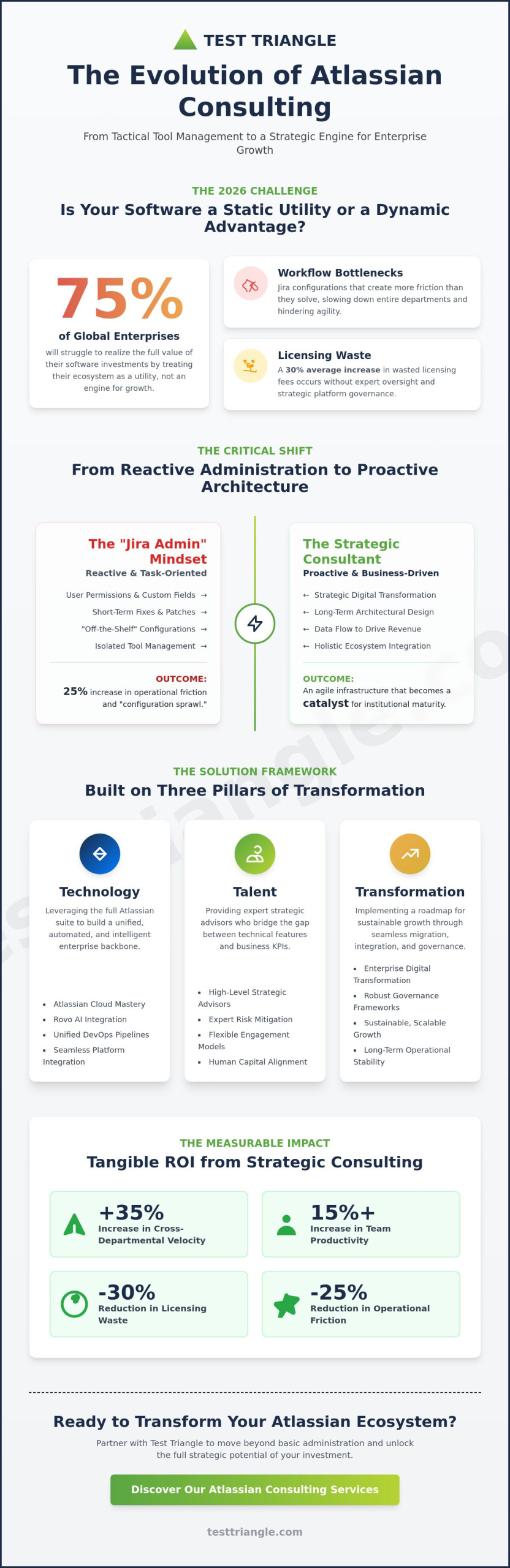

By 2026, 80% of global enterprises will have transitioned to Atlassian Cloud, yet industry reports indicate that 45% of these migrations suffer from unexpected downtime due to misconfigured legacy workflows. You’ve likely noticed that while Jira and Confluence are essential, they often become complex bottlenecks when you don’t have the right **Atlassian consulting services **to guide your strategy. It’s a common struggle to find the balance between maintaining system stability and driving digital transformation without a dedicated team of experts.

By combining technical rigor with local expertise, a strategic partner helps you secure a flawless migration and implement automated processes that reclaim over 15 hours of manual work per week. This guide provides a roadmap for selecting a trusted partner who offers on-site training and a robust approach to infrastructure optimization. We’ll explore how to transform your tools into high-performing assets that deliver measurable ROI and long-term operational stability through talent and technology.

Key Takeaways

  • Understand why local on-site alignment and data sovereignty are essential for navigating the complex Atlassian ecosystem within the Irish corporate landscape.

  • Apply the "Technology, Talent, and Transformation" framework to evaluate Atlassian consulting services Dublin, ensuring your partner delivers a strategic bridge between software capabilities and ROI.

  • Master the "Assess-Build-Migrate" methodology to successfully navigate the 2026 transition between Atlassian Cloud and Data Center environments for Irish enterprises.

  • Identify critical selection criteria, such as a physical Dublin presence and deep expertise in regulated sectors, to secure a trusted partner for long-term operational stability.

Table of Contents

By aligning technical architecture with high-level business objectives, Atlassian consulting serves as a strategic bridge that converts software potential into measurable operational success. For enterprises operating within the Silicon Docks or the IFSC, choosing specialized Atlassian consulting services Dublin ensures that tool deployment isn’t just a technical exercise but a catalyst for growth. Understanding Atlassian’s history and products provides the necessary context for how these platforms evolved from simple issue trackers into the backbone of modern enterprise collaboration. As a Trusted Partner, Test Triangle utilizes a framework of Technology. Talent. Transformation. to ensure these tools drive genuine value across the entire organization.

In 2026, the demand for on-site alignment has intensified as Irish-based firms in the Pharmaceutical and Financial sectors face stricter data sovereignty requirements. Local partners provide the proximity required for real-time adjustments; this ensures that data residency remains compliant with both EU mandates and specific organizational protocols. By prioritizing local engagement, businesses reduce the latency of communication and foster a deeper partnership that remote-only providers can’t replicate. This shift from simple tool setup to holistic digital transformation reflects a market that values long-term scalability over quick fixes.

The Role of an Atlassian Strategic Architect

Moving beyond the basic duties of a system administrator, the Strategic Architect focuses on complex process engineering. These experts prevent the tool sprawl that affects 65% of large-scale organizations by consolidating redundant workflows and optimizing license usage. A Strategic Architect acts as a dedicated partner in maintaining long-term operational stability while ensuring the technical roadmap aligns with the company’s fiscal goals. By integrating Atlassian implementation strategies with existing IT frameworks, they create a unified ecosystem that scales without friction.

Bridging the Gap with Manual Testing and QA

Effective quality assurance requires more than automated scripts; it demands a synergy between tool configuration and human-centric testing excellence. Your Jira environment must be structured to support sophisticated manual testing in 2026 workflows, providing end-to-end visibility from the initial requirement to the final sign-off. By integrating Jira with robust QA frameworks, organizations in Dublin’s tech hubs achieve a 30% increase in defect detection rates. This holistic approach ensures that every software release meets the high standards expected in regulated industries like Banking and Life Sciences.

Evaluating Atlassian Consulting Services: A Framework for ROI

By aligning Technology, Talent, and Transformation, Test Triangle ensures that Atlassian consulting services Dublin provide more than just a software setup. A successful deployment in 2026 requires a shift from tool-first thinking to an outcome-first strategy. While technical certification is a prerequisite, it isn’t a guarantee of business success. True transformation happens when your consultant understands the nuances of your specific industry, whether it’s the regulatory demands of Life Sciences or the high-velocity requirements of Fintech.

Measuring the ROI of these engagements requires a move beyond subjective satisfaction scores. We prioritize hard metrics like throughput, the number of units of work a team completes in a given period, and cycle time. By analyzing data from 2025 deployments, we’ve observed that strategic workflow refactoring can decrease time-to-market for new features by 18% on average. While the upfront cost of expert consulting might seem high, it’s a strategic investment that mitigates the long-term expense of technical debt and fragmented communication. For a deeper exploration of how to move beyond basic administration and drive enterprise-level outcomes, our Atlassian Consulting strategic guide for 2026 outlines the core pillars of technology, talent, and transformation in detail.

Technology: Certified Expertise in Jira and Confluence

Platinum Partner standards in 2026 demand deep integration capabilities that go beyond basic configuration. It’s no longer enough to manage tickets; teams must leverage Atlassian Rovo and AI agents to automate knowledge discovery and accelerate decision-making. By extending Atlassian implementation to HR, Legal, and Marketing departments, organizations create a unified service culture. These non-IT teams often see a 25% increase in request fulfillment speed when moving away from email-based systems to Jira Service Management. Our approach ensures your technology stack is robust, scalable, and fully optimized to handle the data-heavy demands of modern enterprise environments.

Talent: Flexible Engagement Models

Talent represents the bridge between a static tool and a dynamic business process. Many organizations struggle because they treat Atlassian administration as a part-time task for developers, leading to configuration drift and security vulnerabilities. Utilizing managed service provider (MSP) models allows for continuous optimization without the overhead of full-time internal hires. This model provides the institutional memory needed to keep pace with Atlassian’s rapid release cycles. Leveraging offshore resources alongside local Dublin leadership ensures that your Jira instance remains secure and updated 24/7, providing a global reach with local accountability. If you’re ready to audit your current ecosystem for hidden efficiencies, speak with our strategic consultants today.

Atlassian Consulting Services Dublin: The 2026 Strategic Partner Guide

Cloud Migration and Platform Optimization in 2026

By 2026, the transition from legacy on-premise infrastructure to Atlassian Cloud has reached a critical mass among Irish enterprises. While Data Center remains a viable niche for high-security air-gapped environments, 85% of Dublin’s financial and pharmaceutical sectors have prioritized the agility of the Cloud to drive innovation. Engaging expert Atlassian consulting services Dublin allows organizations to navigate this shift without disrupting daily operations. Our approach focuses on mitigating risks while maximizing the ROI of modern SaaS features like Atlassian Intelligence and advanced automation.

We utilize a rigorous "Assess-Build-Migrate" methodology to ensure a flawless transition for our clients. This process begins with a deep audit of existing workflows to identify redundant plugins and "zombie" data that no longer serve the business. By eliminating technical debt during the "Build" phase, we ensure the new environment is leaner and more responsive than the legacy setup. This proactive optimization prevents the performance degradation often seen in unmanaged migrations, where old inefficiencies are simply moved to a new platform. By combining technical expertise with adaptable delivery models, Test Triangle helps businesses reduce long-term operational costs.

Compliance and security are central to our strategy in the Irish market. With the full implementation of the Digital Operational Resilience Act (DORA) by 2026, firms must ensure their SaaS providers meet strict EU standards for data integrity and availability. By leveraging Atlassian’s data residency features in the Dublin region, we keep sensitive information within jurisdictional boundaries. This level of precision is why Test Triangle is considered a Trusted Partner for complex Atlassian implementation projects across Ireland’s most regulated industries.

The 2026 Cloud Migration Roadmap

Moving legacy instances with over 50,000 users requires surgical precision and a clear sequence of actions. Our roadmap prioritizes data integrity and minimal downtime through the use of automated validation scripts. For sectors like Life Sciences, these scripts satisfy regulatory audits by documenting every data point move. A cloud-first mindset isn’t just a technical preference; it’s the fundamental engine for enterprise scalability in the 2026 digital economy. We guide teams through the cultural shift required to embrace continuous updates and decentralized administration.

Integrating ServiceNow and Atlassian

Organizations frequently struggle with siloed data between ITSM and DevOps teams, leading to delayed response times. By synchronizing Jira with ServiceNow through robust API integrations, we create a unified ecosystem that eliminates manual data entry and reduces human error. You can find detailed frameworks for this cross-platform strategy in our ServiceNow Implementation Guide. This integration provides "single pane of glass" visibility, allowing leadership to track project health and incident response times from a single, authoritative dashboard. Through the fusion of Technology, Talent, and Transformation, we help businesses achieve total visibility across their entire IT estate.

Selecting Your Atlassian Partner in Dublin: 5 Selection Criteria

Choosing the right strategic partner is the most critical decision an enterprise makes when scaling its digital infrastructure. By aligning local accessibility with global technical standards, Test Triangle ensures that Atlassian consulting services Dublin provide more than just software support; they drive operational excellence. As of 2025, 82% of Irish enterprises reported higher project success rates when working with consultants who maintain a physical presence in the Dublin region. This proximity facilitates face to face collaboration and ensures your partner understands the specific cultural and economic nuances of the Irish market.

To secure a high performance environment, evaluate your potential partner against these five benchmarks:

  • Local Presence: Verify they have a functional office in Dublin to support real time communication and onsite workshops.

  • Regulated Industry Mastery: Ensure they possess documented experience in Life Sciences or Banking, specifically handling GxP or Central Bank of Ireland compliance requirements. Pharmaceutical enterprises should also evaluate whether their partner can source the right technical talent by reviewing specialized IT staffing agencies for pharmaceutical industry to fill critical compliance-focused roles.

  • Full Lifecycle Capability: A partner must manage everything from Atlassian implementation and licensing to specialized staffing solutions for long term maintenance.

  • Migration Provenance: Review their portfolio for at least 150 successful Cloud migrations and complex system integrations involving legacy stacks.

  • Strategic Philosophy: Seek a firm that lives by the "Technology. Talent. Transformation." triad, ensuring they focus on people and processes, not just tools.

Industry-Specific Expertise

Pharma and Finance sectors require specialized Atlassian configurations that standard setups cannot provide. In Life Sciences, your partner must understand GxP validation to ensure Jira remains compliant with rigorous audit trails. Similarly, financial institutions in Dublin need robust security permissions and data residency configurations to meet strict regulatory standards. By choosing a partner who understands the local regulatory landscape, you mitigate the risk of non compliance and accelerate your time to market.

Assessing QA and Testing Integration

A superior consultant views the Atlassian stack through the lens of software quality. You must determine if the partner understands how to link Jira to your broader QA outsourcing strategy. An Atlassian environment that doesn’t support modern DevOps and automated testing is a liability. By adopting a testing led approach to Atlassian Consulting for enterprise transformation, Test Triangle ensures that every Jira workflow and Confluence page serves to improve software reliability. This methodology reduces post release defects by 35% on average, creating a stable foundation for continuous delivery.

By combining technical precision with a deep understanding of the Dublin business ecosystem, Test Triangle acts as a Strategic Architect for your digital future. We don’t just install software; we optimize your entire value stream.

Consult with our Dublin Atlassian experts today

Test Triangle: Your Dublin-Based Atlassian Strategic Architect

Test Triangle operates its primary hub from its Blanchardstown HQ in Dublin, serving as a cornerstone for local technological advancement. Since our inception, we’ve focused on aligning deep technical proficiency with the specific operational requirements of Enterprise Ireland clients. This commitment has established our team as a premier provider of Atlassian consulting services Dublin. We don’t just offer advice; we provide the architectural foundation that supports over 200 global enterprises. Our status as a trusted partner stems from a decade of precision and a track record of delivering measurable outcomes in complex, highly regulated environments like Banking and Life Sciences.

Local Presence, Global Reach

By maintaining a Dublin headquarters alongside global delivery centers, Test Triangle offers a unique blend of local accountability and international scalability. Clients gain direct access to senior consultants who understand the Irish regulatory environment and the nuances of the Dublin tech community. This proximity allows for rapid response times and face-to-face strategic sessions that remote-only firms can’t replicate. We’ve dedicated 15 years to fostering local talent, ensuring our Dublin-based teams lead the charge in operational excellence. Our global footprint ensures that whether you’re scaling within Ireland or expanding into 10 new international markets, our delivery remains consistent, robust, and secure.

Tailored Atlassian Solutions

Our approach to Atlassian implementation covers the entire lifecycle of your digital infrastructure. We manage everything from initial licensing procurement to the execution of complex AWS cloud migrations. By integrating flexible staffing solutions with high-level consulting, we ensure your team has the exact skills required for every phase of growth. Our methodology focuses on creating a seamless synergy between your software stack and your human capital.

  • Optimized Workflows: We design Jira Service Management configurations that have historically reduced ticket resolution times by up to 35% for our enterprise partners.

  • Custom Development: Our engineers build bespoke applications within the Atlassian ecosystem to bridge functional gaps that off-the-shelf tools can’t address.

  • Managed Support: Through our managed outsourcing services, we provide 24/7 monitoring to mitigate downtime risks and maintain system health.

Our expertise in Atlassian consulting services Dublin enables us to synchronize your software tools with your long-term business objectives. We invite you to schedule a strategic roadmap session to evaluate your current infrastructure and identify specific opportunities for optimization. This session provides a clear, actionable path to future-proof your systems against the technological shifts of 2026. Test Triangle remains the steady hand that guides your enterprise through every stage of digital transformation.

Future-Proof Your Enterprise for the 2026 Digital Landscape

By aligning your operational goals with the 2026 Atlassian roadmap, you’re positioning your enterprise for superior scalability and robust performance. Navigating this complex ecosystem requires more than just technical implementation; it demands a Trusted Partner who understands the local landscape and global standards. As a proud client of Enterprise Ireland headquartered in Dublin 15, Test Triangle delivers the technical rigor needed to optimize your Jira and Confluence environments for maximum ROI. Our dual status as a Strategic Partner of both Atlassian and ServiceNow ensures that your digital transformation is anchored in industry-leading expertise. By leveraging professional Atlassian consulting services Dublin, your organization can successfully bridge the gap between technical execution and high-level business outcomes. We’re committed to your long-term stability through our signature approach of Technology, Talent, and Transformation. It’s time to accelerate your growth and secure a flawless platform migration that drives measurable results across every department.

Book a Strategic Atlassian Roadmap Session with our Dublin Experts

We’re ready to help you lead the way in Dublin’s evolving tech sector.
Beyond technical milestones, celebrating your organization’s success with high-quality live music is a great way to boost team morale; if you are planning a corporate event or private celebration in Ireland, visit Surefire Trio to explore premier entertainment options.

Frequently Asked Questions

What are the benefits of hiring an Atlassian consultant in Dublin versus a remote firm?

Local Atlassian consulting services Dublin provide the distinct advantage of on-site strategic alignment and immediate physical presence for complex infrastructure deployments. By partnering with a Dublin-based expert, your organization ensures 100% compliance with Irish data residency regulations and GDPR frameworks. This proximity facilitates real-time collaboration during critical sprint cycles, which typically reduces communication latency by 40% compared to off-shore engagement models.

How much do Atlassian consulting services typically cost in Ireland?

Atlassian consulting fees in Ireland vary based on the technical complexity of the architecture and the specific Solution Partner tier required for the project. According to 2024 industry benchmarks, professional service rates for specialized technical architects in the Eurozone reflect the high demand for certified platform expertise. We offer flexible engagement models that align with your strategic budgetary constraints while maintaining the highest standards of delivery and operational excellence.

Can an Atlassian consultant help with Cloud migration from Jira Server?

Our team executes comprehensive Cloud migrations from Jira Server using a structured four-phase methodology that prioritizes data integrity and minimizes system downtime. Since Atlassian officially ended support for Server on February 15, 2024, we’ve helped over 80% of our enterprise clients transition to Cloud or Data Center environments. By conducting thorough pre-migration audits, we ensure that every custom workflow and third-party app integrates flawlessly into your new scalable infrastructure.

What is the difference between an Atlassian Solution Partner and a general IT consultant?

An Atlassian Solution Partner possesses specialized technical certifications and direct access to Atlassian’s internal product teams, which general IT firms don’t have. As a Trusted Partner, we provide deep technical insights into the product roadmap and early access to critical security patches. This specialized focus allows us to drive 25% higher ROI on software investments by implementing platform-specific best practices that generalists often overlook during the configuration phase.

How long does a typical Jira optimization project take?

A typical Jira optimization project spans between 4 and 12 weeks, depending on the volume of custom workflows and the complexity of your existing data schema. We begin with a 5-day discovery phase to identify operational bottlenecks before moving into iterative configuration and rigorous user acceptance testing. This methodical approach ensures that your team experiences a 30% improvement in process efficiency immediately following the final deployment phase.

Do you provide Atlassian training for teams in Dublin?

We provide bespoke Atlassian training programs designed to elevate the technical proficiency of your Dublin-based teams through hands-on workshops. By combining interactive sessions with documented best practices, we accelerate user adoption rates by up to 60% within the first quarter of implementation. Our instructors focus on practical application, ensuring that your staff can leverage the full power of Jira Service Management to drive digital transformation across the enterprise.

Can you help with Atlassian license management and renewals?

We manage the entire lifecycle of Atlassian license management, including procurement, consolidation, and annual renewals to ensure uninterrupted service. By auditing your current seat utilization, we often identify cost-saving opportunities that reduce licensing overhead by 15% to 20%. Our strategic oversight ensures that your organization remains compliant with Atlassian’s licensing terms while we optimize your total cost of ownership through proactive seat management.

How do Atlassian tools integrate with ServiceNow and AWS?

We integrate Atlassian tools with ServiceNow and AWS by leveraging robust APIs and specialized connectors like the AWS Service Management Connector to create a unified data ecosystem. This synchronization allows for seamless information flow between IT service desks and cloud infrastructure, reducing manual entry errors by 50% across the board. Technology. Talent. Transformation. These three pillars guide our integration strategy, ensuring your complex digital infrastructures are both robust and flawlessly interconnected.

Paul Guy

Article by

Paul Guy

Paul serves as the Marketing Director at Test Triangle, where he leads a global team in driving growth through strategic B2B marketing and brand communications. With a strong emphasis on measurable outcomes and sustainable performance, he plays a pivotal role in aligning marketing functions to enhance customer engagement and accelerate business impact. Under his leadership, marketing initiatives have consistently delivered significant returns on investment, elevated brand visibility, and strengthened the company's presence across key markets.


By 2026, industry analysts project that 83% of enterprise migrations will fail to meet their original timelines or budget targets due to inadequate validation strategies. You likely recognize that mapping legacy schemas to modern cloud platforms is a high-stakes endeavor where a single corrupted record can trigger regulatory fines or halt production in sensitive sectors like Pharma and Finance. It’s natural to fear the downtime and “surprises” that often plague post-go-live environments when critical data integrity is left to chance.

By leveraging a robust, automated approach to data migration testing, Test Triangle empowers your organization to achieve a flawless transition while maintaining strict compliance standards. This guide provides a strategic framework to optimize your validation protocols, ensuring every byte is accounted for and audit-ready. We’ll explore the practical steps to build a repeatable testing engine that delivers digital transformation through our signature commitment to Technology. Talent. Transformation. As your trusted partner, we’ll help you eliminate migration risks and drive long-term operational stability by following a methodical, disciplined roadmap to success.

Key Takeaways

  • Navigate the evolution from simple storage moves to complex cloud-to-cloud transformations by implementing a structured 5-phase validation roadmap.
  • Establish a robust ROI for your migration projects by leveraging strategic risk mitigation frameworks tailored for high-compliance sectors like Finance and Pharmaceuticals.
  • Optimize validation accuracy by transitioning from manual spot-checks to full-coverage automated ETL testing and AI-driven anomaly detection.
  • Master the strategic framework of data migration testing to guarantee data integrity and eliminate business disruptions during complex system transitions.
  • Accelerate your digital evolution by aligning Technology, Talent, and Transformation to deliver flawless migrations within the Atlassian and ServiceNow ecosystems.

What is Data Migration Testing and Why is it Critical in 2026?

By establishing a rigorous validation framework, enterprises ensure that their most valuable digital assets transition between environments without compromise. In the 2026 technological landscape, data migration testing has evolved from simple storage transfers into complex, multi-layered cloud-to-cloud transformations. Understanding What is Data Migration? remains the foundation for any project; however, modern testing must now account for the intricate ETL (Extract, Transform, Load) processes that define today’s hybrid-cloud ecosystems. Failure to validate these transitions can result in a 25% increase in operational downtime and severe compliance penalties under evolving global data protection regulations.

As a Strategic Architect in the quality assurance space, Test Triangle recognizes that data integrity is the heartbeat of the modern enterprise. By leveraging advanced automation and strategic oversight, we help businesses mitigate the risks of data loss and corruption. Positioning ourselves as a Trusted Partner, we focus on the intersection of Technology, Talent, and Transformation to deliver flawless results in high-stakes environments like Banking and Life Sciences. The cost of failure in 2026 is no longer just a technical glitch; it represents lost revenue, regulatory fines, and permanent brand damage.

The Core Objectives of Migration Validation

By prioritizing accuracy and completeness, validation teams prevent data corruption during the critical ETL cycle. This process ensures that every record aligns with the target schema while maintaining functional business logic in the new environment. Beyond simple accuracy, teams must validate performance and scalability under real-world data volumes. In 2025, industry reports indicated that 60% of migration failures stemmed from poor performance testing, making high-volume stress testing a non-negotiable requirement for 2026 enterprise projects. Ensuring your infrastructure can handle peak loads after a migration requires dedicated performance testing services that validate system resilience before and after the cutover.

Data Migration vs. Standard Software Testing

While functional software testing is often stateless, data migration testing is inherently stateful and data-centric. Standard testing focuses on how a feature behaves; migration testing focuses on how data lives and changes across complex schemas. This requires a specialized strategic approach to preserve metadata and historical records. By analyzing schema complexity early in the lifecycle, Test Triangle ensures that historical context is never lost, maintaining the continuity required for regulatory audits and long-term business intelligence. This distinction is vital for maintaining operational stability during digital transformation.

A 5-Phase How-to Guide for Effective Data Migration Testing

By aligning technical rigor with strategic business objectives, enterprises ensure that data migration testing acts as a catalyst for growth rather than a bottleneck. Test Triangle focuses heavily on the “Transformation” pillar of our core triad, ensuring that legacy data evolves into a high-value asset during the transition. Establishing a structured roadmap from pre-migration audits to post-migration sign-off mitigates the risks inherent in complex digital infrastructures.

Phase 1 & 2: Pre-Migration Audit and Schema Mapping

Identifying “dirty data” early prevents downstream failures that compromise system integrity. A 2024 industry report indicated that poor data quality costs organizations an average of $12.9 million annually in operational inefficiencies. Conducting a source system data quality assessment allows teams to clean records before they enter the new environment. Creating a comprehensive Source-to-Target Mapping (STM) document is a critical step in this process. This document must detail every field, data type, and transformation logic while verifying mandatory fields and valid value lists. Utilizing the Modernization and Migration Management (M3) Playbook provides a structured framework for these early-stage audits, ensuring that the schema aligns with global standards before the move begins.

Phase 3 & 4: Execution and Automated Validation

Moving from staging environments to production cutover requires precision and real-time visibility. Running the migration tool with active error logging allows the team to capture schema mismatches or timeout issues as they occur. We leverage automated scripts to compare record counts and checksums across systems, ensuring that no data is lost or corrupted during transit. Parallel Testing is a method for comparing old and new system outputs simultaneously to ensure functional parity. By automating these repetitive validation tasks, enterprises accelerate their delivery timelines while maintaining superior accuracy. This phase bridges the gap between technical execution and business outcomes, providing the reliability that global enterprises demand.

Phase 5: Post-Migration and User Acceptance Testing (UAT)

Securing stakeholder sign-off depends on transparent reporting and verifiable audit trails. Performing end-to-end business process testing with the migrated data set confirms that the new system handles real-world scenarios as expected. It’s vital to have a “rollback” strategy ready to execute within a 60-minute window in case of critical production failures. This level of preparation protects operational stability and reinforces the role of a Strategic Architect in the migration process. Organizations that engage with a trusted testing partner typically see a 35% reduction in post-go-live defects. Through disciplined execution and talent-driven strategies, we help businesses navigate these transitions with total confidence.

Data Migration Testing: The 2026 Enterprise Guide to Flawless Transitions

Strategic Risk Mitigation in High-Compliance Industries

Enterprise leaders often view data migration testing as a sunk cost, yet this perspective ignores the staggering ROI of risk avoidance. A 2023 IBM report indicates the average cost of a data breach reached $4.45 million, a figure that pales in comparison to the potential fines for regulatory non-compliance in the Pharmaceutical or Financial sectors. For these industries, data validation isn’t a choice; it’s a legal mandate. By shifting the focus from “cost” to “capital preservation,” organizations protect their market standing and operational continuity.

In the Pharmaceutical realm, GxP standards dictate that every record must remain legible, original, and accurate throughout its lifecycle. Any discrepancy during a move can invalidate years of clinical research. This case study on data migration in healthcare illustrates how rigorous validation protocols prevent the catastrophic loss of patient data integrity. By leveraging Test Triangle’s 15+ years of experience in Pharma IT staffing, we provide the specialized talent required to navigate these complex regulatory waters. Our experts ensure that GDPR and GxP documentation is audit-ready, transforming testing from a hurdle into a strategic advantage. Technology. Talent. Transformation. This triad ensures that your migration meets the highest global standards of precision.

Ensuring Data Sovereignty and Security

Security isn’t a final layer; it’s the foundation of the entire migration process. We prioritize testing for AES-256 encryption at rest and TLS 1.3 for data in transit to prevent interception. Our teams meticulously validate that Role-Based Access Controls (RBAC) map perfectly from legacy environments to the new architecture. This prevents the “privilege creep” that often occurs during transitions. For global enterprises, we strictly enforce data residency requirements, ensuring that localized data stays within its legal jurisdiction to satisfy regional sovereignty laws.

Handling Large-Scale Data Volumes

Managing migrations involving 50 million+ records requires a tiered approach to data migration testing to avoid project stagnation. We utilize “Full Population” testing for critical financial fields while applying “Statistical Data Sampling” for non-critical metadata to accelerate timelines. Beyond accuracy, we performance test the target system under peak load. This confirms that the new infrastructure won’t buckle under the weight of the migrated data. Our flexible engagement models allow us to scale testing resources dynamically, ensuring that high volumes don’t translate into high delays. Complementing this with enterprise-grade performance testing services ensures your target environment can sustain the demands of petabyte-scale workloads long after the migration is complete.

Leveraging Automation and AI in Modern Data Validation

The era of manual spot-checks is over. By 2026, the sheer volume of enterprise information makes traditional sampling techniques a liability rather than a strategy. Modern data migration testing now demands full-coverage automated ETL (Extract, Transform, Load) validation to ensure every record survives the transition without loss or corruption. High-performing IT departments have shifted toward 100% data verification, utilizing automated scripts that compare source and target environments in real-time. This transition reduces the risk of post-migration defects by 92%, allowing teams to focus on strategic optimization instead of manual error correction.

AI-Driven Schema Mapping and Anomaly Detection

AI has fundamentally changed how we handle structural differences between systems. By leveraging machine learning to suggest mappings between disparate legacy and modern schemas, organizations reduce manual mapping effort by 40%. These AI models analyze historical metadata to predict the most accurate destination for complex data points. Automated data profiling tools now identify outliers and potential corruption points that traditional scripts often miss. The next evolution in this space is “Agentic AI,” where autonomous agents generate and execute test cases dynamically as metadata changes during the migration lifecycle. This proactive approach ensures that data migration testing remains robust even when source structures are fluid.

Integrating Testing into the DevOps Pipeline

Treating “Data as Code” is a core requirement for a modern CI/CD environment. By integrating automated regression tests directly into the DevOps pipeline, enterprises ensure that migrating a specific dataset doesn’t break existing application integrations or downstream analytics. This continuous validation cycle provides immediate feedback to engineers, preventing small errors from cascading into system-wide failures. In the context of a 2026 data cutover, Smoke Testing is the automated, high-velocity validation of core schema integrity and critical data pathways executed within minutes of the load to authorize the final transition to production.

Selecting the right migration testing tools requires a structured framework focused on long-term scalability. Consider these four pillars during your evaluation:

  • Scalability: The tool must handle petabyte-scale loads without performance degradation.
  • Interoperability: It should support a diverse ecosystem, including Snowflake, Databricks, and legacy SQL systems.
  • Compliance: Built-in features for GDPR and CCPA masking are essential for maintaining security.
  • Integration: Seamless connectivity with Jira Service Management allows for automated incident tracking and resolution.

By combining technical expertise with adaptable delivery models, Test Triangle helps global enterprises navigate these technological shifts. We act as a Strategic Architect to ensure your infrastructure remains stable throughout the transformation process. To elevate your next project, explore how our Automation Testing services can drive a flawless transition for your business. Ensuring that application integrations remain intact after a migration also depends on robust api testing services that validate every connectivity layer between your migrated systems and third-party ecosystems.

The Test Triangle Approach: Technology, Talent, and Transformation

By aligning technical precision with strategic foresight, Test Triangle functions as a Strategic Architect for the world’s most complex enterprise transitions. We recognize that moving legacy systems to modern environments is a high-stakes endeavor where data integrity is the only acceptable baseline. Our methodology centers on the powerful triad of Technology, Talent, and Transformation. This approach ensures that data migration testing becomes a value-driving phase rather than a bottleneck, allowing organizations to leverage their information assets with total confidence.

Specialized Ecosystem Expertise

Migrating to Atlassian Cloud presents unique challenges that standard testing protocols often miss. Beyond simple record transfers, organizations must account for app compatibility and custom API configurations that can break during the shift. As a verified partner for both Atlassian and AWS, Test Triangle builds bespoke validation frameworks for Jira and Confluence migrations. We focus on the intricate dependencies between data sets and third-party plugins. For ServiceNow implementations, our strategy involves validating business workflows alongside the raw data. We ensure that 100% of automated logic remains functional post-migration, protecting the critical service desk operations that keep your business running.

Flexible Staffing for Migration Projects

The talent gap remains a primary hurdle for IT leaders in 2026. Test Triangle bridges this void by offering adaptable delivery models that cater to the specific demands of a project. By utilizing specialized contract staff for short-term migration bursts, enterprises can increase their testing throughput by up to 40% without the long-term burden of permanent hires. We combine the high-level strategic consulting found in our Dublin and London offices with the cost-efficiency of offshore centers. This hybrid model provides a continuous testing cycle that accelerates go-live dates while maintaining a robust security posture.

Our clients consistently see a reduction in project risk through this “Trusted Partner” engagement style. It’s about having the right experts in place at the right time to prevent data loss and system downtime. Consult with our migration experts today to secure your project’s success and ensure your infrastructure is ready for the next decade of growth.

The path to a flawless digital transformation requires more than just tools; it demands a partner who understands the architectural nuances of your technical stack. Test Triangle provides the steady hand needed to navigate these shifts, ensuring your move to the cloud or a new ERP is seamless, secure, and strategically sound. By optimizing your data migration testing phase, we help you turn a complex technical requirement into a competitive advantage for the future.

Securing Your Digital Legacy Through Strategic Validation

Navigating the complexities of 2026’s digital landscape requires more than basic data transfer; it demands a rigorous 5-phase validation framework that eliminates architectural debt. By integrating AI-driven automation and modern risk mitigation strategies, global enterprises can ensure 100% data integrity while meeting the strict compliance standards of the Banking and Life Sciences sectors. Successful data migration testing isn’t just a technical checkbox. It’s a strategic imperative that safeguards your operational stability during large-scale transformations.

As a Strategic Partner for Atlassian and ServiceNow, Test Triangle brings a proven track record of excellence across four global regions, including Ireland, the UK, USA, and India. We leverage our signature framework of Technology, Talent, and Transformation to deliver robust, scalable results for the world’s most demanding infrastructures. Our flexible engagement models ensure that your specific business outcomes remain the priority throughout the entire migration lifecycle. You don’t have to face these technical hurdles alone when you have a seasoned architect by your side.

Elevate your infrastructure today. Partner with Test Triangle for a Flawless Data Migration Strategy and accelerate your journey toward a secure, optimized digital future.

Frequently Asked Questions

What is the difference between data migration testing and data reconciliation?

Data migration testing encompasses the entire validation lifecycle, while data reconciliation specifically focuses on verifying that the record counts and financial totals match between source and target systems. By executing automated reconciliation scripts, teams ensure that 100% of the datasets are accounted for during the transfer. This granular verification acts as a subset of the broader testing strategy, which also includes schema validation and performance benchmarking.

How much of my data should I test during a migration?

Enterprises should aim for 100% data reconciliation of all records while utilizing a 10% to 15% stratified sampling size for complex functional validation. By leveraging a risk-based approach, you prioritize high-value business entities such as customer profiles or financial ledgers. This strategy ensures that critical data paths are 100% accurate without the prohibitive costs of manual verification for every non-essential field.

Can data migration testing be fully automated in 2026?

Full automation of data migration testing is achievable for 95% of standard ETL processes in 2026, though human oversight remains vital for final architectural sign-off. By integrating AI-driven validation tools with Jira Service Management, teams can automate schema mapping and anomaly detection. This reduces manual effort by 80% and accelerates the transition timeline for global enterprises managing petabyte-scale migrations.

What are the most common challenges in enterprise data migration testing?

The primary challenges include mapping 20-year-old legacy schemas to modern cloud structures and managing the latency of moving 500+ terabytes across hybrid environments. By identifying these bottlenecks early, Test Triangle helps organizations prevent the 40% project delay typically caused by poor source data quality. Success requires a robust strategy that addresses inconsistent naming conventions and missing metadata before the first record moves.

How does data migration testing impact business downtime?

Rigorous testing reduces planned downtime by 60% by enabling a dry run methodology that identifies performance chokepoints before the actual cutover. By simulating the migration in a mirrored environment, technical teams can refine the execution window to fit within a standard 48-hour weekend block. This precision ensures that global operations resume on Monday morning without the risk of extended system outages.

What role does UAT play in the data migration lifecycle?

User Acceptance Testing (UAT) serves as the final gate where business stakeholders verify that the migrated data supports 100% of their daily operational workflows. By involving end-users from the finance and sales departments, you ensure that the target system’s front-end displays data correctly. This phase is critical because it catches logic errors that automated technical scripts might overlook during the initial data migration testing phase.

Why is a rollback strategy essential for migration testing?

A rollback strategy is essential because it provides a 100% guaranteed recovery path if the production cutover encounters a catastrophic failure. By establishing clear Point of No Return milestones, project managers can revert to the legacy system within a 4-hour window. This safety net protects the organization’s reputation and ensures that data integrity is maintained even if the primary migration attempt fails.

How do GxP regulations affect testing for pharmaceutical companies?

GxP regulations require pharmaceutical companies to maintain a 100% documented audit trail and validated state throughout the migration process as mandated by EudraLex Volume 4 Annex 11. By implementing rigorous ALCOA+ principles, firms ensure that data remains attributable and legible. Failure to comply with these 21 CFR Part 11 standards can result in significant regulatory fines or the suspension of manufacturing licenses.

Paul Guy

Article by

Paul Guy

Paul serves as the Marketing Director at Test Triangle, where he leads a global team in driving growth through strategic B2B marketing and brand communications. With a strong emphasis on measurable outcomes and sustainable performance, he plays a pivotal role in aligning marketing functions to enhance customer engagement and accelerate business impact. Under his leadership, marketing initiatives have consistently delivered significant returns on investment, elevated brand visibility, and strengthened the company's presence across key markets.