
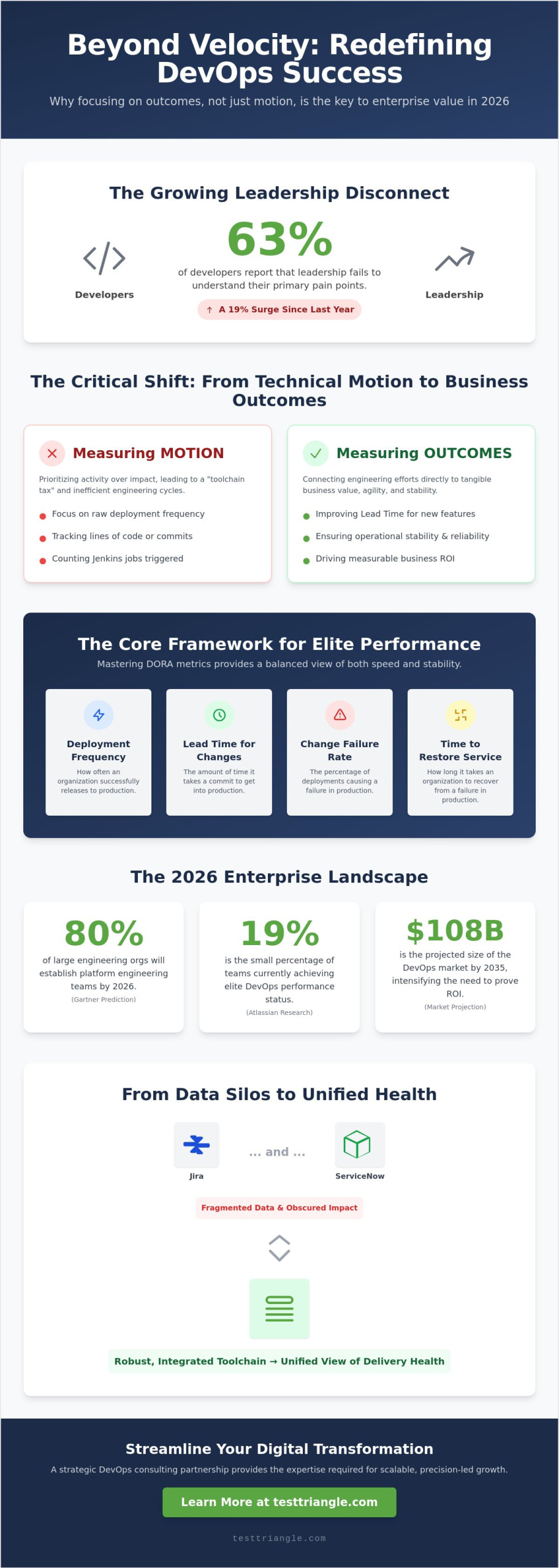
63% of developers report that leadership fails to understand their primary pain points, a figure that has surged by 19% since last year according to Atlassian research. This disconnect often stems from a focus on technical motion rather than meaningful progress, leaving organizations unable to translate rapid engineering cycles into tangible business value. If you’re managing complex digital infrastructures, you likely feel the strain of data silos between platforms like Jira and ServiceNow that obscure the true impact of your DevOps initiatives.

You can bridge this gap by mastering the strategic frameworks required for measuring devops success metrics and kpis to ensure your technical velocity drives real-world ROI. We’ll provide a clear roadmap for building an actionable KPI dashboard that aligns engineering output with executive expectations, moving beyond the 19% of teams currently reaching elite performance status. By the end of this guide, you’ll understand how to optimize deployment frequency and stability while maintaining the operational precision your enterprise demands.

Key Takeaways

  • Understand why the shift from measuring motion to measuring outcomes is essential for maintaining a competitive edge in the 2026 enterprise landscape.
  • Master the foundational DORA benchmarks to refine your approach to measuring devops success metrics and kpis, ensuring every code commit translates into reliable production value.
  • Discover the methodology for converting engineering cycle times into measurable time-to-market advantages that resonate with executive leadership.
  • Establish a robust, integrated toolchain across Atlassian and ServiceNow ecosystems to eliminate data silos and provide a unified view of your delivery health.
  • Explore how a strategic partnership involving DevOps Consulting can streamline your digital transformation by providing the expertise required for scalable, precision-led growth.

Beyond Velocity: Redefining DevOps Success in 2026

Success in 2026 is no longer defined by how often you push code, but by the value that code generates for the end user. While early adoption focused on the raw mechanics of What is DevOps?, modern enterprises now face a “Measurement Gap” where technical velocity fails to move the needle on business ROI. This friction occurs when teams prioritize activity over outcomes. Effective measuring devops success metrics and kpis requires a transition from simply tracking deployment frequency to understanding how those deployments impact operational stability and market agility. It’s about ensuring that every sprint contributes to a more resilient and responsive digital infrastructure.

Executives don’t care about the number of Jenkins jobs triggered; they care about lead time for revenue-generating features. In a landscape where the DevOps market is projected to reach USD 108.26 billion by 2035, the pressure to prove ROI is immense. Organizations must bridge the disconnect between engineering speed and executive satisfaction by aligning technical milestones with strategic business goals. This involves a disciplined approach to systemic improvement where every metric serves as a proxy for customer value. Many teams currently struggle with a “toolchain tax,” spending excessive time maintaining fragmented systems rather than delivering features. Reducing this overhead is a primary goal of measuring devops success metrics and kpis in the modern era.

The Evolution of DevOps Performance Standards

Digital Transformation Services have fundamentally raised the bar for what constitutes “elite” performance. It’s no longer enough to be fast; you must be secure and scalable. In 2026, success is measured by the ability to maintain high-velocity output without compromising the integrity of complex, highly regulated digital infrastructures. This shift moves the focus from reactive incident monitoring to proactive strategic roadmapping. Gartner predicts that 80% of large engineering organizations will establish platform engineering teams by 2026. This evolution allows for a more focused measurement of developer experience and productivity, ensuring that human expertise is empowered by technical tools rather than hindered by them.

The Strategic Importance of Quality Assurance

While automation is a cornerstone of speed, Manual Testing remains a vital counter-metric for ensuring qualitative excellence. Pure velocity often creates “noise” through useless security alerts or unstable releases. Balancing speed with Digital Assurance ensures that brand protection is never sacrificed for a faster release cycle. High-standard software QA services provide the necessary oversight to translate technical execution into enduring business value. This balanced approach ensures that stability remains a constant even as deployment frequencies increase, providing the peace of mind that comes from reduced risk and enhanced operational reliability.

The Core Framework: Mastering DORA Metrics and Lead Time

Establishing a high-performance culture requires a shift from anecdotal evidence to empirical data. The DevOps Research and Assessment (DORA) metrics provide the foundational benchmark for this transition, offering a balanced view of both speed and stability. For global enterprises operating in highly regulated industries, the challenge lies in scaling these metrics across fragmented toolchains while maintaining strict compliance. Effective measuring devops success metrics and kpis depends on these four pillars to identify bottlenecks and ensure that engineering efforts align with strategic organizational growth.

Success in 2026 isn’t just about the metrics themselves, but the methodology used to capture them. Data silos between development and operations often lead to skewed results that don’t reflect reality. By implementing a unified framework, organizations can move beyond basic activity tracking to achieve a sophisticated understanding of their operational health. This disciplined approach provides the peace of mind that comes from knowing your infrastructure is both agile and resilient.

Deep Dive into Lead Time and Deployment Frequency

Lead Time for Changes is the primary indicator of pipeline efficiency, quantifying the journey from the initial code commit to a successful production release. High-performing organizations utilize Atlassian tools to automate the collection of these data points, ensuring that leadership has a transparent view of the delivery lifecycle. According to the 2024 DORA State of DevOps report, elite performers deploy 182 times more frequently than low performers. However, with only 19% of teams qualifying as elite, most organizations still face significant hurdles in achieving this level of agility. Strategic roadmapping helps bridge this gap by identifying exactly where manual handoffs are stalling the rhythm of your delivery pipeline.

Stability Metrics: MTTR and Change Failure Rate

Velocity must always be tempered by reliability to protect brand integrity and operational continuity. The Change Failure Rate serves as an essential metric for process quality, measuring the percentage of deployments that require immediate remediation. The integration of software test automation services provides the necessary safety net, allowing teams to accelerate without increasing risk. When incidents do occur, Mean Time to Recovery (MTTR) becomes the ultimate measure of resilience. A sophisticated ServiceNow implementation streamlines this response by connecting technical alerts to automated incident management workflows. This methodical approach ensures that stability remains a constant, even as your organization scales its digital infrastructure. To see how these frameworks can be tailored to your specific environment, consider how a strategic consultation can optimize your measurement strategy.
Measuring DevOps Success: Strategic Metrics and KPIs for 2026

Bridging the Gap: Connecting Engineering KPIs to Business ROI

Engineering velocity lacks inherent value if it fails to translate into measurable business growth. For executive stakeholders, “Cycle Time” is often viewed as a technical abstraction, requiring a strategic translation into “Time to Market” to demonstrate economic impact. By measuring devops success metrics and kpis through the lens of revenue generation and market agility, organizations can justify the intensive capital required for large-scale technological evolution. A primary driver of this justification is the ROI of DevOps Consulting, which manifests in substantial cost-per-release reductions. These efficiencies are achieved by identifying systemic waste and automating manual bottlenecks that otherwise drain resources and delay profitability.

Beyond raw output, Developer Experience (DX) has emerged as a leading indicator of long-term productivity and talent retention. Atlassian research indicates that teams with easy access to self-serve information are 4.4 times more productive, yet many organizations continue to ignore the friction within their own toolchains. Improving DX reduces the cognitive load on engineers, allowing them to focus on innovation rather than infrastructure maintenance. This cultural shift is essential for maintaining the institutional maturity required to operate across diverse, highly regulated industries.

Strategic vs. Operational KPIs

Strategic KPIs focus on high-level outcomes such as revenue impact, customer satisfaction, and market agility; they provide the evidence executive leadership needs to support continued digital investment. Conversely, operational KPIs like sprint velocity, bug leakage, and infrastructure uptime offer the granular detail technical managers require to maintain stability. Creating a balanced scorecard that synthesizes these two perspectives ensures that both the CTO and CFO are aligned on the definition of success. This unified view fosters a spirit of partnership, ensuring that every deployment is a calculated step toward organizational progress.

The Role of Specialized Talent in Metric Success

The “Human Element” remains the most significant variable in achieving elite DevOps status. Access to specialized IT staffing directly influences an organization’s ability to meet complex KPI benchmarks, particularly in sectors with stringent compliance requirements. Pharmaceutical IT staffing, for example, provides the domain expertise necessary to ensure that security and regulatory KPIs are met without hindering delivery speed. Additionally, the strategic use of remote offshore resources can optimize cost-efficiency metrics when integrated into a disciplined, globally-minded framework. Positioning “Staffing as a Service” as a catalyst for growth allows enterprises to remain versatile while benefiting from a steady hand in a fast-changing landscape. Precision, Productivity, Profitability; these are the natural results of a well-staffed, data-driven DevOps culture.

Strategic Implementation: Building a Data-Driven DevOps Culture

The transition toward a data-driven DevOps culture requires a methodical approach that transcends simple tool adoption, beginning with a comprehensive audit to establish a clear baseline for current operational health. Without this foundational step, measuring devops success metrics and kpis becomes an exercise in tracking motion without direction. Once a baseline is established, organizations must move toward a strategic integration of their toolchain, ensuring that data flows seamlessly between Jira, Bitbucket, and ServiceNow. This connectivity allows leadership to define “North Star” metrics that align technical output with specific, high-level business objectives. Precision, Performance, Progress; these three pillars form the core of a mature implementation strategy.

Achieving this level of transparency often requires the expertise found in Atlassian Consulting to automate reporting and eliminate manual data entry. Automation ensures that the insights generated are both accurate and timely, providing executive stakeholders with the confidence needed to make informed investment decisions. The final stage of this implementation is iterative refinement, where continuous feedback loops allow teams to adjust their strategies based on real-world performance data. This disciplined cycle ensures that the DevOps framework remains adaptable and resilient in a fast-changing technological landscape.

Toolchain Integration for Holistic Visibility

Establishing a “Single Source of Truth” is critical for enterprise reporting, as fragmented data lead to conflicting interpretations of success. By leveraging sophisticated IT Service Management solutions, organizations can bridge the gap between development and operations, creating end-to-end visibility across the entire lifecycle. Data silos dissolve when tools connect. Automating KPI dashboards reduces manual reporting overhead, allowing engineers to focus on high-value tasks while providing leadership with real-time health indicators. This integration ensures that every stakeholder, from the developer to the CFO, is working from the same set of verified facts.

Fostering a Culture of Continuous Improvement

A data-driven culture thrives when organizations move away from a “Blame Culture” and embrace a “Learning Culture” rooted in empirical evidence. Using measuring devops success metrics and kpis to identify training gaps and staffing needs allows for more targeted professional development and resource allocation. Successful KPI adoption depends heavily on effective change management and ongoing training, ensuring that teams understand the “why” behind the metrics. When data are used as a tool for empowerment rather than a metric for punishment, organizational progress becomes a shared mission. To begin your journey toward a more transparent and efficient delivery model, consider scheduling a strategic roadmap session to align your toolchain with your business goals.

Optimising Delivery: The Test Triangle Strategic Partnership Model

Achieving peak delivery performance requires more than just a list of benchmarks; it demands a reliable long-term collaborator capable of aligning technical rigor with corporate strategy. Test Triangle positions itself as this steady hand, providing the institutional maturity necessary to manage large-scale technological shifts. By integrating our Managed Outsourcing Services, enterprises can remove the inherent friction of measuring devops success metrics and kpis, allowing internal teams to focus on core innovation while we handle the intricacies of data collection and analysis. Strategy, Stability, Success; these three pillars form the foundation of our integrated consulting approach. We combine industry-leading tools with specialized talent and proven techniques to ensure that your delivery pipeline remains both agile and resilient.

We recognize that a one-size-fits-all approach is insufficient for global enterprises operating in highly regulated sectors. Whether your organization is in finance, healthcare, or retail, our customized KPI frameworks are designed to address the specific regulatory and operational challenges of your industry. This sector-specific expertise ensures that your DevOps transformation isn’t just fast, but also compliant and secure. By bridging the gap between technical execution and business outcomes, we empower leadership to make data-driven decisions that foster sustainable, scalable growth.

Comprehensive DevOps and QA Support

A truly optimized delivery pipeline must account for qualitative excellence at every stage of the lifecycle. Integrating QA Outsourcing into your DevOps pipeline provides a critical layer of digital assurance, ensuring that brand protection is never sacrificed for the sake of velocity. Our global presence supports 24/7 delivery and monitoring, providing the infrastructure needed to maintain high-performance standards across diverse time zones. Beyond immediate technical support, we offer strategic technology roadmapping as a service, helping your organization anticipate future shifts in the landscape and adjust your measuring devops success metrics and kpis accordingly.

Next Steps for Enterprise Transformation

The journey toward elite performance begins with an objective evaluation of your current maturity level through a strategic audit. We identify existing bottlenecks and data silos that hinder your ability to translate engineering speed into ROI. We advocate for a phased implementation approach to DevOps metrics, which allows for the gradual adoption of sophisticated benchmarks without overwhelming your operational teams. This methodical progression ensures that each new KPI provides immediate value while building toward a comprehensive dashboard of delivery health. If you’re ready to master the frameworks required for 2026, Test Triangle is prepared to serve as your strategic partner. Reach out to our team today for a bespoke consultation on your DevOps roadmap and take the first step toward a more transparent, efficient, and profitable future.

Mastering the Future of DevOps Delivery

Navigating the complexities of modern digital infrastructure requires a shift from tracking simple activity to prioritizing high-impact business outcomes. By refining your approach to measuring devops success metrics and kpis, you ensure that every engineering sprint contributes directly to market agility and operational stability. Establishing a single source of truth across integrated toolchains isn’t just a technical goal; it’s a strategic necessity for enterprises seeking elite performance status. This alignment provides the transparency required to justify technological investments and drive sustainable growth.

As an Atlassian Platinum Solution Partner and ServiceNow Specialist Partner, Test Triangle provides a global delivery model infused with localized expertise to guide your digital evolution. We act as a reliable long-term collaborator, helping you bridge the gap between technical velocity and executive satisfaction through precision-led frameworks. Partner with Test Triangle to optimize your DevOps metrics and drive strategic growth. Together, we can transform your delivery pipeline into a powerful engine for innovation and profitability.

Frequently Asked Questions

What are the most important DevOps KPIs to track for executives?

Executives should prioritize high-level outcomes such as Time-to-Market, Customer Satisfaction Scores (CSAT), and the total cost of delivery per feature. These indicators translate technical motion into financial and market impact, allowing leadership to assess how digital transformation initiatives drive competitive advantage. By focusing on these strategic results, organizations can justify the capital investment required for large-scale infrastructure evolution.

How do DORA metrics help in measuring DevOps success?

DORA metrics provide a standardized, empirical framework for benchmarking your organization against industry-wide performance tiers. By tracking Deployment Frequency and Change Failure Rate, teams gain a balanced view of both agility and reliability. This disciplined approach is essential for measuring devops success metrics and kpis in a way that identifies specific process bottlenecks and guides systemic improvement.

Can DevOps metrics be used to improve developer experience?

Metrics like developer toil, build times, and documentation accessibility serve as direct indicators of the internal developer experience. High friction within the toolchain often leads to burnout and decreased productivity, which eventually impacts the bottom line. Organizations that prioritize these leading indicators typically see a strong correlation with improved talent retention and higher-quality code output.

How do I integrate Jira and ServiceNow for better DevOps visibility?

Integration is achieved by connecting development workflows in Jira with service management processes in ServiceNow to create a unified, end-to-end data stream. This connectivity ensures that incident data and change requests are automatically synchronized across the lifecycle. A successful ServiceNow implementation eliminates manual status updates and provides the “Single Source of Truth” required for accurate enterprise reporting.

What is the difference between leading and lagging indicators in DevOps?

Leading indicators, such as pull request review times or sprint velocity, predict future performance, while lagging indicators like monthly uptime or total revenue reflect past results. Both are necessary for a comprehensive balanced scorecard. Leading metrics allow for proactive adjustments to the pipeline, whereas lagging metrics confirm whether your long-term strategic objectives were actually met.

How often should we review our DevOps success metrics?

While operational dashboards should be monitored in real-time, strategic reviews of your overarching KPI framework should occur on a quarterly basis. This cadence allows sufficient time for systemic changes to manifest in the data without reacting to short-term noise. Regular audits ensure that your measurement strategy remains closely aligned with shifting business priorities and evolving market conditions.

What role does automation play in achieving elite DevOps metrics?

Automation acts as the primary catalyst for achieving elite performance by removing human error and accelerating the feedback loop. It’s particularly critical for measuring devops success metrics and kpis because it ensures that data are collected consistently and transparently across the entire pipeline. Without automated testing and deployment, maintaining high velocity while reducing operational risk is virtually impossible.

How can I justify the cost of DevOps consulting using KPIs?

You can justify the investment by demonstrating a clear reduction in the cost-per-release and a decrease in the financial impact of production outages. DevOps Consulting provides the specialized expertise required to identify and eliminate systemic waste that drains corporate resources. By linking these efficiency gains to improved time-to-market, you provide executive leadership with a compelling ROI case rooted in financial performance.

Paul Guy

Article by

Paul Guy

Paul serves as the Marketing Director at Test Triangle, where he leads a global team in driving growth through strategic B2B marketing and brand communications. With a strong emphasis on measurable outcomes and sustainable performance, he plays a pivotal role in aligning marketing functions to enhance customer engagement and accelerate business impact. Under his leadership, marketing initiatives have consistently delivered significant returns on investment, elevated brand visibility, and strengthened the company's presence across key markets.

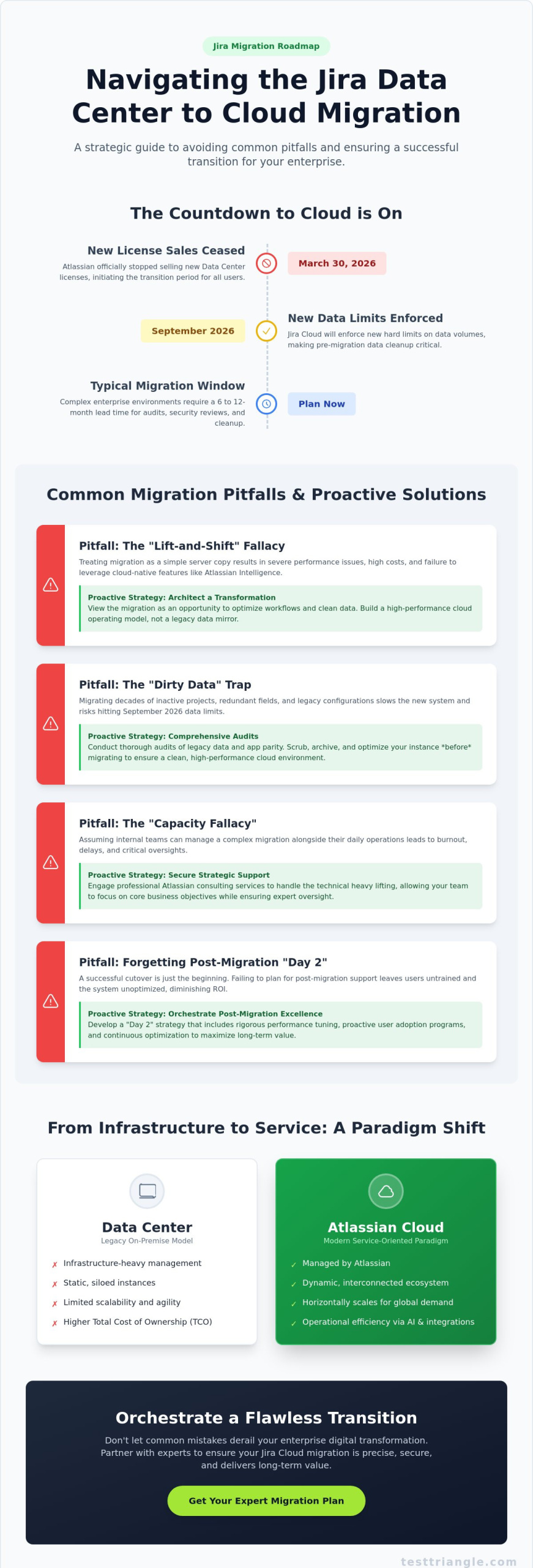
Did you know that as of March 30, 2026, Atlassian has officially ceased the sale of new Data Center licenses, effectively placing a firm countdown on your legacy infrastructure? It’s a reality that many global organizations find daunting, especially when faced with the intricate challenge of moving high-volume instances. You likely recognize that the complexity of migrating third-party apps and the risk of business downtime during cutover are not just technical hurdles; they’re significant threats to your operational continuity. By identifying common jira data center to cloud migration mistakes early, your team can pivot from a reactive posture to a proactive strategy that ensures precision, pace, and performance.

This guide identifies the critical pitfalls that derail enterprise transitions and provides a clear risk-mitigation roadmap for the current regulatory environment. We’ll examine the nuances of Atlassian Cloud features, the impact of the September 2026 data limits, and the strategic business case for professional Atlassian consulting to ensure your long-term success. Whether you’re navigating the requirements of the NIS2 Directive or managing a hybrid-sovereign cloud model, understanding these nuances is essential for a secure and high-performance transition.

Key Takeaways

  • Architect a strategic transition by moving beyond the simple “lift-and-shift” mentality to ensure your cloud environment functions as a high-performance operating model rather than a legacy data mirror.
  • Mitigate technical risks by conducting comprehensive audits of legacy data and app parity, effectively neutralizing common jira data center to cloud migration mistakes before they impact your production environment.
  • Navigate the evolving landscape of global data sovereignty and residency regulations to maintain strict compliance with modern frameworks like the NIS2 Directive and the EU Data Act.
  • Secure organizational stability by addressing the “capacity fallacy,” ensuring that internal teams have the necessary strategic support to manage both daily operations and the technical nuances of Atlassian Cloud.
  • Orchestrate a successful “Day 2” strategy that prioritizes rigorous performance tuning and proactive user adoption to maximize the long-term value of your enterprise digital transformation.

Beyond the Lift-and-Shift: The Strategic Landscape of Jira Cloud Migration in 2026

Transitioning from Jira Data Center to the Cloud is no longer a mere technical upgrade; it’s a fundamental transformation of your organizational operating model. In 2026, the distinction between maintaining a legacy environment and evolving into a cloud-native enterprise is defined by how effectively leadership views the platform as a driver of velocity. Treating this transition as a simple “lift-and-shift” operation is one of the most common jira data center to cloud migration mistakes, often resulting in severe post-migration performance issues. This outdated mentality fails to account for the architectural differences between clustered on-premise servers and the multi-tenant, service-oriented nature of the Atlassian Cloud.

Success in the current landscape requires a shift in focus from the immediate cost of migration to the long-term Total Cost of Ownership (TCO). While the initial project expenses are visible, the true value lies in the operational efficiency gained through Atlassian Intelligence and Rovo integrations. These AI-driven tools, which transform whiteboard sessions into actionable Jira items and automate status updates, require clean, structured data to function. Migrating “dirty data” or redundant workflows prevents these sophisticated systems from delivering the insights they’re designed to provide. Consequently, a strategic approach prioritizes data hygiene and workflow optimization long before the first record is moved.

The Evolution from Data Center to Cloud Architecture

The transition from Data Center to Cloud represents a move from infrastructure-heavy management to a service-oriented paradigm where Atlassian manages the underlying complexities. When understanding the fundamentals of cloud migration, it’s clear that the shift involves a total re-evaluation of how data is processed and stored globally. Atlassian Cloud utilizes a distributed architecture that scales horizontally, ensuring that performance remains consistent regardless of user volume. Cloud-Native Jira is a dynamic ecosystem of interconnected services that scale horizontally to meet global demand, rather than a static, siloed instance. This architecture allows for a level of agility and security that traditional Data Center models simply cannot replicate in a fast-paced market.

Why Planning Delays are Fatal for Enterprise Timelines

A frequent error that compromises enterprise stability is waiting too long to initiate the migration process. With the March 30, 2026 deadline for new Data Center license sales already passed, the countdown to the 2029 end-of-life is accelerating. Complex enterprise environments typically require a 6 to 12-month lead time to navigate app parity audits, security reviews, and data cleanup. Underestimating this timeline is another of the common jira data center to cloud migration mistakes that leads to rushed cutovers and avoidable downtime. Partnering with professional Atlassian Consulting Services provides the strategic oversight needed to manage these nuances, allowing your internal teams to maintain focus on core business objectives while experts handle the technical heavy lifting.

The Technical Pitfalls: Data Integrity, App Parity, and Identity Management

Technical execution often falters when organizations prioritize speed over data hygiene. Migrating decades of legacy configurations, inactive projects, and redundant custom fields creates the “Dirty Data” trap. This clutter doesn’t just slow down the system; it actively compromises the user experience and can trigger the new hard limits on data volumes that Jira Cloud will enforce starting in September 2026. Failing to scrub your instance before deployment is one of the most common jira data center to cloud migration mistakes, leading to a platform that feels bloated and unresponsive from day one.

App parity remains a significant point of friction. Many stakeholders assume that a “Cloud-compatible” version of a Data Center app provides identical functionality, but the reality is often a reduced feature set or a completely different workflow. This functional gap requires a disciplined evaluation of your app ecosystem to ensure business processes remain intact. Without rigorous sandbox testing, these discrepancies only surface post-cutover, causing immediate productivity losses and technical debt. To ensure your technical roadmap is sound, you might consider consulting with a technical strategist before finalizing your cutover plan.

Executing a Comprehensive App and Data Audit

A robust audit framework categorizes every third-party integration into three paths: Retire, Replace, or Reinstall. Retiring obsolete apps reduces licensing costs and security risks, while replacing others with cloud-native alternatives ensures long-term stability. Before utilizing the Jira Cloud Migration Assistant (JCMA), teams must perform meticulous data mapping for complex custom fields. This step ensures that critical metadata survives the transition and aligns with the Cloud’s specific data structures, preventing the loss of historical context during the transfer.

Identity and Access Management (IAM) Strategy

The shift from local LDAP or Active Directory to Atlassian Guard represents a major architectural change. Ignoring User Provisioning (SCIM) during the planning phase often results in fragmented user directories and failed Single Sign-On (SSO) attempts. Validating these permissions is vital; leveraging Software Test Automation Services allows organizations to verify that complex access hierarchies remain secure and functional across the entire enterprise. This automated validation provides the qualitative assurance needed for high-stakes environments.

Relying on a single test migration is a high-risk oversight for enterprise-scale data. Effective migrations utilize multiple sandbox environments to refine the process, identifying edge cases that only appear under heavy load or complex data interdependencies. This iterative methodology transforms a volatile technical transfer into a controlled, predictable evolution that supports long-term operational stability.

Common Jira Data Center to Cloud Migration Mistakes: A Strategic Guide for 2026

Compliance and Security Oversights: Navigating Global Data Sovereignty

A frequent misunderstanding in the migration journey is the assumption that Atlassian’s shared responsibility model provides an all-encompassing shield against local regulatory infractions. While Atlassian maintains robust platform security, the onus of data governance, residency compliance, and configuration integrity remains firmly with the enterprise. Overlooking this distinction is one of the most common jira data center to cloud migration mistakes, potentially exposing organizations to the severe penalties associated with the NIS2 Directive and the EU Data Act. In an era where cumulative GDPR fines reached €7.1 billion by early 2026, assuming “Cloud-native” equals “automatically compliant” is a risk no global leader should take.

Highly regulated sectors face even more granular challenges that require a strategic, practical approach. Pharmaceutical organizations must navigate GxP validation requirements to ensure their Jira Cloud environments remain compliant with electronic record standards. Similarly, financial institutions are often bound by the “Right to Audit” and strict encryption protocols for data at rest and in motion. Failing to account for these sector-specific mandates during the architectural phase leads to costly retrofitting or total project halts during external audits. Precision in planning is the only antidote to such high-stakes regulatory friction.

Data Sovereignty in a Post-GDPR Landscape

Jira Cloud Enterprise offers sophisticated data residency features that allow organizations to pin their data to specific geographic regions. However, selecting the wrong region for a global team can inadvertently trigger jurisdictional conflicts or latency issues. Many enterprises fail to align their data storage locations with the specific requirements of the over 140 countries that now have active data protection laws. To navigate these complexities, engaging with a Managed Service Provider ensures your cloud architecture is strategically aligned with both global performance needs and local legal mandates.

Security Configuration vs. Platform Security

There’s a critical difference between the security of the Atlassian platform and the security of how you configure your specific instance. Bulk migrations often result in the preservation of “over-privileged users,” where permissions that were safe in a siloed Data Center environment become vulnerabilities in the Cloud. This oversight can lead to unauthorized data exposure or non-compliance with internal security policies. A Zero-Trust approach to Cloud Jira access is not merely a preference; it’s a fundamental requirement for modern enterprise stability. By implementing strict identity verification and least-privilege access, organizations can mitigate the risks inherent in large-scale technological evolution while maintaining operational agility.

The Human Element: Why Change Management and Resource Underestimation Fail

Organizations often succumb to the “Capacity Fallacy,” assuming that their internal Jira administrators can maintain business-as-usual operations while simultaneously architecting a complex migration. This resource underestimation is among the most common jira data center to cloud migration mistakes; it leads to burnout, overlooked technical requirements, and eventually, a compromised transition. When internal teams are stretched thin, the meticulous attention required for data mapping and security configuration inevitably wavers, creating systemic vulnerabilities that manifest long after the cutover is complete. True operational stability requires a recognition that migration is a dedicated project, not a side task for an already burdened IT department.

Beyond the technical staffing, the human element of user adoption often becomes a primary point of failure. Ignoring the UI/UX changes between Data Center and Cloud results in immediate productivity loss as users struggle with a redesigned interface and new navigation patterns. This “Migration Anxiety” is exacerbated by a communication void where stakeholders feel uninformed about how their daily workflows will evolve. Training gaps are equally damaging, particularly when power users aren’t educated on Cloud-only features like advanced Automation or Rovo. Without a structured approach to change management, even the most technically perfect migration can be perceived as a failure by the workforce it was intended to empower.

Bridging the Internal Expertise Gap

Augmenting your core team with specialized IT Staffing Services provides the necessary bandwidth to manage complex migrations without disrupting daily output. An experienced Atlassian Solution Architect plays a pivotal role in this process, ensuring that the new Cloud environment is built to avoid architectural debt and long-term performance bottlenecks. When evaluating the investment, leaders must compare the cost of external consulting against the catastrophic financial impact of a failed 48-hour cutover. Precision in staffing is a prerequisite for a seamless, low-risk transition that protects your enterprise’s operational integrity.

A Strategic Communication and Training Roadmap

Mitigating common jira data center to cloud migration mistakes requires a structured, 4-phase communication plan: Announcement, Education, Preparation, and Support. Identifying “Champion” users within each department allows for peer-to-peer leadership, which often proves more effective than top-down directives. These advocates help bridge the gap between technical changes and practical application. Furthermore, a human-centric approach to quality is essential; referring to a Manual Testing Guide can help your team understand how to validate the user experience through the eyes of the end-user rather than just through automated scripts. This comprehensive preparation ensures that when the system goes live, your workforce is ready to leverage the new platform’s full potential.

To ensure your internal teams are supported by the right expertise during this critical evolution, speak with an enterprise migration strategist to secure your resource roadmap.

Orchestrating a Flawless Transition: A Framework for Post-Migration Excellence

The successful execution of a technical cutover isn’t the finish line; it’s the commencement of your platform’s most vulnerable phase. One of the most common jira data center to cloud migration mistakes is the “Day 2” oversight, where organizations prematurely disband their project teams once the data appears to be live. This strategic withdrawal often leads to unresolved latency issues, broken integration hooks, and a frustrated user base that lacks immediate support. Realizing the full value of your investment requires a shift from a “Migrated” status to an “Optimized” state, ensuring the system meets the rigorous speed and reliability standards expected in 2026.

True post-migration excellence is defined by how effectively you leverage the cloud-native features that weren’t available in your legacy environment. In the current landscape, this means integrating Atlassian Intelligence and Rovo to drive automated status updates and intelligent search capabilities across your entire digital ecosystem. Without proactive performance tuning and the removal of technical debt that survived the move, these sophisticated tools won’t reach their full potential. A disciplined approach to refinement ensures that your transition results in a high-performance, future-ready infrastructure rather than a mere mirror of your old on-premise limitations.

Post-Migration Hypercare and Optimization

A structured “Hypercare” period, typically spanning the first 30 days post-migration, is essential for maintaining operational cadence. During this window, dedicated support resources must be available to address edge cases that only emerge under the pressure of full-scale production. Conducting a post-migration audit is vital to identify “Ghost Data” or broken links that can occur when complex project interdependencies are moved between architectures. For organizations looking to transform this initial stability into a long-term competitive advantage, engaging with DevOps Consulting Services provides a roadmap for continuous platform evolution and systemic improvement.

Establishing a Cloud Governance Framework

Failing to update governance policies for the cloud environment often leads to “admin sprawl,” where a lack of centralized control results in redundant configurations and security vulnerabilities. Strategic management of Atlassian Marketplace app subscriptions is equally critical; organizations must monitor renewals and usage patterns to prevent licensing costs from escalating unchecked. By establishing a robust governance framework, you ensure that your Jira Cloud instance remains secure, scalable, and cost-effective. To navigate these complexities with confidence and secure your organizational progress, Partner with Test Triangle for a Risk-Free Atlassian Migration and experience the peace of mind that comes from expert-led digital transformation.

Strategizing Your Evolution to Atlassian Cloud

Successfully navigating the transition to Atlassian Cloud requires a fundamental shift in perspective, moving from a narrow focus on technical file transfers to a comprehensive strategy for organizational evolution. By proactively addressing common jira data center to cloud migration mistakes, your enterprise can effectively bypass the technical debt and compliance risks that frequently stall global digital transformations. This journey demands a disciplined approach to data hygiene, a robust governance framework, and a dedicated focus on user adoption that empowers your workforce to leverage the full potential of Atlassian Intelligence. You don’t have to manage this intricate process in isolation; the right partnership transforms a volatile project into a predictable success story.

As an Atlassian Gold Solution Partner, we provide the specialized expertise in Pharma and Finance compliance required to ensure your transition meets the most rigorous global regulatory standards. Our global delivery model offers the strategic oversight and technical precision necessary to maintain operational stability during high-stakes cutovers. Secure Your Seamless Atlassian Cloud Migration with Test Triangle and begin your journey toward a high-performance, future-ready infrastructure. Your path to a secure and scalable cloud environment starts here.

Frequently Asked Questions

What is the most common mistake in Jira Data Center to Cloud migrations?

Underestimating the architectural shift by treating the project as a simple “lift-and-shift” is the most frequent error global organizations make. This reactive approach leads to common jira data center to cloud migration mistakes such as severe performance bottlenecks and broken automation hooks. Successful transitions require a strategic overhaul of data hygiene and app parity long before the final production cutover begins.

How long does a typical enterprise Jira Cloud migration take in 2026?

Enterprise-scale migrations typically require a lead time of 6 to 12 months to navigate the complexities of global data residency and rigorous security audits. This timeline allows for meticulous planning, data scrubbing, and multiple sandbox testing phases to identify edge cases. Rushing this window often compromises the integrity of the final environment and leads to avoidable business downtime.

Can we migrate all our Jira Data Center apps to the Cloud?

Not every Data Center app has a direct Cloud equivalent with identical functionality; some require complete replacement or retirement. You must categorize your app ecosystem into those to retire, replace, or reinstall based on their specific Cloud-native capabilities. A disciplined audit prevents functional gaps that disrupt critical business processes after the transition is complete.

Is Jira Cloud as secure as Jira Data Center for regulated industries?

Jira Cloud provides robust security through Atlassian Guard, but organizations must actively manage their specific configurations to meet local regulatory mandates. This shared responsibility model ensures that while the platform is secure, the client remains accountable for data governance and user access hierarchies. Proper alignment with frameworks like the NIS2 Directive is essential for maintaining compliance in regulated sectors.

What happens if our Jira migration fails during the cutover weekend?

A failed cutover requires the immediate execution of a pre-verified rollback plan to restore services on the original Data Center instance. To avoid this scenario, teams should conduct exhaustive performance testing and sandbox rehearsals to identify technical friction points before the live migration. Minimizing downtime depends on a disciplined methodology and the foresight to have experts on standby.

How do we handle user training for the new Jira Cloud interface?

User training should follow a structured roadmap that includes early announcements and the identification of department-level “champion” advocates. These champions help bridge the gap between technical UI changes and practical daily application for their peers through peer-to-peer support. Focusing on the human element ensures that the workforce remains productive and engaged during the technological evolution.

Do we need an external Atlassian consultant for the migration?

Engaging an external Atlassian consultant is a strategic decision that provides the specialized expertise needed to avoid common jira data center to cloud migration mistakes. Professional consultants bring a global delivery model and deep technical knowledge that internal teams, often occupied with daily operations, may lack. This partnership significantly reduces project risk and ensures long-term operational stability.

What is the difference between Jira Cloud and Jira Data Center features in 2026?

By 2026, the primary differentiator is the integration of Atlassian Intelligence and Rovo, which are features exclusive to the Cloud platform. These tools offer automated status updates and intelligent search capabilities that traditional Data Center environments cannot support. The Cloud architecture also scales horizontally, providing superior performance and agility for global teams compared to siloed server clusters.

Paul Guy

Article by

Paul Guy

Paul serves as the Marketing Director at Test Triangle, where he leads a global team in driving growth through strategic B2B marketing and brand communications. With a strong emphasis on measurable outcomes and sustainable performance, he plays a pivotal role in aligning marketing functions to enhance customer engagement and accelerate business impact. Under his leadership, marketing initiatives have consistently delivered significant returns on investment, elevated brand visibility, and strengthened the company's presence across key markets.