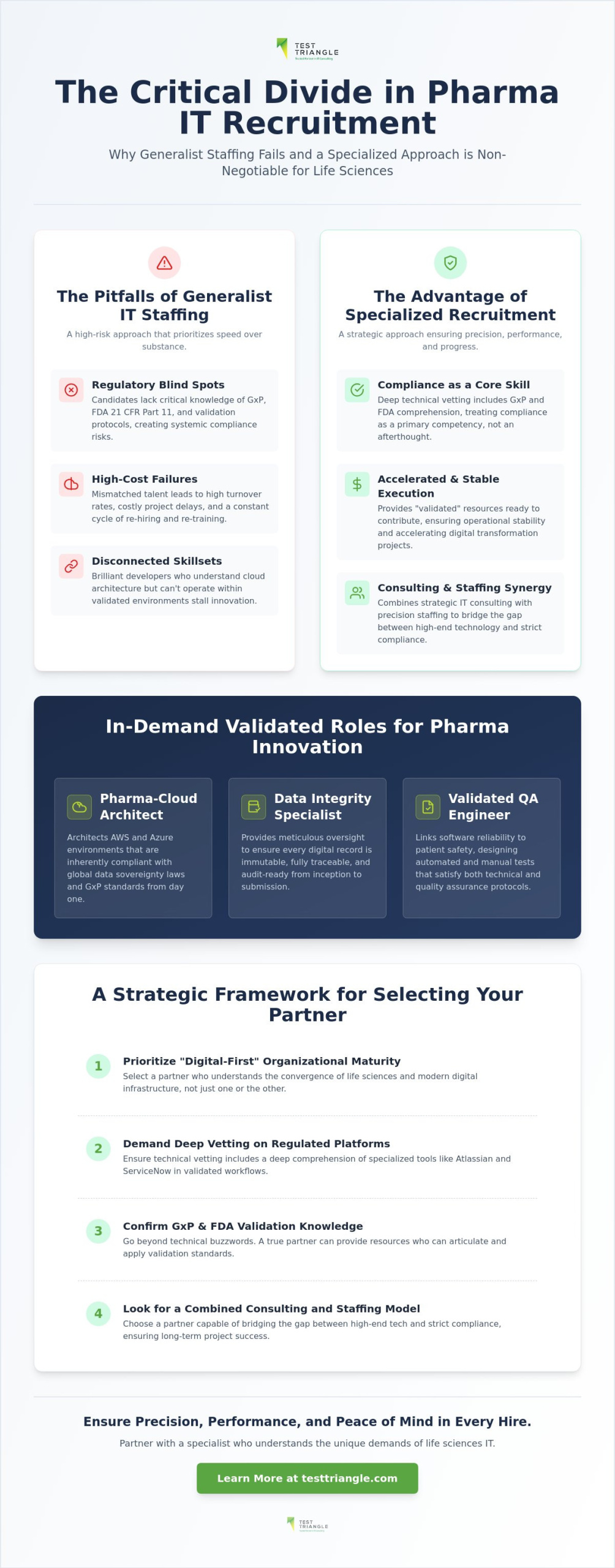
Could the greatest threat to your digital transformation be a recruiter who treats a pharmaceutical environment like a standard tech startup? In the high-stakes world of life sciences, the standard approach to Technology & Pharmaceutical Recruitment often falls short because it ignores the non-negotiable reality of regulatory compliance. You’ve likely felt the frustration of interviewing brilliant developers who lack any concept of GxP or FDA validation requirements. It’s a common pain point; general IT staffing firms often prioritize speed over the specific technical rigor required for life sciences, leading to high turnover and project delays.

We understand that finding talent for complex cloud migrations or DevOps integration in a regulated space is a delicate balancing act. You need professionals who treat compliance as a core feature rather than an afterthought. This article demonstrates how a strategic approach to talent acquisition can reduce your time-to-hire for niche roles and ensure your team is ready for the demands of digital transformation. We’ll examine the specific methodologies used to identify “validated” tech talent who can maintain operational stability while driving innovation through human expertise and technical precision.

Key Takeaways

  • Learn how the convergence of life sciences and digital infrastructure is reshaping Technology & Pharmaceutical Recruitment to prioritize “digital-first” organizational maturity.
  • Identify the critical technical competencies required for modern pharmaceutical innovation, including the specialized use of Atlassian and ServiceNow platforms in regulated workflows.
  • Understand the high-risk pitfalls of generalist IT staffing and why technical vetting must include a deep comprehension of GxP and FDA validation standards.
  • Master a strategic framework for selecting recruitment partners who can provide “validated” resources capable of bridging the gap between high-end tech and strict compliance.
  • Discover how a combined consulting and staffing approach ensures operational stability and accelerates the execution of large-scale digital transformation projects.

The Convergence of Technology & Pharmaceutical Recruitment in 2026

Technology & Pharmaceutical Recruitment represents the sophisticated intersection where life sciences meet high-velocity digital infrastructure. By 2026, the traditional boundaries between laboratory research and information technology have effectively dissolved. Within the pharmaceutical industry, the focus has shifted from manual, lab-centric processes to cloud-native environments that rely on real-time data processing and automated workflows. This evolution demands a recruitment strategy that prioritizes candidates who possess both technical fluency and a deep understanding of the regulatory frameworks that govern drug development. It’s a matter of ensuring precision, performance, and peace of mind in every hire.

Generalist recruitment agencies often struggle in this specialized landscape because they fail to grasp the nuances of GxP and FDA 21 CFR Part 11. Hiring a developer who understands cloud architecture but lacks knowledge of electronic record-keeping compliance can lead to systemic failures. In a regulated environment, code isn’t just functional; it must be “validated.” This requirement necessitates a partner who offers specialized IT Staffing Services tailored to the specific rigors of the life sciences sector. Without this niche expertise, organizations risk significant operational delays and regulatory scrutiny.

Digital Assurance: The New Standard for Life Sciences

Software testing is no longer a peripheral activity; it’s a central pillar of patient safety. As AI and machine learning become integrated into R&D pipelines, the need for Software and Digital Assurance Testing has reached an all-time high. Validated talent is the most critical asset for 2026. These are professionals who can design automated testing frameworks that satisfy both technical performance benchmarks and stringent quality assurance protocols. When Technology & Pharmaceutical Recruitment is executed with this level of technical depth, it ensures that innovation doesn’t outpace safety.

The Regulatory Reality of Modern Tech Hiring

The technical requirements of GxP in IT staffing are absolute. A single oversight in how a system manages data integrity can stall a drug launch, costing organizations millions in lost revenue and potential legal penalties. Bridging the gap between agile development and rigid regulatory frameworks is the primary challenge for modern leadership. Successful recruitment involves identifying tech leads who can maintain the speed of a DevOps environment while ensuring every change is documented and compliant. It’s about finding the steady hand that understands how to innovate within the lines, ensuring progress never comes at the expense of precision.

Specialized Roles Driving Pharmaceutical Innovation

The landscape of Technology & Pharmaceutical Recruitment is undergoing a profound transformation as organizations seek out hybrid experts who can navigate the tension between rapid innovation and absolute regulatory adherence. In 2026, the most sought-after profile is the “Pharma-Cloud” Architect. These professionals possess the unique ability to architect AWS and Azure environments that are inherently compliant with global data sovereignty laws and GxP standards. They don’t simply move data to the cloud; they build resilient, secure infrastructures that serve as the foundation for the next generation of digital therapeutics and drug discovery platforms. Alongside them, data integrity specialists have become the essential backbone of clinical trials, providing the meticulous oversight needed to ensure that every digital record is immutable and fully traceable from inception to final submission.

Software Testing and QA in a Regulated Environment

Within a sector where software reliability is inextricably linked to patient safety, quality assurance has evolved into a high-stakes discipline. While the industry leans heavily toward efficiency, Manual Testing continues to be a vital requirement for the nuanced validation of pharmaceutical software where automated scripts might miss subtle regulatory non-compliance in user interfaces. For organizations developing digital health applications, integrating software test automation services is the most effective way to accelerate time-to-market while maintaining the rigorous documentation standards required by auditors. Finding talent that understands the complexities of System Integration Testing (SIT) for healthcare APIs is equally critical, as these professionals ensure that data flows securely and accurately across the entire healthcare ecosystem.

DevOps and Platform Engineering for Life Sciences

Accelerating software delivery in a pharmaceutical context requires a specialized methodology that prioritizes stability alongside speed. Engaging in professional DevOps Consulting allows organizations to build CI/CD pipelines where “Compliance-as-Code” is the default setting, ensuring that every deployment is automatically vetted against regulatory requirements. Recruitment for specialized Atlassian implementation and ServiceNow consulting roles has become a strategic priority, as these platforms provide the structured environment necessary for managing complex pharmaceutical workflows and change control. These tools act as the operational nervous system, connecting technical execution with business outcomes and regulatory oversight. If you’re looking to bridge the talent gap in your digital infrastructure, it’s beneficial to discuss your specific technical requirements with a partner who understands the nuances of Technology & Pharmaceutical Recruitment.

Why Generalist IT Staffing Fails the Pharmaceutical Industry

Generalist recruitment platforms often prioritize volume over validity, a strategy that inevitably collapses within the pharmaceutical sector. While a top-tier developer from a standard tech hub might possess exceptional coding skills, their lack of exposure to GxP environments creates a significant “Compliance Gap.” In this industry, technical execution cannot be decoupled from regulatory adherence. Technology & Pharmaceutical Recruitment requires a partner who understands that a single oversight in data handling can compromise years of research and development. Precision is not optional.

The hidden costs of poor technical vetting are immense. Beyond the immediate expense of turnover, a candidate who ignores audit trail requirements or fails to document system changes properly can trigger severe regulatory friction during an inspection. This is the difference between basic IT staffing and strategic talent orchestration. We focus on placing professionals who act as a steady hand, ensuring that digital transformation projects remain compliant, stable, and scalable. Our methodology prioritizes the peace of mind that comes from knowing every technical contributor understands the gravity of pharmaceutical safety and the necessity of rigorous documentation.

The Nuance of Pharmaceutical Data Integrity

Data integrity is the non-negotiable foundation of the life sciences. Recruits must be intimately familiar with ALCOA+ principles: Attributable, Legible, Contemporaneous, Original, and Accurate. A developer who treats an audit trail as a secondary feature rather than a core requirement poses a fundamental risk to clinical trial validity. Compliance is the priority. Specialized agencies vet for “Validation Awareness,” ensuring that every technical lead recognizes their role in maintaining the chain of custody for critical health data. This rigorous screening process eliminates candidates who lack the discipline required for high-stakes pharmaceutical environments.

Managing Flexible Staffing Models in Pharma

High-velocity clinical projects often require a rapid influx of specialized talent. Utilizing professional IT Staffing Services allows organizations to scale their teams with precision, partnership, and progress. This model is particularly effective for managing the security risks associated with remote or offshore resources. By implementing a standardized vetting process that accounts for global compliance standards, organizations can leverage distributed tech teams without compromising on security or data sovereignty. This strategic approach ensures that Technology & Pharmaceutical Recruitment serves as a catalyst for growth rather than a source of risk. It’s about building a reliable, long-term collaboration that supports your operational stability and long-term success.

A Strategic Framework for Selecting Recruitment Partners

Selecting a partner for Technology & Pharmaceutical Recruitment requires a significant departure from traditional procurement metrics. It’s a strategic decision that directly impacts the integrity of your digital infrastructure and the success of your regulatory submissions. A high-level partner must demonstrate a sophisticated blend of IT Service Management (ITSM) expertise and a granular understanding of the life sciences sector. This ensures that every technical resource is not just capable of executing a task, but is also “validated” to operate within GxP and FDA-regulated environments. Reliability is the cornerstone of this selection process.

A robust framework for evaluation should prioritize the following criteria to ensure organizational progress and risk reduction:

  • Ecosystem Alignment: Look for strategic partnerships with platform leaders like Atlassian, ServiceNow, and AWS, as these relationships signal a deep alignment with the tools driving modern pharmaceutical workflows.
  • Operational Flexibility: The ability to pivot between permanent placements, contract staffing, and comprehensive managed services allows for scalable growth and adaptable service delivery.
  • Technical Depth: A partner must possess deep-rooted expertise in software and digital assurance testing to guarantee that all technical implementations meet the highest standards of quality and security.

Vetting for Technical Rigor

When you evaluate potential collaborators, it’s essential to ask specific questions about their internal technical screening. Does the agency employ in-house technical experts who conduct rigorous interviews before a candidate ever reaches your desk? You should prioritize agencies that also provide technology consulting. This dual perspective ensures they understand the practical, day-to-day challenges of your digital transformation projects. This internal vetting process reduces the burden on your leadership and guarantees that only the most qualified, compliance-aware talent is presented. It’s about finding a steady hand in a fast-changing landscape.

Evaluating Long-Term Strategic Value

The transition from simple placement fees to genuine partnership value is a hallmark of institutional maturity. Selecting a partner who offers Managed Outsourcing Services provides long-term project stability and ensures that technical knowledge remains within your organization even as individual roles evolve. This strategic approach supports your overarching digital transformation roadmap, turning recruitment into a functional asset for sustainable innovation. If you require a partner who values precision and partnership, contact our strategic recruitment team to discuss your specific talent requirements for 2026 and beyond.
Technology & Pharmaceutical Recruitment: Expert Strategies

Test Triangle: Precision, Partnership, and Progress in Pharma IT

Test Triangle occupies a unique position in the industry by bridging the gap between high-end technology consulting and specialized recruitment. Our methodology is built on the premise that effective Technology & Pharmaceutical Recruitment requires more than just a database of resumes; it demands a deep, functional understanding of the software ecosystems that power modern life sciences. Because we are practitioners in DevOps and digital assurance, our staffing solutions are backed by the same technical rigor we apply to our consulting engagements. This ensures that every professional we place is capable of maintaining operational stability while driving systemic improvement across your digital infrastructure.

Our Atlassian Consulting Services provide a distinct advantage for pharmaceutical organizations looking to harmonize their development and compliance workflows. By integrating these industry-leading platforms directly into our service descriptions, we signal a voice that is closely aligned with the specific tools your teams use every day. Global pharmaceutical leaders trust us with their most sensitive digital projects because we operate as a steady hand, providing the human expertise and technical tools necessary for scalable growth in a highly regulated landscape. We position ourselves as a reliable collaborator deeply invested in your long-term success.

The ‘Validated Staffing’ Advantage

Sourcing and vetting technical talent for a GxP-regulated environment requires a disciplined approach that generalist agencies cannot replicate. We integrate ServiceNow Consulting into our talent search to identify candidates who are proficient in managing complex service architectures and automated compliance checks. Our internal technical experts conduct exhaustive screenings to ensure that every candidate possesses a high standard of quality and security awareness. We deliver talent that is technically elite and regulatorily ready. This process reduces risk and provides the peace of mind that comes from a reliable long-term collaboration.

Your Partner in Digital Transformation

Our commitment to your success extends beyond the initial placement to support your entire IT lifecycle. By leveraging our IT Service Management solutions, pharmaceutical enterprises can achieve a sense of order and comprehensive coverage across their global operations. We don’t just provide resources; we empower your organization to evolve through the successful execution of cloud migrations and digital transformation initiatives. As a strategic visionary with a practical focus, we remain deeply invested in your operational stability and long-term success. It’s time to secure your pharmaceutical tech future with Test Triangle and experience the benefits of precision, partnership, and progress.

Securing Your Competitive Advantage in a Regulated Landscape

The evolution toward a digital-first pharmaceutical industry requires a fundamental shift in how global organizations approach talent acquisition. Success in 2026 depends on bridging the gap between high-velocity technical execution and the rigid requirements of GxP compliance. By prioritizing “validated” talent and moving away from the inherent risks of generalist staffing, your organization can ensure long-term operational stability and the successful execution of complex digital transformation projects. It’s about aligning human expertise with the technical tools that drive progress.

As an Atlassian Gold Solution Partner and ServiceNow Strategic Partner with over 14 years of specialized IT and Pharma staffing expertise, we provide the steady hand necessary to navigate this complex environment. We understand that specialized talent acquisition is not merely about filling roles; it’s about building the resilient human infrastructure required for life-saving innovation. We invite you to Partner with the specialists in Technology & Pharmaceutical Recruitment to reduce your time-to-hire and ensure your technical teams are regulatorily ready. We look forward to supporting your journey toward technical precision and sustainable growth.

Frequently Asked Questions

What is the difference between general IT recruitment and pharmaceutical tech recruitment?

Pharmaceutical tech recruitment focuses on “validated” talent who understand regulatory frameworks like GxP, whereas general IT recruitment prioritizes speed and general coding proficiency. In the life sciences sector, technical execution must be paired with an understanding of data integrity and audit trails. Technology & Pharmaceutical Recruitment requires a partner who can bridge the gap between high-velocity tech and stringent compliance, ensuring every hire contributes to operational stability and regulatory success.

Why is GxP compliance important for IT staff in the pharmaceutical industry?

GxP compliance is essential because it ensures that software systems used in drug development produce reliable, accurate, and traceable data. For IT staff, this means following strict documentation protocols and maintaining clear audit trails for every system change. Non-compliance can lead to failed audits, drug launch delays, and significant legal penalties, making “compliance-aware” talent a critical asset for risk reduction and peace of mind.

Can you provide temporary contract staff for short-term clinical trial projects?

Yes, we provide highly specialized temporary contract staff tailored to the specific needs of clinical trial projects. Our flexible delivery model allows pharmaceutical organizations to scale technical teams rapidly with professionals who already understand the regulatory rigors of the life sciences sector. This approach ensures project continuity and technical precision without the long-term overhead of permanent hires, supporting your organization’s adaptable service delivery and progress.

How do you vet candidates for their understanding of FDA 21 CFR Part 11?

We vet candidates using a multi-layered technical screening process that includes specific scenarios related to electronic records and signatures. Our in-house technical experts evaluate a candidate’s ability to implement immutable audit trails and secure data access controls. This ensures every recruit understands the functional requirements of FDA 21 CFR Part 11, moving beyond surface-level knowledge to practical, compliant technical execution that protects your research integrity.

What are the benefits of using a specialized agency for Atlassian and ServiceNow roles in pharma?

Specialized agencies ensure that Atlassian and ServiceNow platforms are implemented within a compliant framework that supports pharmaceutical workflows. General recruiters often overlook the validation requirements of these tools, but a specialized partner ensures your ITSM and DevOps pipelines are regulatorily ready. This alignment between technical tools and business outcomes provides the peace of mind that your digital infrastructure is managed with institutional maturity and precision.

How does software testing expertise improve the quality of tech recruits?

Software testing expertise allows us to evaluate candidates from a quality assurance perspective, ensuring they treat compliance as a core feature rather than an afterthought. Because we provide technology consulting and testing services, we can identify candidates who possess the technical rigor to design automated, validated testing frameworks. This methodology results in elite talent who can maintain the speed of development while ensuring absolute software reliability and safety.

Do you offer remote or offshore staffing solutions for pharmaceutical companies?

We offer adaptable remote and offshore staffing solutions that prioritize global compliance and data sovereignty. By implementing a standardized vetting process, we ensure distributed tech teams operate within the same GxP and security standards as on-site resources. This allows pharmaceutical companies to leverage a global talent pool while maintaining the stability and security necessary for sensitive projects through strategic Technology & Pharmaceutical Recruitment.

How do recruitment fees work for permanent vs. contract placements in the tech-pharma sector?

Recruitment fees are structured differently based on the level of engagement and the specific talent acquisition model required. Permanent placements typically involve a one-time fee based on the candidate’s compensation package, while contract placements are managed through a standard hourly or daily rate. We focus on providing partnership value rather than just placement fees, ensuring our models support a reliable long-term collaboration and operational stability.

Paul Guy

Article by

Paul Guy

Paul serves as the Marketing Director at Test Triangle, where he leads a global team in driving growth through strategic B2B marketing and brand communications. With a strong emphasis on measurable outcomes and sustainable performance, he plays a pivotal role in aligning marketing functions to enhance customer engagement and accelerate business impact. Under his leadership, marketing initiatives have consistently delivered significant returns on investment, elevated brand visibility, and strengthened the company's presence across key markets.

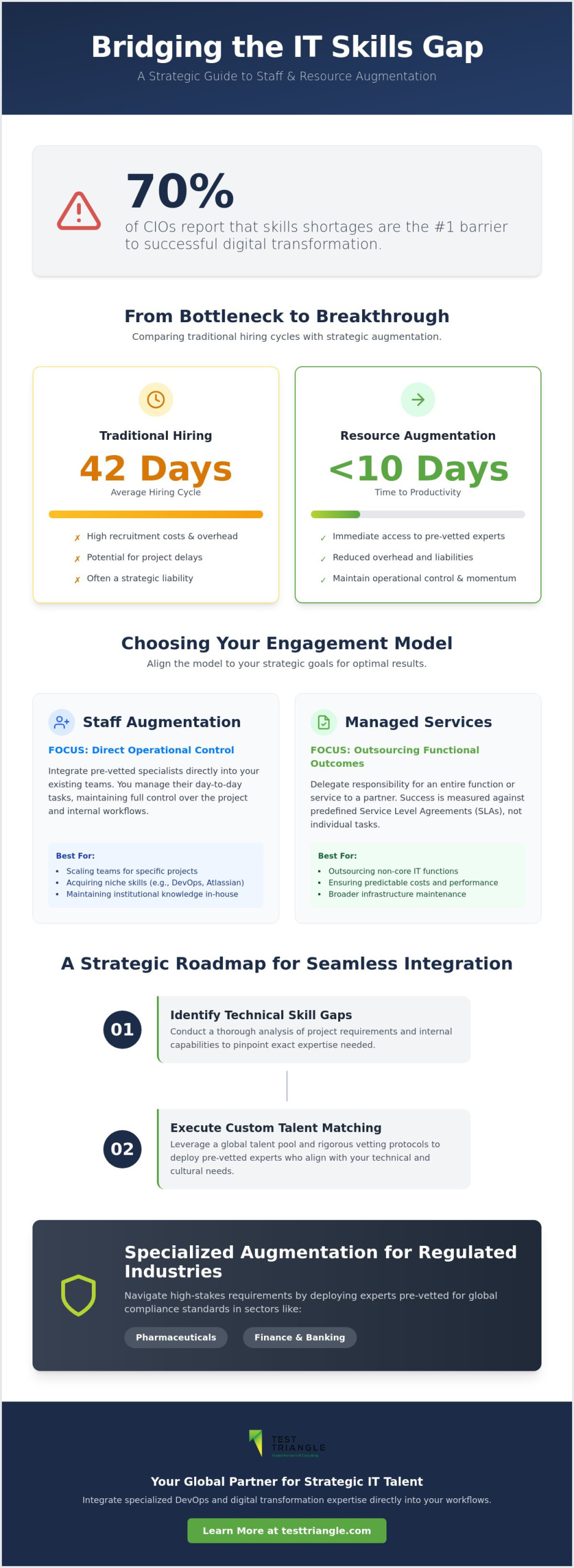

Over 70% of CIOs globally report that skills shortages are the primary barrier to digital transformation, proving that traditional hiring is often a strategic liability. You’ve likely felt the pressure of searching for niche DevOps or Atlassian engineers while project deadlines loom and recruitment costs climb. By implementing sophisticated Staffing and Resource Augmentation Solutions, your organization can bypass the typical 42-day hiring cycle and achieve a time-to-productivity of under 10 days. This article demonstrates how to bridge critical IT skill gaps, ensure regulatory compliance, and scale your digital infrastructure through models that prioritize stability, precision, and growth.

In 2026, successful resource augmentation is defined by ecosystem integration, which matches talent to specific platform architectures and complex regulatory frameworks. You’ll discover how to deploy pre-vetted experts who integrate seamlessly with your internal culture while reducing the overhead associated with permanent hiring. We’ll preview a strategic framework that combines human expertise with technical tools to ensure your enterprise remains a steady hand in a fast-changing technological landscape.

Key Takeaways

  • Understand why modern enterprise speed requires a transition from traditional hiring to sophisticated Staffing and Resource Augmentation Solutions that prioritize ecosystem alignment over simple headcounts.
  • Discern the critical differences between maintaining direct operational control via staff augmentation and outsourcing functional outcomes through managed services to optimize project delivery.
  • Learn how to navigate the high-stakes requirements of regulated sectors like pharmaceuticals and finance by deploying experts who are pre-vetted for global compliance standards.
  • Implement a structured, two-phase roadmap designed to identify technical skill gaps and execute custom talent matching through rigorous global vetting protocols.
  • Discover the long-term benefits of a strategic partnership approach that integrates specialized DevOps and digital transformation expertise directly into your existing internal workflows.

The global talent deficit has reached a critical inflection point where the standard 42-day hiring cycle acts as a bottleneck for enterprise agility. In a year defined by rapid technological shifts, relying solely on permanent recruitment often leads to missed market opportunities and stagnant digital growth. Modern Staffing and Resource Augmentation Solutions provide a sophisticated alternative, allowing organizations to inject high-level expertise into their existing teams without the long-term liabilities of traditional headcount expansion. This approach effectively resolves the quality versus speed paradox by providing immediate access to pre-vetted specialists who understand the nuances of complex platform architectures. By reducing the time-to-productivity to under 10 days, enterprises can maintain momentum even when internal resources are at capacity.

To understand this shift, we must look at how the industry views What is Staff Augmentation? beyond the legacy definition of temporary labor. It’s now a strategic pillar for maintaining operational stability during intensive digital transformation phases. By integrating external talent directly into internal workflows, companies ensure that institutional knowledge remains within the firm while technical execution accelerates. This creates a resilient operational framework that isn’t disrupted by the volatility of the niche labor market.

The Evolution of Augmentation: Beyond Temporary Support

Identifying the Need for External Technical Expertise

Specific triggers often signal the necessity for professional Staffing and Resource Augmentation Solutions. These include high-stakes product launches, large-scale cloud migrations, or sudden seasonal spikes in demand that threaten to overwhelm core personnel. The hidden costs of making do with overstretched internal teams often manifest as burnout, technical debt, and security vulnerabilities. Resource augmentation serves as a strategic mechanism for scalable growth that empowers organizations to expand capacity while maintaining rigorous standards of precision and security.

Evaluating Engagement Models: Staff Augmentation vs. Managed Services

Selecting the right engagement model is a strategic decision that directly influences project velocity, operational risk, and long-term cost efficiency. While Staffing and Resource Augmentation Solutions offer the agility to scale teams rapidly, managed services provide a framework for outsourcing entire functional responsibilities. The choice depends on whether your organization requires direct control over daily tasks or prefers to hold a partner accountable for specific service level agreements (SLAs). By aligning talent selection with comprehensive IT Service Management solutions, leaders can ensure that every external expert contributes to a unified operational standard, maintaining the stability, precision, and growth required for enterprise success.

Modern delivery often involves a hybrid approach where augmented staff handle specialized ecosystem tasks, such as Atlassian configurations or ServiceNow workflows, while managed service agreements cover broader infrastructure maintenance. This trend is particularly evident in Specialized Augmentation in the Public Sector, where agencies utilize targeted expertise to modernize legacy systems without fully relinquishing management oversight. This blended strategy allows for a steady hand during complex migrations, ensuring that technical execution remains closely coupled with business objectives.

When to Choose Staff Augmentation

Staff augmentation is ideal for scenarios where you have existing management capacity but lack specific technical competencies. This model places embedded professionals under your direct supervision, allowing for immediate course corrections as project requirements evolve. It’s especially cost-effective for short-term milestones, as margin-based billing for contract staff eliminates the overhead of permanent hiring. You’ll find this flexibility invaluable during seasonal spikes or when launching new digital products that require niche DevOps or automation testing skills. Consult with our team to determine the optimal engagement model for your next infrastructure upgrade.

When Managed Services Provide Superior Value

For functions that aren’t core to your business differentiation, shifting risk and accountability to a strategic partner is often the more mature choice. Evaluating Managed Outsourcing Services allows your internal leadership to focus on high-level strategy while we handle ongoing platform maintenance and performance monitoring. This model offers long-term cost predictability through subscription-based structures, ensuring that operational expenses remain stable regardless of labor market volatility. It transforms IT from a series of reactive staffing needs into a reliable, outcome-based utility that empowers your organization to scale with confidence.

Specialised Augmentation for Regulated Industries: Pharma and Finance

Operating within highly regulated sectors requires a level of technical precision that goes beyond standard engineering capabilities. In these environments, Staffing and Resource Augmentation Solutions must account for stringent global compliance standards such as GDPR and HIPAA. Failure to integrate experts who understand these frameworks can lead to catastrophic regulatory penalties or data breaches. By securing pre-vetted talent, enterprises ensure that every line of code and every infrastructure change remains within the boundaries of industry-specific mandates. This disciplined approach provides the peace of mind that comes from knowing your digital evolution is managed by experts who value precision and scalable growth.

Pharma IT Staffing: Validation and Compliance

The pharmaceutical and healthcare sectors face a unique challenge: bridging the gap between rapid IT innovation and rigid life sciences regulatory requirements. Maintaining GxP compliance is non-negotiable, particularly when dealing with patient data or clinical trial results. This is why many leaders consult an IT staffing agencies for pharmaceutical industry guide to find specialists who understand GAMP5 and validation protocols. Pharma IT staffing requires a deep understanding of the validation lifecycle; augmented professionals must be capable of navigating the complexities of Computer System Validation (CSV) while accelerating digital transformation initiatives. Our approach ensures that augmented staff are already familiar with Software and Digital Assurance Testing, which is critical for maintaining the integrity of laboratory information management systems (LIMS) and ensuring that all digital tools meet the high standards of security expected in the life sciences.

Financial Services: Security and Scalability

Financial services demand a different kind of rigor, focusing on high-load application development and uncompromising performance testing. As banking institutions navigate legacy system modernization, they need teams that can scale infrastructure while embedding security testing into every stage of the lifecycle. Modern Staffing and Resource Augmentation Solutions in the banking sector aren’t just about adding capacity; they’re about ensuring the stability and security of global transactions. Augmented engineers play a vital role in stress-testing high-frequency trading platforms and ensuring that security protocols are resilient against evolving threats. This focus on qualitative descriptors and high standards ensures that both technical managers and executive leadership feel confident in their operational stability. By integrating specialized talent into existing workflows, financial institutions can modernize their core systems without the disruption often associated with large-scale technological shifts.

A Strategic Roadmap for Seamless Resource Integration

Establishing a resilient operational framework requires more than just identifying talent; it necessitates a structured methodology that bridges the gap between organizational need and technical execution. Professional Staffing and Resource Augmentation Solutions succeed when they follow a rigorous roadmap designed to eliminate integration friction and maximize project ROI. This process begins with a comprehensive assessment of current business needs and technical skill gaps, ensuring that the augmentation strategy aligns perfectly with overarching digital transformation goals. Once the requirements are defined, the focus shifts to custom talent matching, where global networks and intensive pre-vetting protocols are leveraged to find specialists who possess the exact technical and cultural fit required for your specific environment.

Vetting for Ecosystem Alignment

Expertise in industry-leading platforms like Atlassian and ServiceNow is a non-negotiable requirement for modern IT teams seeking to maintain high standards of quality and security. When evaluating candidates for Atlassian Implementation or ServiceNow Consulting, the vetting process must extend beyond basic certification to include practical, architectural experience within complex enterprise environments. Day Zero readiness ensures that augmented professionals contribute to project velocity immediately upon arrival. This level of ecosystem alignment reduces the learning curve and prevents the technical debt often caused by poor integration during critical migration phases.

Governance and Knowledge Transfer

Sustainable growth depends on ensuring that the specialized expertise brought in by augmented staff remains within the organization long after the engagement concludes. Effective governance involves establishing clear communication cadences and documentation standards that facilitate continuous knowledge transfer between external experts and internal teams. This disciplined approach to governance doesn’t just protect your institutional knowledge; it reinforces your long-term operational stability. By standardizing quality benchmarks, enterprises can ensure that every contributor operates under a single, unified methodology. To build your own custom integration plan, contact our strategic talent advisors today.

Efficient Staffing and Resource Augmentation Solutions

Test Triangle: Your Global Partner for Strategic IT Talent

Test Triangle operates as a steady hand for global enterprises, providing the technical rigor and organizational maturity required to navigate complex digital environments. With over a decade of specialized expertise in software testing, DevOps, and digital transformation, we have refined our approach to Staffing and Resource Augmentation Solutions to prioritize long-term stability over short-term fixes. Our presence across Europe, North America, and Asia ensures that we deliver global reach with local precision, allowing us to align with your specific regional compliance and operational needs. As an Atlassian Platinum Solution Partner, we offer more than just headcount; we provide deep ecosystem knowledge that accelerates platform implementation and maximizes the value of your existing software investments.

Our methodology focuses on creating a seamless integration between external expertise and your internal culture, ensuring that every engagement results in tangible business outcomes. We position ourselves as a high-level corporate partner rather than a mere service provider, emphasizing the peace of mind derived from risk reduction and the empowerment found in large-scale technological evolution. By choosing a collaborator that is deeply invested in your long-term success, you secure a resilient operational framework that can withstand the volatility of the niche labor market. We bridge the gap between technical execution and executive vision, ensuring that your digital infrastructure remains a primary driver of organizational growth.

Why Leading Enterprises Choose Test Triangle

Organizations operating in highly regulated sectors choose Test Triangle because we understand the high stakes of compliance, security, and precision. We offer access to a pre-vetted pool of specialists who are not just technically proficient but also deeply familiar with the nuances of pharma and finance mandates discussed earlier in this guide. Our proven track record in DevOps Consulting demonstrates our ability to drive systemic improvement while reducing operational risk across diverse industries. We characterize our value through three core pillars: precision, partnership, and progress. By framing our services as a reliable long-term collaboration, we ensure that your digital infrastructure remains resilient as your business scales.

Get Started: Accelerate Your Digital Roadmap

Securing the expertise your business demands begins with a clear understanding of your current technical landscape and resource constraints. We invite you to request a comprehensive talent audit, which allows our strategic advisors to identify your most critical resource gaps and recommend the most effective intervention model. Our flexible engagement models for Staffing Solutions are tailored to your specific project goals, whether you require embedded specialists for a high-load product launch or managed services for ongoing platform maintenance. By choosing a partner that values stability and precision, you empower your organization to move from a general need for improvement to a specific technical solution with absolute confidence. Contact our strategic advisors today to begin your transition toward a more scalable and efficient digital future.

Securing the Future of Your Digital Infrastructure

Adopting sophisticated Staffing and Resource Augmentation Solutions has transitioned from a tactical necessity to a core strategic advantage for global enterprises. By prioritizing ecosystem alignment and rigorous compliance standards, organizations can effectively bridge technical skill gaps while maintaining the operational stability required for large-scale evolution. You’ve seen how a structured roadmap and specialized expertise in platforms like Atlassian and ServiceNow transform external talent into a seamless extension of your internal culture, ensuring that institutional knowledge remains a permanent asset.

With over 14 years of excellence in IT staffing and consulting, Test Triangle acts as a steady hand in the fast-changing technological landscape. As an Atlassian Platinum Solution Partner and a strategic collaborator for ServiceNow and AWS, we provide the precision, partnership, and progress your business demands. It’s time to move beyond temporary support and build a resilient framework for scalable growth. Scale your technical capabilities with Test Triangle’s Strategic Staffing Solutions and ensure your digital roadmap remains on a path toward long-term success.

Frequently Asked Questions

What is the primary difference between staff augmentation and traditional recruitment?

Staff augmentation provides immediate access to specialized expertise without the long-term liabilities of permanent employment. While traditional recruitment often takes 42 days to complete, Staffing and Resource Augmentation Solutions enable a time-to-productivity of under 10 days. This model prioritizes project velocity and technical precision over administrative headcount growth.

How quickly can a resource augmentation solution be deployed for a new project?

Most technical specialists can be integrated into your internal workflow within 10 days of identifying the skill gap. This rapid deployment allows your organization to scale capacity in response to sudden product launches or complex cloud migrations. You maintain momentum without the systemic delays typical of standard HR cycles.

Is staff augmentation suitable for highly regulated industries like Pharmaceuticals?

Specialized augmentation is highly suitable for the pharmaceutical sector when managed by a partner who understands GxP and validation protocols. Our talent pool includes experts pre-vetted for these high-stakes environments. They ensure your digital transformation remains compliant with GDPR and HIPAA standards while accelerating technical innovation.

How does Test Triangle ensure the quality and vetting of augmented IT staff?

Test Triangle employs a rigorous multi-stage vetting process that evaluates both technical proficiency and cultural alignment. We focus on ecosystem readiness, ensuring that every engineer possesses practical experience with industry-standard platforms. This disciplined approach reduces the risk of poor integration and ensures high standards of security.

What are the cost benefits of using resource augmentation over permanent hiring in 2026?

Organizations can save up to 40% compared to full-time hiring by eliminating recruitment, onboarding, and training expenses. Staffing and Resource Augmentation Solutions also reduce the overhead of idle capacity during project lulls. This creates a more predictable and efficient operational budget that empowers large-scale technological evolution.

Can augmented staff work seamlessly with our existing Atlassian or ServiceNow workflows?

Augmented staff are specifically selected for their expertise in standard enterprise software ecosystems. They integrate directly into your existing Atlassian or ServiceNow workflows to ensure operational stability from the first day. This Day Zero readiness prevents technical debt and accelerates project delivery without disrupting established internal processes.

What happens if a project’s scope changes during the augmentation period?

The model is designed for maximum flexibility, allowing you to scale resources up or down as project requirements change. If your scope evolves, we adjust the talent mix to match the new technical demands or milestones. This adaptability ensures that your digital infrastructure remains resilient regardless of shifting business priorities.

How do we handle intellectual property and security when using external resources?

Intellectual property and data security are governed by robust legal frameworks and non-disclosure agreements. All work performed by augmented specialists remains the exclusive property of your organization. We embed security testing and compliance checks into the integration process to protect your digital assets and ensure long-term stability.

Paul Guy

Article by

Paul Guy

Paul serves as the Marketing Director at Test Triangle, where he leads a global team in driving growth through strategic B2B marketing and brand communications. With a strong emphasis on measurable outcomes and sustainable performance, he plays a pivotal role in aligning marketing functions to enhance customer engagement and accelerate business impact. Under his leadership, marketing initiatives have consistently delivered significant returns on investment, elevated brand visibility, and strengthened the company's presence across key markets.
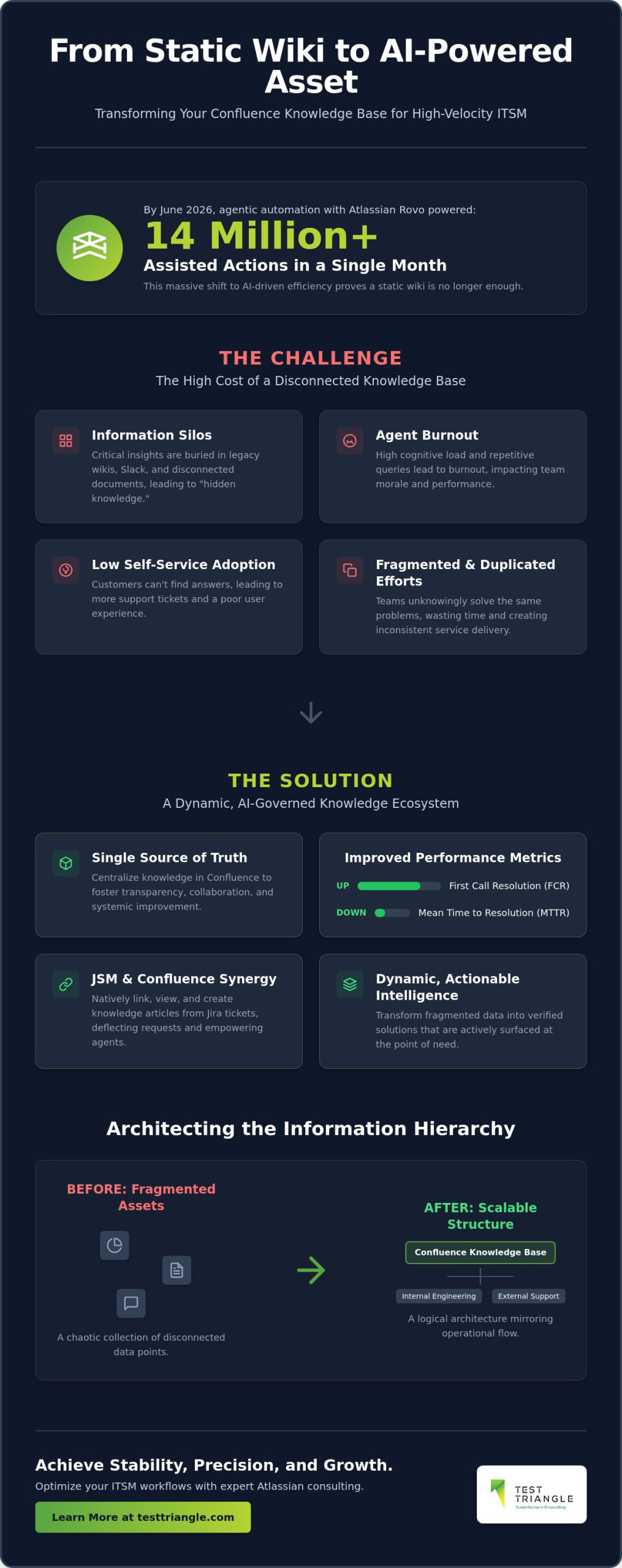

Did you know that by June 2026, agentic automation powered by Atlassian Rovo supported more than 14 million assisted actions in a single month? This massive shift toward AI-driven efficiency highlights a critical reality for global enterprises: a static wiki is no longer enough to support modern service delivery. To maintain operational stability, your organization needs a robust confluence knowledge base for itsm that functions as a dynamic, AI-governed engine rather than a forgotten digital archive.

We recognize that information silos across Slack and legacy wikis often lead to low self-service adoption and agent burnout, creating a fragmented landscape that hinders organizational progress. This guide demonstrates how to transform these disparate data points into a high-velocity asset by leveraging strategic Atlassian governance to drive precision, performance, and progress. You’ll discover the methodology required to establish a single source of truth, increase first-call resolution rates, and secure a seamless integration between Jira Service Management and Confluence. By bridging the gap between technical execution and business outcomes, we’ll outline a path toward a scalable, secure, and sophisticated knowledge ecosystem that empowers your workforce and satisfies your customers.

Key Takeaways

  • Understand the evolution from static documentation to a dynamic ecosystem, positioning a confluence knowledge base for itsm as a high-velocity asset that drives organizational progress.
  • Master the architectural principles of information hierarchy to establish a scalable source of truth that bridges the gap between internal engineering and external support.
  • Harness the capabilities of Atlassian Rovo to eliminate information silos, enabling teams to surface critical insights across fragmented SaaS tools with AI-driven precision.
  • Follow a structured implementation roadmap to audit and transition legacy assets into optimized templates that reduce agent burnout and accelerate resolution.
  • Leverage strategic Atlassian consulting to achieve the stability, precision, and growth necessary for managing complex digital infrastructures.

The Strategic Role of a Confluence Knowledge Base in Modern ITSM

In the high-velocity environment of 2026, the traditional wiki has evolved into a sophisticated engine for operational stability. A confluence knowledge base for itsm is no longer a passive repository of “how-to” articles; it’s a strategic asset that powers the entire service lifecycle. By 2026, the paradigm has shifted from static documentation to dynamic knowledge sharing. This evolution ensures that information isn’t just stored but is actively surfaced at the point of need, transforming fragmented data into actionable intelligence. This transition is essential for organizations aiming to achieve institutional maturity and maintain a competitive edge in complex digital landscapes.

Effective knowledge management serves as a cornerstone of the ITIL 4 Service Value System, ensuring that every service interaction contributes to value co-creation. When teams integrate their knowledge assets directly into IT Service Management (ITSM) frameworks, the impact on performance metrics is profound. We see a direct correlation between advanced knowledge governance and improvements in First Call Resolution (FCR) and Mean Time to Resolution (MTTR). By providing agents with immediate access to verified solutions, enterprises reduce the cognitive load on staff, mitigate agent burnout, and deliver the peace of mind that comes from predictable, high-quality service outcomes.

Breaking Down Information Silos in Global Enterprises

Fragmented data remains a significant barrier to organizational progress. In many global enterprises, critical insights are often buried within legacy wikis, disconnected PDF repositories, or transient chat histories. These silos create “hidden knowledge” that is inaccessible to the broader team, leading to duplicated efforts and inconsistent service delivery. Confluence acts as a unified layer that bridges these gaps, providing a single source of truth for cross-functional DevOps and IT teams. This centralized approach fosters a culture of transparency and collaboration, allowing organizations to capitalize on their collective expertise and drive systemic improvement through stability, precision, and growth.

The Symbiosis of Jira Service Management and Confluence

The native integration between Jira Service Management and Confluence creates a powerful synergy that redefines the agent and customer experience. Within the agent workspace, team members can view, link, or even create knowledge articles directly from a ticket, ensuring that the confluence knowledge base for itsm stays current with real-world issues. Simultaneously, customer portals leverage this data to deflect incoming requests by suggesting relevant articles as users type their queries. Implementing professional IT Service Management solutions ensures this integration is optimized for high-velocity delivery, allowing your organization to scale its support capabilities without a linear increase in headcount. This collaborative framework positions your company as a reliable long-term partner capable of navigating the complexities of modern digital infrastructure.

Architecting the Information Hierarchy for High-Velocity Service Delivery

Establishing a high-performance confluence knowledge base for itsm requires a logical architecture that mirrors your organization’s operational flow rather than just a collection of documents. By designing a scalable space structure that distinguishes between internal engineering documentation and external customer support content, enterprises can ensure that technical staff and end-users access the precise information they require without cognitive overhead. This structural precision is supported by rigorous naming conventions and metadata standards, which empower search algorithms to surface relevant articles with surgical accuracy. When sensitive technical data is involved, utilizing page restrictions and granular permissions becomes a critical component of your risk reduction strategy, maintaining security without sacrificing the speed of service delivery.

Preventing “knowledge rot” is a primary challenge for global organizations, requiring a proactive content lifecycle policy that identifies and archives outdated entries. Without these safeguards, the accumulation of irrelevant documentation can lead to agent confusion and increased resolution times. Implementing a structured hierarchy allows your team to move from a state of reactive information gathering to a proactive, solution-oriented environment. If you’re looking for guidance on refining these structures, discussing your knowledge architecture with our specialists can provide the clarity needed for long-term success.

Designing Spaces for Scalability and Precision

Strategic space organization begins with a clear distinction between Global Knowledge Spaces, which house universal policies, and Departmental Workspaces, which contain specialized technical insights. By employing Space Categories, administrators can organize content for different user personas, ensuring that a DevOps engineer and a front-office clerk see the most relevant data for their specific roles. Integrating Atlassian implementation best practices during the initial setup phase ensures that the technical architecture remains resilient as your digital infrastructure evolves, providing a steady hand in a fast-changing technological landscape.

Implementing Robust Governance and Content Lifecycle

Knowledge Governance is the systematic oversight of content accuracy and relevance. This discipline requires clearly defined roles, including Knowledge Owners who oversee space strategy, Subject Matter Experts (SMEs) who verify technical accuracy, and Knowledge Managers who facilitate the overall flow of information. To maintain institutional maturity, we recommend a 90-day review cycle for critical ITSM documentation, such as Runbooks and Post-Incident Reports (PIRs). Adhering to these ensures that your confluence knowledge base for itsm remains a reliable, high-velocity asset that supports operational stability and empowers your workforce through large-scale technological evolution.

Leveraging Atlassian Intelligence and Rovo for Knowledge Discovery

In the high-velocity technological landscape of 2026, the ability to surface relevant information across disparate platforms has become the defining characteristic of an elite service desk. Atlassian Rovo serves as a sophisticated AI operating layer that connects work and knowledge, not just within your confluence knowledge base for itsm, but across more than 50 connected third-party applications. By June 2026, Rovo supported more than 14 million assisted actions in a single month, demonstrating its maturity as a tool for global enterprises. This AI-driven discovery engine understands user intent with surgical precision, ensuring that customers find exact solutions through self-service portals while agents receive real-time recommendations during active incident management. By integrating these capabilities, organizations can move beyond simple keyword searches to a model of intelligent knowledge surfacing that significantly reduces cognitive load.

While the benefits are substantial, we recognize the inherent risks associated with AI-generated content, particularly regarding technical accuracy. Addressing the challenge of “AI Hallucinations” requires a disciplined human-in-the-loop validation process where Subject Matter Experts (SMEs) verify AI-drafted articles before they’re published to the wider organization. This strategic oversight ensures that while Atlassian Intelligence handles the heavy lifting of summarization and tone adjustment, the technical integrity of your documentation remains uncompromised. Adhering to these ITIL best practices ensures that AI remains a tool for augmentation rather than a source of operational risk.

Rovo: The AI Search Engine for the Modern Enterprise

Rovo’s ability to index data from third-party applications like Slack, Google Drive, and GitHub eliminates the friction of context switching by providing a unified search experience. Beyond simple discovery, Rovo Agents can be deployed to automate repetitive knowledge tasks, such as identifying and updating “Known Errors” based on recent deployment logs or developer commits. For organizations looking to bridge the gap between development and operations, our insights on DevOps Consulting offer a blueprint for integrating these AI agents directly into the CI/CD pipeline. This systemic improvement allows your team to maintain a high-velocity confluence knowledge base for itsm that evolves at the same pace as your software delivery.

Enhancing the Agent Experience with Atlassian Intelligence

Atlassian Intelligence provides a suite of internal tools designed to accelerate agent workflows, such as the ability to draft comprehensive Post-Incident Reports (PIRs) directly from Jira ticket history. This feature extracts key timelines, root causes, and resolution steps, allowing agents to focus on strategic improvements rather than administrative documentation. Additionally, the “Smart Links” feature provides instant context for technical terms or internal projects without requiring the user to leave the page. Ultimately, AI in ITSM is a force multiplier that converts raw data into actionable intelligence at the point of service. This approach empowers technical managers and executive leadership alike by fostering an environment of institutional maturity and operational stability.

Confluence Knowledge Base for ITSM: A Strategic Guide to Enterprise Knowledge Management in 2026

Implementation Roadmap: Transitioning from Static to Dynamic Knowledge

Transitioning to a high-velocity confluence knowledge base for itsm requires more than a simple data transfer; it demands a structured audit of existing assets to identify critical gaps in technical documentation. By analyzing legacy wikis, shared drives, and disconnected repositories, organizations can determine which assets remain relevant and which require immediate decommissioning to prevent information bloat. Once this audit is complete, selecting and customizing ITSM-specific templates, such as standardized “How-to” guides, “Known Errors” logs, and “Change Plans,” ensures that all future content adheres to a consistent, professional standard. This methodical approach establishes a foundation for operational stability and systemic improvement across the entire service value chain.

Executing a phased migration strategy is essential for minimizing operational downtime during large-scale digital transformations. We recommend launching a pilot program with a “Champion Team,” a small, versatile group of technical experts who can refine the structure and workflows before a global rollout occurs. To measure the success of this transition, enterprises must establish clear KPIs for knowledge health. Metrics such as “Article Usefulness” scores and “Deflection Rate” provide tangible evidence of the system’s impact on service efficiency, ensuring that technical managers and executive leadership can track organizational progress with precision. This disciplined framework allows for the combination of human expertise and technical tools to deliver a superior service experience.

The Data Migration and Cleanup Phase

A critical component of this roadmap is the “ROT” analysis, which requires teams to Remove, Outdate, or Transform legacy content. This process ensures that the new environment isn’t polluted with redundant or trivial information that could lead to agent burnout. During the technical migration, preserving link integrity is paramount to prevent broken cross-references that frustrate both agents and customers. Leveraging Software and Digital Assurance Testing ensures data parity after the migration, confirming that the technical architecture remains robust and secure. This level of rigor is what distinguishes a seasoned expert from a mere service provider in the complex landscape of enterprise IT.

Training and Cultural Adoption Strategies

Sustainable success relies on shifting the organizational mindset from “Knowledge is Power” to “Knowledge Sharing is Power.” Adopting a Knowledge Centered Service (KCS) methodology encourages continuous content creation as a natural byproduct of the problem-solving process, ensuring the confluence knowledge base for itsm remains a living asset. To drive this cultural evolution, we propose gamification strategies that reward Subject Matter Experts (SMEs) for their contributions and peer-reviewed accuracy. This approach fosters a spirit of partnership and support, ensuring that knowledge management becomes a core competency of the enterprise, ultimately delivering stability, scalability, and success. If your organization is ready to modernize its service delivery, consult with our Atlassian experts to begin your strategic implementation roadmap today.

Optimizing ITSM Workflows with Test Triangle’s Atlassian Consulting

Test Triangle operates as a strategic visionary in the Atlassian ecosystem, providing the high-level expertise required to transform a standard confluence knowledge base for itsm into a bespoke enterprise asset. While the technical tools provide the framework, it’s our deep institutional maturity that allows us to align these platforms with your specific business outcomes. By leveraging our “Partner Approach” to digital transformation, we ensure that every configuration choice serves the dual goals of risk reduction and operational stability. This expert oversight significantly reduces the “Time to Value” for new deployments, allowing global enterprises to bypass common implementation pitfalls and achieve immediate systemic improvement. Our methodology connects technical rigor with a deep understanding of your operational needs, ensuring that the transition from fragmented information to a unified truth is both seamless and sustainable.

We don’t just implement software; we engineer environments that foster collaboration and empower your workforce through human expertise and technical tools. This collaborative framework positions our team as a steady hand in a fast-changing technological landscape, emphasizing organizational progress through a combination of precision, performance, and progress. As a reliable long-term collaborator, we’re deeply invested in your long-term success and operational stability, ensuring that your digital infrastructure remains resilient as your organization evolves.

Customized ITSM Solutions for Regulated Industries

For organizations operating within highly regulated sectors such as finance, healthcare, and pharmaceuticals, a generic knowledge setup is insufficient to meet modern standards. We specialize in tailoring Confluence to meet stringent compliance requirements, ensuring that every article and workflow maintains a robust audit trail for future reviews. This level of precision is explored further in our Atlassian Partner Guide, which outlines the methodology for scaling enterprise quality across complex digital infrastructures. By prioritizing security and standards, we provide the peace of mind necessary for large-scale technological evolution in even the most scrutinized industries.

Maximizing ROI Through Strategic Atlassian Licensing

Achieving a high return on investment requires a disciplined approach to license management within the Atlassian Cloud ecosystem. Test Triangle optimizes your license spend by ensuring that your subscription tiers align perfectly with your actual usage and growth projections, preventing unnecessary overhead. Beyond the initial setup, our Managed Outsourcing Services provide recurring monthly support that addresses system maintenance, updates, and ongoing environment optimization. This steady hand ensures that your confluence knowledge base for itsm remains a high-velocity asset that grows alongside your organization, delivering stability, scalability, and success. Partner with Test Triangle for your Atlassian Transformation to secure the stability and growth your enterprise demands.

Scaling Success, Securing Stability, Sustaining Growth

The transition from fragmented documentation to a high-velocity knowledge ecosystem requires a disciplined combination of technical precision and strategic governance. By architecting a robust information hierarchy and leveraging the agentic automation of Atlassian Rovo, global enterprises can transform their service delivery from a reactive cost center into a proactive, AI-powered asset. Establishing a confluence knowledge base for itsm isn’t merely a software implementation; it’s a commitment to institutional maturity that empowers your workforce and satisfies your customers through predictable, high-quality outcomes. This journey involves bridging the gap between technical execution and business value, ensuring that your organization remains resilient in a fast-changing technological landscape.

As an Atlassian Platinum Solution Partner with a global presence, Test Triangle acts as a steady hand for organizations navigating complex legacy-to-cloud migrations across diverse, highly regulated industries. We position ourselves as a reliable long-term collaborator, deeply invested in your operational stability and long-term success. Our experts provide the strategic visionary perspective needed to reduce risk and maximize the ROI of your Atlassian ecosystem. Accelerate your ITSM maturity with Test Triangle’s Atlassian Consulting and secure the future of your enterprise knowledge management. We’re ready to help you turn your digital infrastructure into a competitive advantage.

Frequently Asked Questions

How does Confluence integrate with Jira Service Management for ITSM?

Confluence integrates with Jira Service Management by establishing a direct link between service tickets and your documentation repository, allowing agents to surface solutions without leaving their active workspace. This native synergy enables automated article suggestions within the customer portal, which effectively deflects common requests before they enter the support queue.

What are the best templates for an IT knowledge base in Confluence?

The most effective templates for an IT knowledge base include standardized “How-to” articles, “Known Error” logs, and comprehensive “Post-Incident Reports” (PIRs). These structured frameworks ensure that all technical documentation remains consistent, professional, and easily searchable across the entire enterprise service value chain.

Can Confluence handle complex permissions for external customer documentation?

Yes, Confluence provides granular page restrictions and space-level permissions that allow organizations to manage sensitive technical data while maintaining public-facing support content. This dual-layered security model ensures that internal engineering details remain protected while end-users receive the precise information they need for self-service resolution.

How does Atlassian Rovo change the way teams find knowledge in 2026?

In 2026, Atlassian Rovo revolutionizes discovery by indexing information across more than 50 third-party applications, including Slack, Google Drive, and GitHub. This capability allows a confluence knowledge base for itsm to serve as a unified search hub, surfacing relevant insights with AI-driven intent regardless of where the data was originally created.

What is the difference between a service desk and a knowledge base?

A service desk is a transactional platform designed for managing incoming requests and incidents, whereas a knowledge base is a centralized repository for storing verified solutions and documentation. While the service desk facilitates the interaction between the user and the agent, the knowledge base provides the intelligence required to resolve issues with precision and speed.

How often should we audit our Confluence knowledge base articles?

We recommend a structured 90-day review cycle for critical documentation, supplemented by trigger-based audits following major software releases or significant system changes. This proactive approach prevents the accumulation of outdated information and ensures that your knowledge assets remain a reliable source of truth for both agents and customers.

What are the common mistakes when setting up a Confluence KB for IT teams?

Common errors include failing to establish clear naming conventions and neglecting to implement a formal governance policy for the content lifecycle. Without these structural safeguards, a confluence knowledge base for itsm can quickly become a fragmented archive of irrelevant data, leading to low user adoption and increased agent burnout.

How can we measure the ROI of our knowledge management strategy?

Measuring the ROI of your knowledge strategy requires a disciplined analysis of request deflection rates, which quantify the number of tickets avoided through effective self-service. Additionally, tracking improvements in Mean Time to Resolution (MTTR) and First Call Resolution (FCR) provides tangible evidence of how a high-velocity knowledge ecosystem reduces operational costs and enhances service quality.

Paul Guy

Article by

Paul Guy

Paul serves as the Marketing Director at Test Triangle, where he leads a global team in driving growth through strategic B2B marketing and brand communications. With a strong emphasis on measurable outcomes and sustainable performance, he plays a pivotal role in aligning marketing functions to enhance customer engagement and accelerate business impact. Under his leadership, marketing initiatives have consistently delivered significant returns on investment, elevated brand visibility, and strengthened the company's presence across key markets.


Is your organization paying for the rapid resolution of problems that should never have occurred in the first place? While the $39,500 annual investment for Atlassian Premier Support provides a direct line to senior engineers for critical outages, it often leaves the heavy administrative burden on your internal teams. Evaluating the choice between atlassian premier support vs managed services has become a high-stakes fiscal decision, especially following the 32.01% surge in enterprise pricing seen in May 2026. You need a solution that doesn’t just react to failures but actively drives your digital evolution.

We understand that managing complex cloud migrations and underutilized licenses can drain your resources and stall your strategic roadmap. This guide examines the critical differences between direct vendor troubleshooting and the proactive, partner-led oversight required to truly master your ecosystem. You’ll gain a clear framework for reducing system downtime, securing expert-led configurations, and ensuring a measurable return on your software investment through stability, precision, and growth.

Key Takeaways

  • Understand why the 2026 Atlassian ecosystem requires more than simple ticket resolution to maintain operational stability in high-pressure corporate environments.
  • Analyze the strategic distinction of atlassian premier support vs managed services to determine whether your enterprise needs reactive vendor troubleshooting or proactive system optimization.
  • Identify the internal resource gaps that necessitate a shift from basic administrative maintenance to a comprehensive, partner-led management model.
  • Discover how a hybrid support framework can maximize platform availability while simultaneously driving digital transformation and workflow efficiency.
  • Learn to align your Atlassian roadmap with broader business objectives by leveraging specialized expertise in cloud migration and cross-platform integration.

The Atlassian ecosystem has transformed from a collection of standalone productivity tools into the central nervous system of the modern enterprise. As we progress through 2026, the traditional model of reactive, ticket-based assistance has become insufficient for global organizations operating at scale. Relying on the “Standard” support tier often leaves teams stranded during complex outages or configuration failures, as these basic levels are designed for minor troubleshooting rather than the intricate demands of a distributed, high-velocity infrastructure. The decision-making process for leadership now centers on a fundamental choice between atlassian premier support vs managed services, representing a shift from simply maintaining software to strategically empowering the business.

Internal administration without external expertise carries significant hidden costs that often go unnoticed until a system audit occurs. These include the opportunity cost of diversion, where senior developers are frequently pulled away from core product builds to manage Jira schemes or permission hierarchies. It also includes the risk of underutilized licenses, which can account for a substantial portion of the average annual enterprise spend on Atlassian products. Choosing between atlassian premier support vs managed services is therefore not just a technical preference but a financial imperative to protect software ROI and operational continuity.

The Complexity of Modern Atlassian Stacks

Modern environments are no longer siloed. The deep integration between Jira, Confluence, and Bitbucket creates a vast support surface area where a single misconfiguration can ripple across the entire development lifecycle. With the accelerating shift to Atlassian Cloud, maintenance requirements have pivoted from server patching to sophisticated identity management, API governance, and cross-platform orchestration. To thrive in this environment, enterprises require a foundation of stability, precision, and scalability. Without a dedicated Managed service provider (MSP) to oversee these connections, the internal administrative burden often leads to technical debt that slows down innovation and increases operational risk.

Identifying the Support Gap

Organizations often realize they have outgrown standard support when internal administrators spend more time on user permissions than on high-value workflow automation. There is a clear distinction between technical troubleshooting, which focuses on why a feature isn’t working, and strategic business alignment, which ensures the toolset actually drives revenue. Many teams find themselves stuck in a loop of reactive fixes, lacking the bandwidth to implement a comprehensive Atlassian implementation strategy. The support gap is the distance between software availability and user productivity.

Atlassian Premier Support: Direct High-Octane Troubleshooting

Atlassian Premier Support serves as the definitive direct vendor lifeline for organizations that require immediate, high-priority access to the engineers who build the software. For an annual investment of $39,500, this tier provides coverage for three named contacts across the primary product suite, excluding specific tools like Opsgenie or Jira Align which require separate agreements. It’s a specialized service designed to protect platform availability by offering a direct escalation path for the most severe technical failures. When weighing atlassian premier support vs managed services, it’s vital to recognize that Premier Support is primarily an insurance policy against catastrophic system downtime rather than a tool for day-to-day administrative relief.

The relationship is often anchored by a Technical Account Manager (TAM) who acts as a strategic advisor within the Atlassian organization. This individual helps align your technical requirements with the product roadmap, ensuring that your enterprise isn’t blindsided by major architectural shifts. However, while the TAM provides high-level guidance, they don’t function as a hands-on administrator. Incorporating a robust service delivery model requires understanding that vendor support is fundamentally a reactive mechanism focused on the health of the core application, not the specific nuances of your business processes.

Core Benefits of the Premier Tier

The primary value proposition of the Premier tier lies in its financially backed Service Level Agreements (SLAs). For critical (L1) issues, Atlassian guarantees an initial response time of one hour, providing peace of mind during high-stakes incidents. You’re not just getting a faster ticket response; you’re gaining access to senior support engineers who understand the platform’s source code and can navigate complex bug fixes that standard support teams might miss. Additionally, the vendor provides periodic proactive health checks and system performance analysis to identify potential bottlenecks before they lead to a total system failure.

Where Premier Support Ends

Despite its technical depth, Premier Support maintains a strict “Hands-Off” policy regarding your internal configurations. Atlassian engineers will troubleshoot why a workflow has crashed, but they won’t build a new custom workflow for your HR department or manage your complex user permission schemes. Furthermore, this tier explicitly excludes troubleshooting for third-party Marketplace apps, which can often add up to 150% to the base cost of your software and introduce significant stability risks. If you’re struggling to bridge the gap between vendor response and internal execution, you can consult with our strategic advisors to explore a more comprehensive approach. Ultimately, Premier Support fixes the platform, but it doesn’t run your business operations.

Atlassian Managed Services: Proactive Administration and Optimization

While Premier Support provides a vital technical safety net for platform-level incidents, Atlassian Managed Services function as a strategic engine for continuous organizational growth. This model represents a comprehensive, hands-on extension of your internal IT department, moving beyond the limitations of reactive troubleshooting to embrace proactive system evolution. When evaluating atlassian premier support vs managed services, the primary distinction lies in the scope of execution. Managed services don’t just ensure the software is running; they ensure it’s optimized to meet the specific, shifting demands of your global enterprise. By integrating a dedicated team into your operational structure, your organization gains the ability to transform raw technical capacity into streamlined business value through vision, velocity, and versatility.

The operational philosophy of a managed model shifts the focus from ticket-based response times to business-centric outcomes. Instead of measuring success by how quickly a bug is acknowledged, success is defined by system health, user adoption rates, and the seamless automation of complex cross-departmental workflows. This partnership provides the steady hand required to manage the daily administrative burden that often overwhelms internal teams. It allows your high-value talent to focus on core innovation while experts handle the intricate details of your Atlassian environment, ensuring that your digital infrastructure remains a competitive advantage rather than a maintenance bottleneck.

The Strategic Advantage of a Managed Partner

A managed partner delivers end-to-end administration that encompasses everything from granular user management and permission schemes to the design of sophisticated custom workflows. This level of involvement ensures that your instance remains clean, performant, and scalable as your organization expands. Beyond simple maintenance, these services provide robust governance and compliance frameworks, ensuring that your data handling and access controls meet the rigorous standards of highly regulated industries. For organizations initiating new projects, leveraging specialized Atlassian Implementation Services within a managed framework ensures that the foundation of your ecosystem is built correctly from day one.

Beyond Troubleshooting: Proactive Growth

Managed services drive proactive growth through regular system audits and targeted user training sessions that identify and eliminate operational friction. Unlike direct vendor support, a managed partner actively vets, installs, and maintains critical Marketplace plugins, mitigating the risks associated with third-party app sprawl. This holistic oversight is particularly critical for organizations pursuing broader DevOps Consulting initiatives, where the seamless integration of Jira and Bitbucket into the CI/CD pipeline is essential for maintaining development speed. By choosing a partner-led approach, you secure a reliable long-term collaborator dedicated to the ongoing optimization of your entire software delivery lifecycle.

The Critical Choice: Direct Vendor Support vs. Strategic Partner Managed Services

Determining the optimal path between atlassian premier support vs managed services requires a candid assessment of your organization’s internal maturity and long-term technical objectives. While the $39,500 annual investment for Premier Support secures a high-priority escalation path to Atlassian’s senior engineers, it assumes your team can handle everything short of a platform-level bug. The strategic divide often rests on whether you possess a dedicated “Atlassian Champion” in-house. If your internal administrators are already stretched thin by daily user requests and complex scheme clean-ups, adding a vendor-side escalation point won’t solve the underlying productivity bottleneck. You must decide if you’re paying for a safety net or a growth engine.

For many global enterprises, the most effective strategy is a “Hybrid” approach that leverages the strengths of both models. In this scenario, Premier Support provides the technical insurance needed for massive-scale Cloud or Data Center deployments, while a strategic partner handles the proactive administration, workflow automation, and cross-platform integrations. This combination ensures that the platform remains stable at the infrastructure level while the business logic continues to evolve at the pace of your market. A cost-benefit analysis should weigh the fixed license-based support fees against the flexible, outcome-based subscriptions of a managed partner, focusing on the total cost of ownership rather than just the initial price tag.

Executive Decision Matrix:

  • Internal Expertise: If your team lacks certified administrators, managed services provide immediate institutional maturity.
  • Operational Focus: Choose Premier for reactive troubleshooting; choose managed services for proactive system optimization and roadmapping.
  • Integration Complexity: Organizations with deep ServiceNow or AWS integrations require the hands-on expertise of a partner-led model.
  • Scalability Requirements: Managed services allow for rapid scaling without the overhead of permanent internal hires.

When to Choose Atlassian Premier Support

This tier is best suited for organizations that already maintain a highly skilled internal IT department. If your team is capable of designing complex Jira workflows and only requires direct vendor intervention for platform-level performance analysis or source code issues, the Premier tier is an ideal fit. It focuses on the core pillars of stability, precision, and scalability at the infrastructure level, ensuring that your massive-scale deployments meet strict uptime requirements without the need for external administrative help.

When to Choose Managed Services

Managed services are the superior choice for teams undergoing rapid digital transformation or those migrating to Atlassian Cloud. If your business requires sophisticated workflow automation, complex ITSM migrations, or simply lacks a dedicated administrator, a partner-led model offers the necessary versatility. For organizations needing to bridge a temporary talent gap, utilizing Managed Outsourcing Services provides a flexible staffing solution that scales alongside your project demands. To determine which model aligns with your 2026 roadmap, you can schedule a strategic consultation with our team today.

Atlassian Premier Support vs Managed Services: A Strategic Decision Guide for 2026

Test Triangle: Elevating Atlassian Environments Through Managed Excellence

Test Triangle positions itself as the strategic visionary for enterprises navigating the complexities of modern digital infrastructure. Our unique methodology transcends basic troubleshooting by combining deep technical rigor with a high-level business vision, ensuring that your software tools are perfectly aligned with your commercial objectives. When navigating the nuances of atlassian premier support vs managed services, the value of a steady hand cannot be overstated. We provide the expertise required to manage high-stakes Atlassian Cloud migrations and complex ServiceNow Implementation projects, bridging the gap between disparate platforms to create a unified, high-performance ecosystem.

Engagement models within our framework are designed with institutional maturity in mind, offering the flexibility that global enterprises demand. Whether your organization requires project-based milestones for a specific digital transformation or a recurring monthly subscription for ongoing administrative excellence, we adapt our delivery to match your internal cadence. Unlike the centralized, often anonymous queues of direct vendor support, our global presence ensures superior regional attention. This localized focus allows us to act as a reliable long-term collaborator, providing the peace of mind that comes from knowing your infrastructure is managed by experts who understand your specific market challenges.

Our Atlassian Consulting Framework

The foundation of our partnership begins with a methodical Discovery and Advisory phase. During this stage, we work to align your existing Atlassian stack with long-term corporate roadmaps, identifying areas where configuration improvements can drive immediate efficiency gains. Our Solution Design and Build phase then crafts bespoke workflows tailored to the unique regulatory and operational requirements of industries such as Finance, Healthcare, and Retail. For organizations seeking localized strategic support, our Atlassian Consulting Services Dublin team provides the proximity and platform expertise needed to accelerate your digital maturity.

Achieving Operational Stability

Operational stability is achieved through a combination of human expertise and disciplined technical tools. Our managed services are specifically engineered to reduce risk and empower your internal teams to lead large-scale technological evolution without being bogged down by administrative debt. We provide dedicated helpdesk support under robust Service Level Agreements, ensuring that your users receive the expert-led configuration and troubleshooting they need to remain productive. This proactive oversight doesn’t just fix issues; it prevents them, allowing your leadership to maintain a composed, solution-oriented focus on long-term success. By choosing a partner-led model, you secure the stability, precision, and scalable growth required to thrive in a fast-changing landscape. Contact Test Triangle for a strategic Atlassian audit to begin optimizing your software spend and operational efficiency today.

Securing Your Strategic Atlassian Roadmap for 2026

The evolution of the enterprise digital landscape demands a shift from reactive troubleshooting to proactive orchestration. Success in the coming year requires more than just keeping the lights on; it necessitates a sophisticated alignment of platform health and business agility. By understanding the functional boundaries of atlassian premier support vs managed services, leadership can move beyond simple ticket resolution toward a model of continuous optimization. Our methodology ensures that your Atlassian ecosystem remains a robust foundation for progress rather than an administrative burden, providing the stability, precision, and scalability your organization deserves.

Leveraging our status as a Global Atlassian Partner, we deliver strategic expertise in Finance and Pharma alongside comprehensive ITSM and DevOps integration. We act as your reliable long-term collaborator, providing the steady hand required to navigate complex migrations and architectural shifts with total confidence. It’s time to transform your software investment into a high-performance engine for growth and innovation.

Optimise your Atlassian stack with Test Triangle’s Managed Services

Empower your teams to achieve new heights of productivity and secure your digital future with a partner dedicated to your long-term success.

Frequently Asked Questions

What is the main difference between Atlassian Premier Support and Managed Services?

The fundamental distinction lies in the nature of the engagement: Premier Support is a reactive technical lifeline provided by the vendor for platform-level issues, whereas Managed Services represent a proactive, hands-on extension of your internal team. While the vendor focuses on the health of the core software, a managed partner oversees daily configurations, user management, and strategic optimization. This ensures your ecosystem isn’t just running, but actively driving business value.

Can I have both Atlassian Premier Support and a Managed Services partner?

Organizations often adopt a hybrid model to maximize both platform stability and operational efficiency. In this scenario, you utilize Atlassian Premier Support as a high-priority escalation point for critical vendor-side bugs while your Managed Services partner handles the intricate execution of your internal workflows and integrations. This dual-layered strategy provides a comprehensive safety net for global enterprises with zero tolerance for system downtime or administrative bottlenecks.

Does Atlassian Premier Support include help with Jira workflow configuration?

No, Atlassian Premier Support does not include hands-on assistance with internal configurations like Jira workflows, permission schemes, or project setups. The vendor’s engineers are strictly focused on troubleshooting the underlying platform and resolving software defects rather than building bespoke business logic. To achieve tailored workflow design that meets your specific operational needs, you require the strategic involvement and practical execution provided by a managed services provider.

How much do Atlassian Managed Services typically cost compared to Premier Support?

Pricing structures for atlassian premier support vs managed services follow different models based on the scope of the engagement. Premier Support involves a fixed annual fee that provides standardized vendor access for a limited number of named contacts. Conversely, Managed Services pricing is customized based on the complexity of your ecosystem, the volume of administrative tasks, and your required service levels. This tailored approach ensures your investment aligns directly with the strategic expertise your business requires.

Is Managed Services better for Atlassian Cloud or Data Center?

Managed Services provide essential value across both Cloud and Data Center deployments, though the operational focus shifts to address the unique requirements of each environment. For Cloud instances, the emphasis remains on identity governance, API management, and cross-platform orchestration. For Data Center, the priority often centers on infrastructure health, performance tuning, and complex version upgrades. In both cases, a partner-led model ensures your environment remains performant and scalable as your organization evolves.

What happens if my third-party Marketplace apps break under Premier Support?

Atlassian Premier Support specifically excludes troubleshooting and maintenance for third-party Marketplace applications. If a critical plugin fails or causes system instability, the vendor will typically direct you to the individual app developer for assistance. A Managed Services partner takes full ownership of your entire stack, vetting and maintaining these integrations to ensure they don’t compromise your system’s overall stability. This proactive oversight reduces the risk of third-party software conflicts.

How does Test Triangle handle Atlassian Cloud migrations within its managed services?

We manage the entire cloud migration lifecycle through a disciplined framework that prioritizes data integrity and minimal user disruption. Our approach begins with a comprehensive assessment of your existing instance, followed by strategic cleanup and mapping to ensure a seamless transition to the Cloud. By acting as a steady hand throughout the process, we mitigate the risks associated with complex migrations while ensuring your new environment is optimized for immediate organizational productivity.

Do Managed Services include user training and onboarding?

Yes, comprehensive user training and structured onboarding are core components of our managed offerings. We believe that technological evolution is only successful when paired with high levels of user adoption and proficiency. By providing targeted training sessions and clear documentation, we empower your teams to fully utilize the advanced features of your Atlassian stack. This commitment to human expertise ensures that your organization realizes the maximum return on its software investment through improved workflow efficiency.

Paul Guy

Article by

Paul Guy

Paul serves as the Marketing Director at Test Triangle, where he leads a global team in driving growth through strategic B2B marketing and brand communications. With a strong emphasis on measurable outcomes and sustainable performance, he plays a pivotal role in aligning marketing functions to enhance customer engagement and accelerate business impact. Under his leadership, marketing initiatives have consistently delivered significant returns on investment, elevated brand visibility, and strengthened the company's presence across key markets.
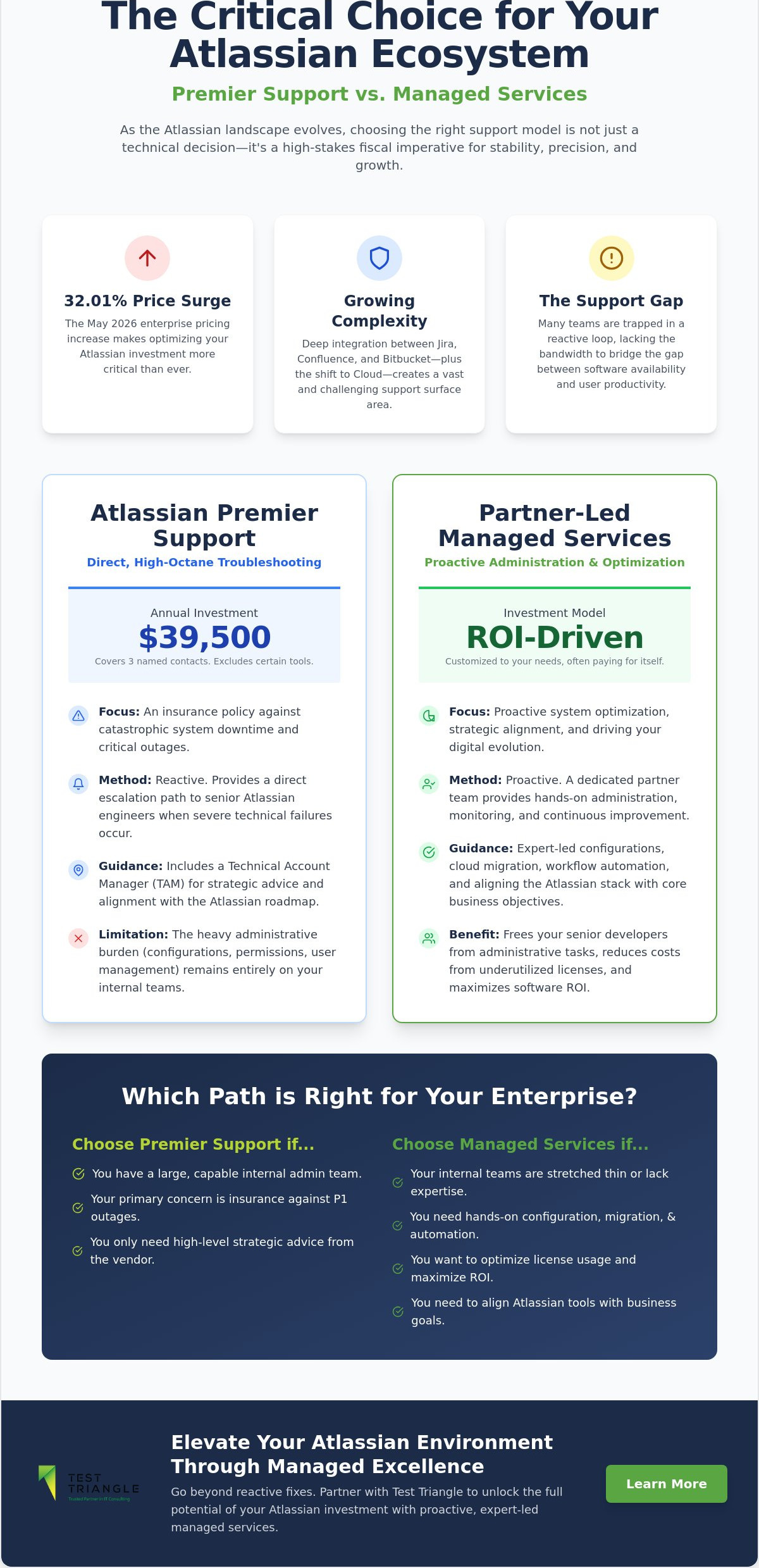

When a cross-border data violation occurs, the average U.S. organization faces $420,000 in immediate costs, a figure that often eclipses the initial savings of a distributed model. You understand that the risks of hiring offshore development teams involve more than just time zone friction; they encompass unpredictable code quality and the looming threat of technical debt in highly regulated sectors like Finance and Pharma. As global data privacy regulations tighten, including the now-mandatory ISO/IEC 27001:2022 certifications, the gap between a low-cost vendor and a strategic partner becomes a matter of institutional survival.

This article provides the methodology to evaluate, mitigate, and master these complexities to ensure your digital infrastructure remains secure and performant. We’ll explore a comprehensive risk-assessment checklist and governance strategies designed to facilitate high-quality, compliant software delivery at scale. By aligning technical execution with business outcomes, we help you secure the stability, precision, and progress necessary for long-term operational success.

Key Takeaways

  • Transition from simple labor arbitrage to strategic ecosystem integration to ensure your offshore model delivers long-term value rather than just short-term cost savings.
  • Identify and neutralize the risks of hiring offshore development teams by implementing rigorous data sovereignty protocols and intellectual property safeguards tailored for highly regulated sectors.
  • Evaluate the true total cost of ownership by accounting for the quality gap and technical debt that often result when speed is prioritized over architectural sustainability.
  • Establish robust governance through quality-centric KPIs and vendor selection processes that move beyond the standard Request for Proposal to verify actual operational maturity.
  • Leverage a managed service approach to achieve precision, partnership, and progress, ensuring high-compliance delivery across global digital infrastructures.

The Strategic Landscape of Offshore Development Risks in 2026

The global delivery landscape has undergone a fundamental transformation, shifting from a model of simple labor arbitrage to one of complex ecosystem integration. In 2026, enterprises no longer view distributed teams as a mere mechanism for reducing payroll; they seek high-level collaborators capable of driving large-scale technological evolution. However, this evolution introduces sophisticated risks of hiring offshore development teams that extend far beyond traditional logistical concerns. A foundational understanding of offshoring reveals that while the economic principles of comparative advantage remain, the execution has become significantly more precarious for those prioritizing immediate savings over long-term stability.

When global enterprises adopt a “low-cost-first” mindset, they often ignore the three pillars of risk that define modern software delivery. These pillars include:

  • Operational Risk: Disruptions in project momentum caused by fragmented governance and misaligned workflows.
  • Technical Risk: The accumulation of technical debt due to sub-optimal architectural decisions and inconsistent code quality.
  • Regulatory Risk: Non-compliance with evolving data privacy standards, such as the ISO/IEC 27001:2022 requirements, which can result in catastrophic financial penalties.

Success in this environment requires a transition toward managed outsourcing services that prioritize precision, partnership, and progress over bottom-line reduction.

The Shift from Cost-Saving to Value-Creation

Traditional offshoring models are failing because they don’t account for the speed of modern digital transformation. Many organizations fall victim to the “Offshore Paradox,” where a 40% reduction in hourly rates actually increases the total cost of ownership by a factor of four due to rework and management overhead. In this context, offshore risk is the quantifiable delta between projected labor savings and the realized technical debt accrued through sub-optimal architectural decisions. By focusing on staffing solutions that emphasize specialized expertise, companies can avoid the trap of prioritizing output volume over delivery value.

Categorising Modern Enterprise Vulnerabilities

Modern vulnerabilities often manifest within the technical infrastructure itself. If an offshore partner lacks robust environmental stability, it directly compromises the integrity of continuous integration and deployment (CI/CD) pipelines, leading to stalled release cycles. Furthermore, the risk of vendor lock-in remains a significant threat; without intentional knowledge transfer, enterprises lose internal institutional knowledge and become dangerously dependent on external entities. This erosion of transparency is frequently exacerbated by fragmented communication protocols, which turn minor misunderstandings into systemic project delays. Maintaining operational control requires a disciplined approach to governance that ensures technical managers and executive leadership remain aligned on every deliverable.

Security, Compliance, and Intellectual Property Vulnerabilities

Data sovereignty remains a primary concern for global enterprises navigating the legal complexities of cross-border data transfers. In 2026, the European Data Protection Board has made Article 17 of the GDPR, the right to erasure, a key enforcement priority. Organizations must also contend with the California Privacy Rights Act (CPRA) regulations that, as of January 1, 2026, require comprehensive privacy risk assessments for processing that presents a significant risk to consumers. These evolving mandates amplify the risks of hiring offshore development teams that lack a mature understanding of localized compliance frameworks. Beyond statutory data protection, vulnerabilities in the software supply chain emerge when using unverified resources, potentially introducing malicious code or unauthorized backdoors into production environments.

Mitigating insider threats requires more than just background checks. It demands a systemic architecture of least-privilege access and continuous monitoring. Unauthorized data access often stems from fragmented identity management between the onshore leadership and the offshore execution team. Establishing a unified security posture is essential to protect the integrity of your digital infrastructure. It’s about maintaining stability and precision throughout the development lifecycle.

Regulatory Compliance in Regulated Sectors

Maintaining GxP and HIPAA compliance presents unique challenges when development occurs in jurisdictions with non-equivalent legal protections. For organizations in the pharmaceutical and finance sectors, the necessity of Software and Digital Assurance Testing cannot be overstated. This approach ensures the creation of immutable audit trails and rigorous validation protocols required by global regulators. It’s also vital to confirm that your partner has completed the transition to the ISO/IEC 27001:2022 standard, as the previous 2013 version’s transition period ended on October 31, 2025. Ensuring these standards are met provides the peace of mind necessary for large-scale technological evolution.

Intellectual Property and Contractual Safeguards

Protecting proprietary algorithms requires contracts that go beyond standard service agreements. To effectively manage the risks of hiring offshore development teams, every offshore contract must include explicit clauses regarding the ownership of work product and the immediate transfer of intellectual property rights upon creation. Utilizing code escrow and secure, encrypted repository management further reduces the risk of asset loss. Standardizing security testing as a non-negotiable component of the Definition of Done (DoD) ensures that protection is baked into the development lifecycle rather than added as an afterthought. If you’re concerned about your current security posture, consulting with a strategic compliance partner can help bridge the gap between technical execution and regulatory certainty.

The ‘Hidden’ Operational Costs: Communication, Culture, and Technical Debt

Operational efficiency often suffers when organizations overlook the subtle friction points inherent in distributed delivery models. While the initial balance sheet might suggest significant savings, the risks of hiring offshore development teams frequently manifest as a “Quality Gap.” This occurs when external teams prioritize velocity and ticket closure over sustainable code architecture. This short-term focus creates a fragile foundation that complicates future scaling and integration efforts. When speed is the only metric, the resulting technical debt acts as a high-interest loan that your internal team will eventually have to repay with interest.

Time zone differences introduce another layer of complexity, often resulting in a 24-hour delay for critical bug fixes. If a production-grade issue is identified at the end of a domestic business day, it may sit idle for half a cycle before an offshore team even begins the triage process. This lag erodes your time-to-market and can be devastating in high-stakes environments like Finance or Pharma. Cultural nuances in requirements gathering also lead to “The Yes-Man” syndrome. This is a phenomenon where offshore partners agree to ambiguous or impossible specifications to avoid perceived conflict, ultimately leading to misaligned deliverables and expensive rework.

The Long-Term Burden of Technical Debt

Quick and dirty code might meet an immediate deadline, but it leads to exponential maintenance costs in later years. To mitigate this, organizations must integrate professional manual testing into their quality assurance strategy. While automation provides speed, manual oversight is essential for catching complex logic errors that automated scripts often miss. Establishing a rigorous code review process ensures that every pull request adheres to your internal standards, protecting your architectural integrity from the onset.

Bridging the Cultural and Communication Divide

Success requires a single source of truth to synchronize disparate workflows. Implementing tools like Jira and Confluence provides the necessary transparency to track progress and document decisions in real-time. Engaging in professional Atlassian Consulting allows you to optimize these platforms for global collaboration, ensuring that your governance model supports asynchronous communication. This structure prevents project bottlenecks, transforming a fragmented team into a cohesive, high-performing unit that values precision and operational stability.

A Framework for Risk Mitigation and Governance

Mitigating the risks of hiring offshore development teams requires a disciplined transition from tactical procurement to a strategic governance framework. While many organizations rely on a standard Request for Proposal (RFP) to vet potential partners, this approach often fails to uncover the operational maturity required for enterprise-grade delivery. A robust selection process must evaluate a vendor’s ability to integrate with your existing digital infrastructure and their commitment to institutional stability. By shifting from a simple “Offshore Staffing” mindset to a comprehensive managed service model, enterprises ensure higher levels of accountability and a shared investment in long-term business outcomes. This methodology replaces fragmented execution with a structured approach that prioritizes precision, performance, and protection.

Establishing transparency across the Software Development Life Cycle (SDLC) is only possible through the integration of shared Key Performance Indicators (KPIs). These metrics should move beyond simple output volume, such as lines of code or ticket velocity, to focus on qualitative benchmarks like defect density and architectural adherence. When governance is treated as a core pillar of the partnership, technical managers gain the visibility needed to manage complex digital assets with confidence. To ensure your distributed model is built on a foundation of technical rigor, speak with our strategic consultants about building a custom governance framework.

Establishing Rigorous Governance Protocols

Integrating Quality Assurance from Day One

Quality cannot be an afterthought in a distributed environment; it must be baked into the delivery pipeline through continuous testing. Utilizing Software Test Automation Services is essential for providing real-time oversight of remote teams, allowing every commit to be validated automatically against your security and functional requirements. By leveraging DevOps Consulting, organizations can build a unified delivery pipeline that synchronizes onshore leadership with offshore execution. This systemic improvement reduces the risks of hiring offshore development teams by creating a transparent, automated environment where progress is measurable and results are predictable.

Navigating the Strategic Risks of Hiring Offshore Development Teams in 2026

The Test Triangle Advantage: Precision, Partnership, and Progress

Test Triangle addresses the fundamental risks of hiring offshore development teams by replacing fragmented, “set and forget” models with a rigorous managed service framework. Our approach ensures that every line of code and every architectural decision aligns with your enterprise goals, effectively neutralizing the Quality Gap and technical debt discussed in previous sections. By integrating industry-leading platforms like Atlassian and ServiceNow directly into our delivery model, we provide the total project visibility necessary for executive leadership to maintain operational control over complex digital infrastructures. This combination of offshore cost-efficiency and local strategic oversight allows global organizations to scale with confidence, clarity, and control.

Our personality is that of a strategic visionary who remains deeply practical, ensuring that your long-term success is never sacrificed for short-term gains. We act as a steady hand in a fast-changing technological landscape, emphasizing organizational progress through the combination of human expertise and sophisticated technical tools. By choosing a partner that values stability, precision, and scalable growth, you empower your organization to navigate the complexities of 2026 with a reliable long-term collaborator at your side.

Managed Outsourcing: Beyond Simple Staffing

Our Managed Outsourcing Services provide the high-level governance that typical offshore teams lack, positioning us as a reliable corporate partner rather than a mere service provider. Having an Ireland-based strategic partner manage global delivery centers means you benefit from institutional maturity, ensuring that cultural and communication barriers are proactively dismantled. For instance, our methodologies have successfully reduced technical debt for global healthcare providers by implementing disciplined code review and automated validation protocols. This approach transforms global delivery from a source of operational anxiety into a driver of systemic improvement.

Enterprise-Grade IT Staffing for Global Compliance

We offer a unique approach to IT Staffing for specialized roles, particularly within the highly regulated Pharma and Finance sectors. Our rigorous vetting process ensures that every resource is not only technically proficient but also fully aligned with your specific compliance requirements and corporate culture. We recognize that stability and precision are non-negotiable in high-stakes environments, which is why our staffing models are built on a foundation of technical rigor and institutional maturity. To optimize your current delivery model and eliminate the risks of hiring offshore development teams, connect with our strategic consultants to audit your existing strategy and establish a path toward high-quality, compliant software delivery at scale.

Securing Your Enterprise Delivery for 2026 and Beyond

The landscape of 2026 demands more than just cost-efficiency; it requires a disciplined commitment to security and quality. Mitigating the risks of hiring offshore development teams involves a fundamental shift from tactical staffing to a managed service model that prioritizes data sovereignty and architectural integrity. By establishing rigorous governance and integrating quality assurance into the core of your SDLC, you ensure that global delivery remains a catalyst for growth rather than a source of technical debt.

As a strategic Atlassian and ServiceNow partner with specialized expertise in Pharma and Finance compliance, Test Triangle provides the institutional maturity necessary for high-stakes environments. Our global reach is anchored by local, Dublin-based leadership, offering the precision and stability required to manage complex digital infrastructures with confidence. This combined approach ensures that technical managers and executive leadership remain aligned on every deliverable, fostering a spirit of partnership and support.

Secure your digital transformation with Test Triangle’s Managed Services and experience the peace of mind that comes from a reliable long-term collaboration. Your path to scalable, compliant, and high-quality software delivery starts with a partner dedicated to your long-term operational success.

Frequently Asked Questions

What are the most common security risks when hiring offshore development teams?

The most common security risks include data sovereignty violations, supply chain compromises, and unmonitored insider threats. In 2026, the risks of hiring offshore development teams are amplified by stricter privacy laws like the CPRA and updated GDPR enforcement. Organizations must implement zero-trust architectures and continuous monitoring to prevent unauthorized access to sensitive digital infrastructure, ensuring that remote resources remain as secure as internal assets.

How can I protect my intellectual property when working with offshore developers?

Protecting intellectual property requires a multi-layered approach that combines ironclad contractual safeguards with technical enforcement. Secure your proprietary algorithms by including explicit IP transfer clauses in every agreement and utilizing encrypted code repositories with strict access controls. Implementing code escrow services provides an additional fail-safe, ensuring that your organization retains full ownership and access to the work product even if the partnership dissolves, thereby maintaining institutional stability.

Is it possible to maintain high code quality with a low-cost offshore team?

Maintaining high code quality with a low-cost team is achievable only through a disciplined governance framework and professional oversight. While lower hourly rates often signal a “Quality Gap,” integrating automated testing and rigorous code reviews can mitigate the accumulation of technical debt. Success depends on shifting the focus from output volume to qualitative benchmarks, ensuring that the final deliverable meets enterprise-grade standards without sacrificing the initial cost-efficiency of the distributed model.

How do I manage the time zone differences effectively in a DevOps environment?

Effective time zone management in a DevOps environment relies on robust asynchronous communication and a “Single Source of Truth.” By leveraging platforms like Jira and Confluence, teams can synchronize workflows without requiring real-time overlap for every task. This structure prevents project bottlenecks and ensures that continuous integration and deployment pipelines remain active, transforming potential 24-hour delays into a rhythmic, around-the-clock development cycle that accelerates your time-to-market.

What compliance standards should I look for in an offshore development partner?

Essential compliance standards for offshore partners include ISO/IEC 27001:2022 for information security and SOC 2 for operational controls. In specialized sectors like Finance or Pharma, you must also verify adherence to GxP or HIPAA requirements to ensure audit readiness. Selecting a partner with these official endorsements provides the peace of mind necessary for large-scale technological evolution, ensuring that your global delivery centers operate within recognized global benchmarks.

What happens if an offshore project fails to meet its technical requirements?

When an offshore project fails to meet technical requirements, the primary recourse is the enforcement of predefined Service Level Agreements (SLAs). These agreements should include specific remediation protocols and financial penalties for non-compliance with quality metrics. To prevent such failures, conduct regular third-party audits and maintain a transparent delivery pipeline, allowing you to identify and correct architectural deviations before they evolve into systemic project failures or unmanageable technical debt.

How does managed outsourcing differ from traditional offshore staffing?

Managed outsourcing differs from traditional staffing by providing a comprehensive governance layer and end-to-end accountability. While traditional staffing merely provides labor, managed outsourcing integrates strategic oversight, quality assurance, and project management into a cohesive service. This model addresses the risks of hiring offshore development teams by ensuring that the provider is deeply invested in your long-term success, offering a steady hand to manage complex digital transformations.

Can offshore teams effectively integrate with Atlassian or ServiceNow platforms?

Offshore teams can effectively integrate with Atlassian or ServiceNow platforms when supported by specialized consulting expertise. These ecosystems provide the necessary project visibility and ITSM rigor to synchronize global delivery centers with onshore leadership. Professional implementation ensures that your distributed workflows are optimized for transparency and precision, allowing technical managers to track every deliverable within a unified, high-performance environment that supports organizational progress.

Paul Guy

Article by

Paul Guy

Paul serves as the Marketing Director at Test Triangle, where he leads a global team in driving growth through strategic B2B marketing and brand communications. With a strong emphasis on measurable outcomes and sustainable performance, he plays a pivotal role in aligning marketing functions to enhance customer engagement and accelerate business impact. Under his leadership, marketing initiatives have consistently delivered significant returns on investment, elevated brand visibility, and strengthened the company's presence across key markets.


With the UK IT contractor demand index climbing to 47.3 in April 2026, representing the largest month-on-month improvement since early 2025, the race for specialized technical talent has officially intensified. If your critical project milestones are slipping due to a lack of available expertise, you’re likely focused on how to hire contract developers quickly in UK markets while maintaining the high standards your digital infrastructure requires. It’s a common challenge to find that generalist agencies often deliver candidates who lack the technical depth needed for complex, large-scale systems.

We recognize that true operational efficiency requires a balance of speed, precision, and rigorous compliance. This guide empowers you to master the methodologies for rapid technical acquisition while safeguarding your organization against the complexities of the April 2026 IR35 threshold changes and new umbrella company liabilities. You’ll discover a strategic framework for accessing pre-vetted talent pools, ensuring full alignment with UK employment laws, and achieving the seamless project execution necessary for long-term stability and growth.

Key Takeaways

  • Identify the strategic methodologies required for how to hire contract developers quickly in UK tech hubs while maintaining the high standards of quality and security essential for global enterprises.
  • Establish a precision-paced vetting framework that leverages automated technical benchmarks to filter and validate elite candidates within a 48-hour timeframe.
  • Mitigate financial and operational risks by understanding the 2026 IR35 compliance requirements and implementing robust Status Determination Statements for all contract engagements.
  • Analyze the comparative advantages of staff augmentation and managed service models to select the most efficient deployment strategy for your specific project milestones.
  • Accelerate your digital transformation by accessing a pre-vetted talent pool of Atlassian and ServiceNow certified experts who integrate seamlessly into your existing DevOps culture.

The Velocity Gap: Why UK Enterprises Struggle with Rapid Staffing

The UK IT contractor market is currently witnessing a significant resurgence in 2026. With contractor opportunities rising by 24% in the first quarter compared to the previous year, the demand for specialized skills has outpaced traditional recruitment cycles. Many organizations are struggling with how to hire contract developers quickly in UK regions because they rely on outdated “post-and-pray” strategies. These methods fail in a high-velocity landscape where the best talent is secured within days, not weeks. A strategic visionary approach to human capital management is required to bridge this velocity gap and maintain a competitive edge.

Understanding the dynamics of contingent work is no longer just an HR function; it’s a core strategic necessity for digital transformation. High-level corporate leaders now recognize that talent acquisition must be as agile as the software development lifecycles it supports. When recruitment delays occur, the costs extend far beyond the hiring fee. Stagnant projects lead to missed market windows, allowing competitors to capture market share while your internal roadmap remains stalled by a lack of specialized execution.

The True Cost of Empty Seats

When a DevOps engineering role remains vacant, the impact isn’t just a slower roadmap; it’s a compounding increase in technical debt. In 2026, staffing bottlenecks act as a friction point that prevents legacy system modernization. Every day a seat is empty, your organizational agility diminishes. This makes it harder to respond to market shifts or security threats. The IT contractor demand index rose to 47.3 in April 2026, which highlights that your competitors are actively filling these gaps while you may still be reviewing irrelevant applications. Calculating the impact of these delays on deployment cycles often reveals a financial loss that dwarfs the cost of a premium contractor rate.

Generalist vs. Specialist: The Speed Paradox

Generalist agencies often create what we call a “speed paradox.” They provide a high volume of CVs quickly, but the lack of rigorous technical vetting means your internal leads spend more time interviewing unqualified candidates. This friction actually slows down the time-to-hire. This is why many enterprises are shifting toward a reliable long-term collaborator rather than a transactional vendor. By moving from reactive hiring to proactive talent pipelining, you ensure that when a project scales, the expertise is already validated. This transition allows for how to hire contract developers quickly in UK markets to become a repeatable, reliable process rather than a frantic search. Specialized partners understand the nuances of the 2026 tech stack, ensuring that candidates are not just available, but technically proficient and culturally aligned.

Precision-Paced Vetting: A Framework for Rapid Technical Validation

Rapidly scaling a technical team requires a shift from traditional, drawn-out interview cycles to a data-driven validation model. By implementing Software and Digital Assurance Testing methodologies early in the recruitment phase, enterprises can verify a developer’s code quality before they ever reach a formal interview. This approach is vital for organizations seeking how to hire contract developers quickly in UK markets, as it effectively eliminates the guesswork often associated with generalist agency referrals. We prioritize a multi-layered technical assessment that focuses on real-world application, ensuring candidates can handle the complexities of enterprise platforms like Atlassian and ServiceNow.

Peer-to-peer technical interviews serve as a secondary layer of validation, significantly reducing onboarding friction by ensuring the candidate can collaborate within your specific environment. While technical prowess is non-negotiable, validating soft skills such as communication and cross-functional collaboration is equally important for long-term project stability. Before finalizing any contract engagement, it’s essential to use the official Check Employment Status for Tax (CEST) tool to ensure the proposed working arrangement aligns with current IR35 regulations. This proactive compliance check prevents future legal bottlenecks and maintains the momentum of your hiring process.

Automated Vetting: Speed Without Sacrifice

We utilize standardized coding challenges tailored to UK enterprise requirements, allowing us to filter candidates within a 48-hour window. These assessments evaluate proficiency in both Manual Testing and automation principles. Technical Validation is the cornerstone of rapid staffing in 2026, serving as the definitive proof of a candidate’s ability to deliver high-quality code under pressure. By leveraging these automated benchmarks, you can quickly identify top-tier talent without sacrificing the technical rigor your infrastructure demands.

The 72-Hour Onboarding Blueprint

Creating a ‘Plug-and-Play’ environment is necessary for immediate project impact. This involves streamlining documentation, background checks, and hardware provisioning into a consolidated 72-hour workflow. Establishing clear Service Level Agreements (SLAs) with your recruitment partners ensures that administrative hurdles don’t undermine your speed-to-hire. If you’re ready to optimize your technical acquisition and secure elite talent, you can consult with our staffing experts to build a custom vetting and onboarding roadmap that meets your specific project timelines.

Deployment Models Compared: Augmentation, Managed Services, and Offshore Synergy

Selecting the appropriate deployment model is as critical as the initial talent validation. While mastering how to hire contract developers quickly in UK tech ecosystems is essential, the structural framework you choose dictates the long-term scalability of your digital infrastructure. In 2026, UK enterprises are moving away from simple headcount additions toward outcome-based architectures that prioritize flexibility, focus, and flow. The ongoing technical skills shortage has a measurable impact on productivity, making the choice between internal team expansion and external stream management a high-stakes executive decision.

Staff augmentation provides the most direct route for scaling internal teams during immediate project bursts. This model allows technical leads to retain granular control over development methodologies while injecting specialized expertise into existing workflows. It remains a primary strategy for those seeking how to hire contract developers quickly in UK hubs to meet aggressive sprint deadlines. Conversely, managed models offer a way to offload entire workstreams, transferring delivery risk and administrative overhead to a strategic partner who manages the project through to completion.

Staff Augmentation vs. Managed Services

Retaining control is often necessary for core proprietary systems, but outsourcing provides maximum speed for secondary workstreams or platform migrations. Our Managed Outsourcing Services deliver a framework for long-term stability by providing dedicated teams that operate under rigorous Service Level Agreements. Evaluating the ROI of each model requires a deep analysis of project duration, where augmentation excels in short-term bursts and managed services offer better cost-efficiency for sustained, complex evolutions.

The Strategic Value of Remote and Offshore Resources

Hybrid models are the 2026 trend for resilient UK enterprise architectures. By integrating local contract developers with remote offshore resources, organizations can implement a “follow-the-sun” development cycle. This synergy ensures that development and quality assurance continue 24/7, significantly accelerating deployment cycles while maintaining time-zone alignment with UK leadership. Managing this global delivery model requires robust communication protocols and standardized digital assurance testing to ensure that quality remains consistent across all distributed teams, regardless of their physical location.

Compliance is often perceived as a friction point that delays digital evolution, yet it serves as the essential foundation for scalable growth. Mastering how to hire contract developers quickly in UK markets in 2026 requires a deep understanding of the regulatory shifts that took effect on April 6, 2026. Specifically, the increased thresholds for “small” companies, now defined by a turnover of no more than ÂŁ15 million and a balance sheet total of no more than ÂŁ7.5 million, have shifted the responsibility of IR35 status determination for many smaller organizations. For larger global enterprises, the requirement to issue accurate Status Determination Statements (SDS) remains a critical path item that, if managed poorly, can stall a project before the first line of code is written.

Strategic leaders recognize that regulatory hurdles shouldn’t dictate the pace of innovation. By integrating compliance checks directly into the procurement cycle, organizations can maintain project momentum while ensuring full adherence to the Border Security, Asylum and Immigration Act 2025 requirements. This proactive stance on how to hire contract developers quickly in UK regions ensures that your search for talent remains both rapid and resilient, protecting the organization from the joint and several liability risks associated with umbrella company failures that became a primary focus for HMRC in early 2026.

IR35: From Obstacle to Opportunity

A professional IT Staffing Service acts as a strategic buffer, managing the administrative and legal complexities of IR35 so that your internal technical leads can focus on delivery. IR35 compliance is a risk-mitigation tool for UK executives that ensures organizational stability, protects against backdated tax liabilities, and maintains the integrity of the technical supply chain. By standardizing contract templates and automating the SDS workflow, we enable rapid deployment without compromising on regulatory rigor. We’ve found that ‘Inside IR35’ roles remain highly attractive to elite talent when paired with competitive day rates and clear project outcomes, proving that stability, security, and scalability are achievable within a compliant framework.

Security and Intellectual Property Protection

Maintaining enterprise-grade security in a remote contract environment is a multi-dimensional challenge involving data protection, access control, and intellectual property rights. The role of IT Service Management Solutions is pivotal here, providing the structured framework necessary for managing granular permissions and ensuring that contract staff only access the repositories relevant to their specific workstreams. Protecting your assets requires more than just technical barriers; it demands standardized non-disclosure agreements (NDAs) that are ready for immediate signature as part of the 72-hour onboarding blueprint. This proactive stance on GDPR and data security ensures that your rapid scaling efforts don’t inadvertently create vulnerabilities in your digital infrastructure.

Our approach integrates compliance directly into the talent acquisition cycle, turning a potential bottleneck into a streamlined process for technical growth. If you need to navigate these regulatory complexities while maintaining project momentum, contact our compliance and staffing experts today to secure your technical roadmap.

How to Hire Contract Developers Quickly in the UK: A Strategic 2026 Guide

Test Triangle: Your Strategic Partner for Rapid Technical Scaling

Navigating the complexities of the UK technical landscape requires more than just a recruitment agency; it demands a partner who understands the intersection of technical excellence and strategic delivery. We bridge the gap between immediate resource needs and long-term architectural stability by combining DevOps Consulting with elite talent acquisition. Our approach to how to hire contract developers quickly in UK markets is built on a foundation of technical validation, ensuring that every professional we deploy is equipped to handle the rigorous demands of high-regulation sectors like Finance, Healthcare, and Pharma. By aligning our recruitment methodologies with your broader digital transformation goals, we provide the peace of mind that comes from risk reduction and operational stability.

As a reliable long-term collaborator, we prioritize the empowerment of your internal teams through the seamless integration of high-level expertise. Our institutional maturity allows us to operate across diverse, highly regulated industries where precision and scalable growth are non-negotiable. We don’t just fill seats; we provide a steady hand in a fast-changing technological landscape, ensuring that your organizational progress is supported by a combination of human expertise and advanced technical tools. This strategic visionary approach ensures that your search for how to hire contract developers quickly in UK tech hubs results in a high-quality, compliant, and technically proficient workforce.

Niche Expertise in Enterprise Ecosystems

Accelerating your digital transformation depends on the rapid integration of specialists who understand your specific platform ecosystem. Through our Atlassian Implementation services and ServiceNow Consulting Services, we provide access to a pre-vetted pool of certified experts who reduce time-to-value from the moment they’re onboarded. This specialized knowledge ensures that workflows are optimized and technical debt is minimized, allowing your core team to focus on high-level innovation rather than troubleshooting basic integration friction. Our ability to provide niche expertise at pace is what sets us apart as a corporate partner dedicated to your success.

The Test Triangle Advantage

Our ‘Source, Vet, Manage’ methodology is the cornerstone of our service delivery, reflecting our commitment to stability, precision, and pace. Because our DNA is rooted in software and digital assurance, we apply a testing-first mindset to every placement, ensuring higher code quality and operational resilience from day one. We provide a validated solution that aligns with your enterprise-grade standards and regulatory compliance requirements, moving beyond transactional staffing to true strategic partnership. If you’re ready to scale your technical capabilities with precision, contact our UK staffing experts today to secure the elite talent your next project milestone demands.

Scaling for Success: Securing Your Technical Future in 2026

The 2026 UK technology landscape demands an approach that prioritizes speed without compromising on the technical rigor or regulatory compliance essential for enterprise stability. By transitioning from reactive hiring to a proactive, data-driven validation model, organizations can effectively solve the challenge of how to hire contract developers quickly in UK tech hubs. Success hinges on a robust understanding of the latest IR35 thresholds and the implementation of precision-paced vetting frameworks that identify elite talent within days.

Choosing the right deployment model, whether through staff augmentation or managed outsourcing, ensures your digital infrastructure remains resilient and scalable. As an Atlassian Gold Solution Partner and ServiceNow Specialist Partner, we combine niche platform expertise with ISO 9001:2015 and ISO 27001:2013 certified processes to deliver quality at pace. We’re committed to acting as your reliable long-term collaborator, providing the steady hand needed to navigate a fast-changing technical environment and ensure your roadmap remains on track.

Ready to transform your talent acquisition strategy and bridge the velocity gap? Accelerate your project with our elite UK contract developers today and secure your organizational growth with confidence.

Frequently Asked Questions

How quickly can I realistically hire a contract developer in the UK?

You can realistically secure a high-quality developer within 48 to 72 hours when leveraging a pre-vetted talent pool and a streamlined vetting framework. This rapid turnaround is essential for maintaining project momentum and avoiding the stagnation that occurs with traditional recruitment cycles. We achieve this speed by bypassing the friction of generalist agencies, focusing instead on how to hire contract developers quickly in UK markets through technical validation and established pipelines.

What are the current IR35 rules for hiring IT contractors in 2026?

As of April 6, 2026, the thresholds for a company to be considered “small” for IR35 purposes have increased to a turnover of no more than ÂŁ15 million and a balance sheet total of ÂŁ7.5 million. For organizations meeting these criteria, the responsibility for determining IR35 status reverts to the contractor’s own Personal Service Company. Larger enterprises must still provide a robust Status Determination Statement (SDS) to mitigate tax risks and ensure full compliance with HMRC regulations.

How do I ensure a contract developer has the right technical skills?

Ensuring technical proficiency requires a multi-layered assessment that prioritizes real-world application through automated testing benchmarks and peer-to-peer interviews. We utilize a rigorous validation process that filters candidates within 48 hours, focusing on code quality and architectural understanding. This methodology eliminates the “speed paradox” where high candidate volume from generalist agencies actually slows down the hiring process due to a lack of technical depth.

Is it better to hire remote or on-site contract developers in the UK?

Hybrid hiring models are the preferred standard in 2026, offering a balance of organizational agility and access to niche skills. Remote developers allow for “follow-the-sun” development cycles, which accelerate project delivery through 24/7 execution across distributed teams. While on-site staff may be preferred for certain sensitive legacy systems, a remote-first approach often provides superior cost-efficiency and time-zone alignment for global enterprises.

What is the difference between staff augmentation and managed services?

Staff augmentation allows you to scale internal teams for immediate project bursts while retaining granular control over development methodologies. Managed services involve offloading entire workstreams to a strategic partner who manages the project through to completion under strict Service Level Agreements. This distinction is vital when determining how to hire contract developers quickly in UK hubs while balancing delivery risk and administrative overhead for long-term success.

How can I protect my company’s IP when hiring contractors?

Protecting intellectual property requires a combination of standardized non-disclosure agreements (NDAs) and robust IT Service Management (ITSM) access controls. By implementing granular permissions, you ensure that contract staff only access the specific repositories and data required for their assigned workstreams. This disciplined approach maintains high standards of security and keeps your enterprise assets protected throughout the duration of the contract engagement.

Does Test Triangle provide specialized developers for Atlassian and ServiceNow?

Yes, we provide access to a pre-vetted pool of experts specifically certified in the Atlassian and ServiceNow ecosystems. As an Atlassian Gold Solution Partner and ServiceNow Specialist Partner, we ensure that our developers possess the niche expertise required for seamless platform implementation and optimization. This specialized knowledge reduces time-to-value, allowing your organization to achieve stability, precision, and pace from the first day of the engagement.

What are the common pitfalls to avoid in rapid UK tech hiring?

Common pitfalls include relying on generalist agencies that provide irrelevant CVs and failing to prepare for the upcoming October 2026 changes to Right to Work checks. Organizations often struggle when they lack a “plug-and-play” onboarding environment, which leads to compounding technical debt and missed market windows. Partnering with a reliable long-term collaborator ensures that you avoid these bottlenecks through a versatile, globally-minded, and disciplined acquisition strategy.

Paul Guy

Article by

Paul Guy

Paul serves as the Marketing Director at Test Triangle, where he leads a global team in driving growth through strategic B2B marketing and brand communications. With a strong emphasis on measurable outcomes and sustainable performance, he plays a pivotal role in aligning marketing functions to enhance customer engagement and accelerate business impact. Under his leadership, marketing initiatives have consistently delivered significant returns on investment, elevated brand visibility, and strengthened the company's presence across key markets.
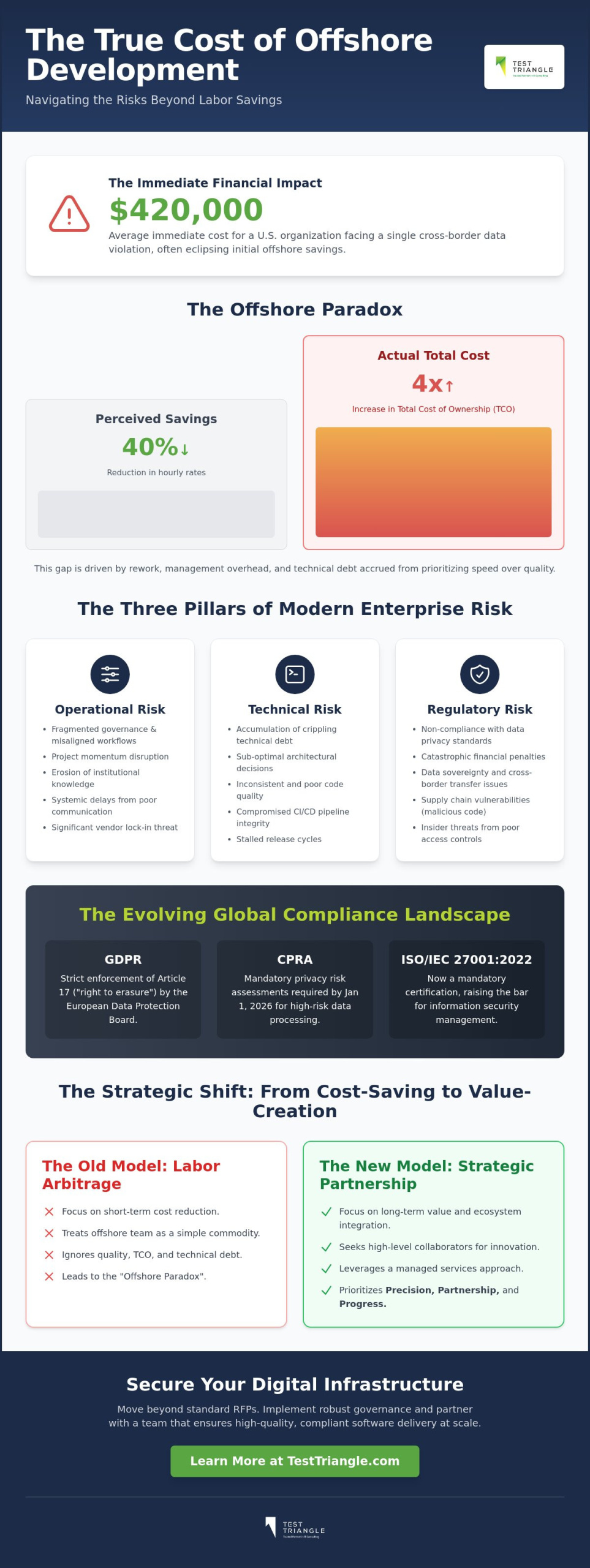

While enterprise deployments in 2026 can require investments exceeding $4.5 million, organizations that successfully execute platform consolidation are realizing an annual return of 51% and a two year payback period. It’s a significant figure that highlights the platform’s potential, yet many leaders still struggle with calculating ServiceNow implementation roi because traditional metrics often fail to capture the nuances of digital transformation. You likely recognize that ServiceNow is more than a ticketing tool; it’s a strategic engine for growth. However, the constant pressure to justify escalating licensing fees while managing the hidden costs of technical debt can make financial validation feel like a moving target.

We’ve designed this framework to bridge the gap between technical execution and executive accountability by providing a clear reporting structure for your investment. You’ll learn how to quantify soft benefits such as user experience improvements, identify the automation areas that drive a 30% to 45% reduction in operational support costs, and validate the consolidation of redundant legacy tools. This guide moves beyond static spreadsheets to offer a dynamic methodology, ensuring you can secure long term operational stability and prove that your ServiceNow roadmap is a disciplined driver of enterprise value.

Key Takeaways

  • Transition from monitoring basic operational activities to measuring strategic business value to ensure your platform investment aligns with 2026 enterprise objectives.
  • Master a multi-dimensional framework for calculating servicenow implementation roi that accurately accounts for both direct cost reductions and indirect productivity enhancements.
  • Identify how AI-driven workflows and broader digital transformation services act as catalysts for accelerating financial returns and expanding organizational talent capacity.
  • Safeguard your long-term financial outcomes by implementing rigorous digital assurance testing to mitigate the risks associated with over-customization and technical debt.
  • Explore how managed services and strategic IT staffing provide the specialized expertise required to maintain platform health and drive continuous operational stability.

The Strategic Imperative of Quantifying ServiceNow Business Value

In the high-stakes corporate environment of 2026, a standard Return on Investment (ROI) calculation is no longer sufficient to justify the scale of enterprise software commitments. Leaders must define ServiceNow ROI as the measurable impact of digitized workflows on overall enterprise profitability. This shift is essential because current market dynamics demand a transition from monitoring simple operational activities to identifying strategic value drivers that empower global growth. By moving beyond the narrow scope of ticket counts, organizations can position ServiceNow as a steady hand that guides the enterprise through technological volatility while ensuring long-term operational stability.

Establishing a baseline for calculating ServiceNow implementation roi requires a clear distinction between activity and value. While resolving a high volume of tickets suggests a productive service desk, it doesn’t necessarily correlate with financial gain if those tickets represent avoidable friction or redundant manual work. True value is realized when automation reduces the cost per transaction and mitigates the risks associated with human error. This approach transforms the platform from a back-office expense into a disciplined engine for strategy, execution, and success.

Shifting from Operational Metrics to Strategic Outcomes

While ticket resolution time remains a common KPI, it’s a surface-level metric that fails to capture the needs of modern enterprises. For global organizations, the more critical metric is the connection between workflow speed and the time-to-market for new business services. When you leverage ServiceNow consulting services to architect your environment, you aren’t just fixing IT issues; you’re accelerating the entire organization’s ability to respond to market shifts. Platform consolidation plays a vital role here by eliminating the redundant software spend and data silos that often plague large-scale digital infrastructures. Reducing this “tool sprawl” provides the peace of mind that comes from a unified, secure, and highly efficient digital ecosystem.

The Total Cost of Ownership (TCO) Equation

A comprehensive approach to calculating ServiceNow implementation roi must account for the full Total Cost of Ownership, which extends far beyond initial licensing. You’ve got to factor in the implementation phase, ongoing platform maintenance, and the inevitable costs of organizational change management. Many enterprises find that the balance between internal staffing and external expertise significantly impacts the TCO baseline. Utilizing managed outsourcing services often proves more cost-effective than maintaining a massive internal team, as it provides access to specialized skills without the overhead of full-time recruitment. Furthermore, don’t overlook the cost of training; ensuring your workforce is empowered to use the platform’s advanced automation is the only way to safeguard your investment and drive the precision, performance, and peace of mind your stakeholders expect.

A Multi-Dimensional Formula for Calculating Implementation ROI

To move beyond anecdotal evidence of success, organizations must adopt a rigorous mathematical approach to financial validation. The standard formula for calculating ServiceNow implementation roi is expressed as: (Total Benefits – Total Costs) / Total Costs x 100. While the equation appears straightforward, its accuracy depends on a comprehensive Total Cost of Ownership (TCO) calculation that accounts for licensing, implementation, and the organizational change management required for adoption. In the context of 2026 enterprise deployments, ServiceNow ROI acts as a longitudinal measure of platform maturity and cost recovery, reflecting an organization’s ability to extract continuous value from digitized workflows over time.

Time to Value (TTV) is a critical component of this framework, particularly for large scale deployments that may span 9 to 12 months. Shortening the TTV ensures that the organization begins realizing cost offsets earlier in the lifecycle, which is vital for maintaining stakeholder confidence. If you’re looking to refine your specific financial model, you might consider how our ServiceNow consulting services can help align these metrics with your broader corporate objectives.

Quantifying Direct Cost Savings

Direct savings provide the most immediate evidence of fiscal discipline. By automating incident management and request fulfillment, organizations can achieve a 35% to 50% reduction in IT labor hours, allowing staff to pivot toward innovation. Furthermore, properly architected deployments typically see a 30% to 50% decrease in Mean Time to Repair (MTTR) within the first six months, which significantly reduces the financial impact of system downtime. Platform consolidation further strengthens the balance sheet; by eliminating the maintenance fees of redundant legacy tools, CIOs can realize an annual ROI of approximately 51%. This systematic approach ensures stability, scalability, and success across the digital infrastructure.

Measuring Indirect Productivity Gains

Indirect gains often represent the largest portion of long term value, though they require more nuanced tracking. Improved employee self-service adoption is a primary driver here; when mature knowledge management and AI assisted workflows are in place, First Contact Resolution (FCR) rates should exceed 70%. This shift reduces administrative friction by allowing cross-departmental workflows to trigger automatically, bypassing manual bottlenecks. We also recommend quantifying the “Experience Factor,” which measures the productivity boost derived from high quality internal and customer interactions. When employees spend less time navigating complex legacy processes, they’re empowered to focus on strategic growth. To explore how these metrics apply to your unique environment, you can reach out to our strategic team for a detailed assessment.

Accelerating Returns through Ecosystem Integration and AI

ServiceNow serves as a powerful catalyst for broader Digital Transformation Services, acting as the connective tissue between disparate enterprise systems. When you integrate ServiceNow with ecosystems like AWS and Atlassian, you create a multiplier effect that significantly enhances the value of each individual platform. This interconnectedness is a pivotal factor when calculating ServiceNow implementation roi, as the returns are no longer confined to IT service management but extend across the entire software development lifecycle. By leveraging DevOps Consulting to align these tools, organizations can accelerate release cycles and ensure that technical execution directly supports business agility.

One of the most profound, yet frequently overlooked, benefits is the ROI of Talent Capacity. By automating the mundane, repetitive tasks that consume your workforce’s time, you empower your existing staff to focus on high-value innovation. This transition from “keeping the lights on” to driving strategic growth provides a sense of empowerment and institutional maturity. It’s about more than just saving hours; it’s about repurposing human expertise to solve complex challenges that a machine cannot, thereby securing your company’s long-term competitive advantage through stability, precision, and scalable growth.

The ROI of Platform Integration

The value of seamless data synchronization between ServiceNow and DevOps tools cannot be overstated. When information flows freely between platforms, you effectively eliminate the data silos that lead to miscommunication and project delays. This integration reduces “swivel-chair management,” where employees manually copy data from one system to another; this process is both inefficient and prone to error. By automating these handoffs, enterprises see a marked improvement in operational precision. This level of coordination ensures that every stakeholder operates from a single source of truth, fostering a culture of reliability and trust.

AI and Machine Learning Returns

The adoption of AI and Machine Learning within the ServiceNow platform offers some of the most quantifiable returns in 2026. Virtual Agents and Predictive Intelligence are no longer experimental; they’re essential tools for handling high-volume requests without human intervention. Mature enterprises report up to a 99.2% reduction in event noise through AIOps, which allows IT teams to ignore the clutter and focus on genuine threats. This AI-driven root cause analysis can cut Mean Time to Resolution (MTTR) by as much as 50%, directly impacting system stability and user satisfaction. Additionally, the role of GenAI in reducing the time required for documentation and knowledge base creation further accelerates the recovery of your initial investment, making the process of calculating ServiceNow implementation roi a clear demonstration of technological evolution.

Safeguarding ROI: Eliminating Technical Debt and Implementation Pitfalls

The mathematical model for calculating ServiceNow implementation roi is only as resilient as the platform’s underlying architecture. While the initial business case often focuses on immediate automation gains, long term financial success is frequently compromised by the silent accumulation of technical debt. Over-customization stands as the primary driver of this value erosion; when organizations deviate too far from standard features to satisfy niche departmental requests, they inadvertently create a rigid environment that is expensive to maintain and difficult to evolve. This complexity often leads to “shadow IT” workarounds, where frustrated users return to manual spreadsheets, effectively nullifying the productivity gains promised during the planning phase.

It’s a common misconception to view ServiceNow implementation as a one-and-done capital expense. In reality, the platform requires a disciplined, evergreen approach to ensure that the cost of recovery doesn’t eventually exceed the value of the digitized workflows. Organizations that fail to account for the ongoing necessity of platform health checks often see their ROI drop by 40% to 60% due to scope creep and technical inefficiencies. To ensure your investment remains a strategic asset rather than a legacy burden, you can consult with our architectural experts for a comprehensive platform audit.

The High Cost of Technical Debt

Custom code acts as a heavy anchor during the twice yearly ServiceNow upgrade cycle, significantly increasing the labor hours required for testing and remediation. To maintain a high “Upgradeability Score,” strategic leaders are increasingly prioritizing a return to Out-of-the-Box (OOTB) functionality. This methodology ensures that the enterprise can immediately leverage new features, such as advanced AI capabilities, without being held back by bespoke scripts that break during version transitions. By treating OOTB as a mandatory standard, you protect the platform’s institutional maturity and ensure that your TCO remains predictable and manageable.

Assurance and Testing as ROI Safeguards

The cost of poor quality is a direct hit to your bottom line, making Software and Digital Assurance Testing an essential protector of your investment. Automated regression testing is particularly vital for every new release, as it provides the peace of mind that existing workflows remain intact while new features are deployed. While automation handles the repetitive checks, Manual Testing remains indispensable for validating complex user journeys and ensuring that the human experience matches technical expectations. This rigorous QA approach prevents production defects that would otherwise result in costly system downtime and lost employee productivity, effectively safeguarding the precision and performance of your digital infrastructure.

Calculating ServiceNow Implementation ROI: A Strategic Framework for 2026

Optimising Long-Term ROI with Managed Services and Flexible Staffing

Achieving a sustainable return requires more than just a successful initial deployment; it demands a resource strategy that balances technical rigor with fiscal agility. While the mathematical framework for calculating ServiceNow implementation roi accounts for licensing and technical debt, the long term trajectory of that value is often determined by the quality of ongoing support. By positioning ServiceNow Consulting Services as the bridge between operational costs and business value, enterprises can ensure that their digital infrastructure remains aligned with evolving corporate objectives. This disciplined approach provides the peace of mind that comes from knowing your platform is managed by experts who prioritize resilience, reliability, and return.

Managed Services vs. In-House Maintenance

Transitioning to a fixed-fee model through Managed Outsourcing Services offers a predictable cost structure that is often superior to the variable expenses of internal hiring. When you maintain a large in-house team, you’re responsible for recruitment, training, and retention in a highly competitive market for ServiceNow specialists. Conversely, a managed service provider grants you immediate access to global expertise, including remote and offshore resources that can provide round-the-clock support without the overhead of permanent headcount. This continuous optimisation prevents platform stagnation, ensuring that your environment is always leveraging the latest automation capabilities to drive cost recovery.

Scaling with Flexible Staffing Models

Specific industries require specialized knowledge to maintain compliance and quality standards. For instance, highly regulated sectors often turn to IT staffing agencies for pharmaceutical industry requirements to find vetted professionals who understand the nuances of GxP compliance within ServiceNow. Utilizing Staffing Solutions allows you to scale your team with “just-in-time” talent for specific implementation phases or complex upgrades. This flexibility is a vital component when calculating ServiceNow implementation roi, as it reduces placement fees and allows you to pay only for the specialized skills you need, when you need them.

Ultimately, the path to long term success is paved through partnership. By choosing a reliable long-term collaborator, you move beyond the role of a service consumer and become a strategic partner in your own technological evolution. This collaborative spirit ensures that your ServiceNow investment continues to deliver operational stability and measurable profitability through a combination of human expertise and technical precision. We remain committed to your long term growth, providing the steady hand needed to navigate a fast changing technological landscape with strategy, support, and success.

Driving Sustained Enterprise Value Through Strategic Platform Governance

When organizations navigate the complexities of the 2026 digital landscape, calculating ServiceNow implementation roi must evolve from a one-time audit into a continuous discipline of value realization. By prioritizing out-of-the-box functionality to mitigate technical debt and integrating AI-driven workflows to enhance talent capacity, enterprise leaders can transform their digital infrastructure into a resilient engine for profitability. Achieving this level of institutional maturity requires a steady hand and a reliable long-term collaborator who understands the intricate requirements of highly regulated industries like Pharma and Finance.

As an Authorized ServiceNow and Atlassian Partner, we provide a global delivery model that leverages offshore cost advantages to deliver precision, performance, and peace of mind. Our approach ensures that your technological evolution is managed with the specialized expertise necessary to safeguard your investment and drive scalable growth. Maximize your platform value with our ServiceNow Consulting Services and secure the operational stability your enterprise deserves. We look forward to supporting your journey toward digital excellence and long-term success.

Frequently Asked Questions

How long does it typically take to see a positive ROI from ServiceNow?

Most global enterprises realize a full return on their investment within a 24 month period. While initial operational improvements such as labor hour recovery often manifest within the first six months, the break-even point typically occurs once the organization has successfully executed platform consolidation and moved into a state of continuous optimization. This timeline ensures that the stabilization phase is complete and the compounding benefits of automated governance are fully realized.

What are the most important KPIs for measuring ServiceNow implementation success?

Success is measured through a sophisticated blend of financial and operational indicators, specifically Mean Time to Resolution (MTTR), labor hour recovery, and the total reduction in legacy tool licensing fees. Strategic leaders also prioritize tracking First Contact Resolution (FCR) rates and self-service adoption levels. These metrics provide a comprehensive view of how digitized workflows are reducing administrative friction and empowering the workforce to focus on high-value innovation.

Does over-customising ServiceNow really decrease its long-term ROI?

Extensive customization significantly erodes long term value by increasing the technical debt and labor costs associated with bi-annual platform upgrades. By deviating from out-of-the-box functionality, organizations create a rigid environment that requires manual remediation during every version transition, which eventually inflates the Total Cost of Ownership. Maintaining architectural discipline ensures the platform remains agile and capable of adopting new features, such as advanced AI, without costly bespoke re-engineering.

How can I calculate the ROI of ServiceNow AI and automation features?

Evaluating the impact of AI involves measuring ticket deflection rates through virtual agents and the reduction in event noise provided by AIOps. When calculating ServiceNow implementation roi for these advanced modules, it’s essential to quantify the talent capacity gained by your technical staff. Shifting human expertise from routine alert management to strategic growth projects represents a substantial gain in organizational productivity and institutional maturity.

Is it better to use an MSP or in-house staff for ServiceNow maintenance to maximize ROI?

Utilizing a Managed Service Provider (MSP) often delivers a more predictable return by replacing variable internal recruitment and training costs with a disciplined, fixed-fee model. This strategic approach provides immediate access to a global pool of certified specialists, ensuring that platform maintenance is handled with precision and reliability. While in-house teams offer internal proximity, the MSP model typically fosters greater operational stability through continuous, expert-led optimization and risk reduction.

What is the role of testing and QA in protecting ServiceNow investment value?

Rigorous digital assurance acts as a critical safeguard that prevents production defects from compromising system availability and user trust. Automated regression testing ensures that new releases don’t disrupt established workflows, while manual validation protects the integrity of complex user journeys. By preventing unplanned downtime and the associated loss of employee productivity, a disciplined testing strategy directly protects the financial integrity of your large-scale technological evolution.

How do I justify the recurring licensing costs of ServiceNow to my CFO?

Justifying recurring fees requires framing ServiceNow as a unified platform that drives cost recovery through the consolidation of redundant legacy software. You should highlight the potential for a 51% annual ROI and the 30% to 45% reduction in operational support costs achieved through mature ITSM automation. Demonstrating how the platform acts as a steady hand that reduces enterprise risk allows executive leadership to view licensing as a strategic investment in long-term success.

Can ServiceNow ROI be measured across non-IT departments like HR or Legal?

Measuring calculating ServiceNow implementation roi across non-IT functions is highly effective when focusing on metrics such as onboarding speed and case resolution efficiency. Organizations utilizing HR Service Delivery frequently report a 60% to 75% improvement in new hire onboarding time, which significantly reduces administrative bottlenecks. These cross-departmental efficiencies ensure that the benefits of digitized workflows are felt across the entire enterprise, providing a consistent and empowered experience for all employees.

Paul Guy

Article by

Paul Guy

Paul serves as the Marketing Director at Test Triangle, where he leads a global team in driving growth through strategic B2B marketing and brand communications. With a strong emphasis on measurable outcomes and sustainable performance, he plays a pivotal role in aligning marketing functions to enhance customer engagement and accelerate business impact. Under his leadership, marketing initiatives have consistently delivered significant returns on investment, elevated brand visibility, and strengthened the company's presence across key markets.


Why do most enterprise leaders find their ServiceNow budgets ballooning by nearly double the initial estimate within the first eighteen months? It’s because the hidden costs of servicenow implementation aren’t just minor oversights; they’re the predictable consequences of treating a massive architectural shift as a simple software purchase. You likely already understand that the Now Platform is a cornerstone of digital evolution, yet the reality of opaque licensing and complex legacy integrations often creates a significant gap between expected value and actual spend.

We’re here to bridge that gap by uncovering the invisible financial traps and operational overheads that frequently derail even the most ambitious digital transformations. This guide delivers a transparent TCO framework designed to stabilize your budget and ensure your 2026 deployment remains strategically aligned with your broader business goals. We’ll explore how a disciplined approach to data management and training can transform potential overhead into predictable progress, securing the high ROI your organization demands while avoiding the common integration failures that stall momentum. By focusing on stability, precision, and growth, you can move from the “Zurich” release through the upcoming “Australia” update with total financial confidence.

Key Takeaways

  • Identify the structural drivers behind the 40-60% budget overruns common in enterprise deployments by navigating the complex ServiceNow “Custom Quote Maze.”
  • Mitigate the hidden costs of servicenow implementation by avoiding excessive architectural debt and the subsequent “upgrade tax” that restricts access to new platform features.
  • Calculate the true operational impact of internal opportunity costs, ensuring that the diversion of your subject matter experts does not compromise core business stability.
  • Implement a rigorous quality assurance framework and pre-implementation audit to identify technical hurdles before they escalate into expensive post-launch fixes.
  • Adopt a phased rollout methodology that balances out-of-the-box functionality with essential business customization to ensure a predictable and scalable total cost of ownership.

The ServiceNow Implementation Mirage: Why Initial Quotes Are Just the Tip of the Iceberg

The initial engagement with the ServiceNow platform often begins with a sense of optimism that’s quickly tempered by the reality of the “Custom Quote Maze.” Since the company doesn’t publish a standard rate card, every enterprise enters a highly negotiated environment where the final contract reflects a unique combination of user count, selected modules, and organizational scale. This lack of transparency often masks the hidden costs of servicenow implementation, leading many executives to mistake the licensing fee for the total investment. It’s a strategic oversight that can compromise long-term operational stability.

Industry data suggests that most enterprises underestimate their initial budget by 40% to 60%. This discrepancy occurs because the quote focuses on software acquisition, failing to account for the structural remediation required to make the platform functional. Think of it as the “Renovation Analogy.” Just as a contractor can’t know the state of a building’s internal wiring until the walls are opened, an implementation partner can’t fully assess the complexity of your legacy data until the project begins. If your IT foundation is fragmented, the effort to align it with ServiceNow’s architecture can easily double your projected timelines. Precision, predictability, and performance require looking far beyond the initial sales proposal.

The Gap Between Licensing and Functional Reality

A common pitfall is viewing a ServiceNow license as a finished solution rather than a sophisticated entry ticket. While the “Out-of-the-Box” (OOTB) promise is a powerful marketing narrative, it’s often a financial trap for organizations with unique regulatory requirements or complex workflows. Turning on a module is a technical task; configuring it to mirror your specific business logic requires deep strategic alignment. Without this alignment, the hidden costs of servicenow implementation surface through endless “fix-it” cycles that occur after the initial launch. True platform readiness involves bridging the gap between what the software can do and what your specific business needs it to do.

The 2026 Pricing Landscape: Fulfillers vs. Requesters

Within the 2026 fiscal environment, the distinction between Fulfiller and Requester licenses has become a critical focal point for budget stability. Fulfiller licenses, particularly for ITSM Professional with AI capabilities, carry a premium that can exceed $160 per user per month. Misclassifying users or failing to account for the growth of your “App Engine” footprint can lead to massive annual overages. To ensure a predictable roadmap, organizations must partner with experts who provide ServiceNow consulting services tailored to long-term scalability. This approach ensures that user-type classification remains accurate as your digital infrastructure evolves, providing the peace of mind that comes from financial precision and systemic improvement.

Architectural Debt: The Long-Term Cost of Over-Customization

While the initial deployment of the ServiceNow platform often focuses on immediate functional gains, the long-term financial burden of “architectural debt” represents one of the most significant hidden costs of servicenow implementation. This debt accumulates when organizations prioritize short-term convenience over platform standards, leading to a complex web of custom scripts and modified workflows. According to research on IT projects, large-scale software initiatives often exceed budgets not because of the initial build, but due to the unforeseen complexity of maintaining non-standard environments. In the ServiceNow ecosystem, this manifests as the “Upgrade Tax,” where custom code prevents your organization from seamlessly transitioning between releases like Zurich and Australia, effectively locking you out of the very innovation you’re paying for.

Integration complexity adds another layer to this financial iceberg. Connecting ServiceNow to high-scale environments like AWS or legacy ERP systems requires a disciplined approach to data throughput and API management. If your team builds custom point-to-point integrations instead of utilizing the native IntegrationHub, you aren’t just paying for the initial development. You’re committing to a permanent maintenance cycle where every third-party update risks breaking your connection. Furthermore, the cost of migrating “dirty data” into a clean ServiceNow instance is a major budget driver. Industry benchmarks suggest that organizations should allocate 20% to 30% of their total implementation budget purely for data migration and cleansing activities to avoid expensive post-launch remediation.

The High Price of Deviating from the OOTB Path

Every line of specialized script represents a future maintenance liability. To protect your return on investment, technical debt must be treated as a transparent line item in your initial budget rather than an afterthought. Strategic leaders prioritize stability, precision, and progress by enforcing a “standard-first” policy that minimizes deviations from out-of-the-box (OOTB) functionality. When customization is unavoidable, it must be documented with the same rigor applied to core business logic to ensure that future upgrades don’t become multi-month rescue missions. If you’re concerned about how your current customizations might impact future scalability, you may want to consult with a strategic partner to audit your roadmap.

Integration Hub and Third-Party API Costs

Modern ServiceNow deployments increasingly rely on automated workflows that connect to external clouds. However, many executives are surprised by transaction-based costs associated with IntegrationHub spokes and automated “pro” features. When scaling AWS Cloud Migration initiatives, the financial impact of API rate limits and data throughput charges can escalate quickly. Managing these costs requires a sophisticated understanding of how data flows between platforms. By balancing the use of IntegrationHub with a clear strategy for high-volume data exchanges, you can avoid the throughput charges that often quietly double the operational overhead of a connected enterprise.

The Operational Iceberg: Personnel, Training, and Quality Assurance

Beyond the technical architecture and licensing fees, the human element represents a massive portion of the hidden costs of servicenow implementation. Executives often overlook the “invisible” salary spend associated with their subject matter experts (SMEs). When you divert your top process owners from their core responsibilities to guide a deployment, the resulting productivity dip is a direct, yet unrecorded, expense. This internal opportunity cost is compounded by a specialized talent gap; industry professionals report that hiring dedicated ServiceNow developers often requires a 30% premium over standard IT roles due to the platform’s unique niche and the high demand for certified expertise.

The “QA Deficit” is another significant financial trap that emerges when organizations treat testing as a perfunctory final step rather than a strategic safeguard. Skipping rigorous validation leads to “post-launch shock,” where remediating a bug in a live environment can cost five to ten times more than fixing it during the development phase. Effective change management is equally vital; without it, employee resistance leads to platform underutilization. You don’t want to pay for a high-performance engine only to have your team use it like a basic spreadsheet. Success requires a disciplined focus on order, oversight, and optimization.

The Critical Role of Software and Digital Assurance

Rigorous quality assurance is the most effective way to protect your digital investment from unforeseen operational overhead. While automated tools are powerful, Manual Testing remains essential for validating complex ServiceNow workflows that involve nuanced human decision-making. By leveraging Software Test Automation Services, your organization can create a repeatable regression suite that reduces long-term maintenance spend. This “Shift Left” approach ensures that quality is baked into the methodology, preventing the architectural flaws that often derail 2026 deployment timelines.

Training and Platform Governance

Continuous learning is a mandatory operational expense, not a one-time workshop. As ServiceNow moves from the Zurich release toward Australia, your team must stay updated on new AI-driven decision intelligence and agentic capabilities to maintain peak efficiency. Establishing a Center of Excellence (CoE) is a proven strategy for preventing platform sprawl and the accumulation of “Zombie Modules”—those expensive, licensed features that sit idle because no one knows how to govern them. Strategic alignment between platform capabilities and business goals ensures that every dollar spent on training translates into tangible, scalable growth.

The Hidden Costs of ServiceNow Implementation: A Strategic Executive Guide for 2026

Strategic Mitigation: Auditing Your 2026 Implementation Roadmap

Mitigating financial risk requires a disciplined transition from reactive troubleshooting to proactive platform governance. A comprehensive pre-implementation audit serves as the diagnostic foundation, identifying the hidden costs of servicenow implementation before they manifest as significant budget overruns. This audit should scrutinize your existing data architecture and process maturity to determine whether a “Phased Rollout” or a “Big Bang” approach better suits your organizational risk profile. While a Big Bang deployment promises immediate consolidation, it frequently results in higher post-launch remediation costs. Conversely, a phased approach provides the flexibility to refine workflows based on real-world usage, ensuring that each milestone delivers stability, precision, and performance.

As we move through 2026, new financial variables have entered the landscape, specifically regarding AI compute credits and ESG reporting modules. The “Zurich” and upcoming “Australia” releases emphasize agentic AI and autonomous service management, which rely on a credit-based consumption model rather than traditional flat-fee licensing. Failing to forecast the volume of AI-driven transactions can lead to unexpected mid-quarter invoices. Furthermore, the rising demand for Environmental, Social, and Governance (ESG) transparency means that organizations must budget for specialized modules that track sustainability metrics across the digital supply chain. These emerging drivers represent the next frontier of total cost of ownership (TCO) management.

The Value of Managed Outsourcing

Comparing the expense of internal hiring against Managed Outsourcing Services is a critical step in stabilizing your post-implementation burn rate. Maintaining a full-time, in-house team of ServiceNow architects is often 30% more expensive than standard IT staffing, making a structured support model more financially viable for many global enterprises. By utilizing predictable Managed Service Provider Subscription Fees, you can eliminate the “emergency consulting” fees that occur when internal resources are overwhelmed by platform upgrades or complex integration failures. This approach positions your partner as a reliable long-term collaborator invested in your operational stability.

Forecasting for 2026 and Beyond

Strategic budget planning must account for ServiceNow’s biannual upgrade cycles, which require dedicated windows for testing and validation. The integration of Generative AI, specifically through “Now Assist,” into existing workflows necessitates a clear understanding of data throughput and compute requirements. As your ServiceNow footprint expands into multi-cloud governance, the complexity of managing cross-platform security and compliance will grow. Developing a three-year roadmap that anticipates these shifts ensures that your platform remains a driver of systemic improvement rather than a source of financial friction. To ensure your 2026 roadmap is optimized for both performance and cost, you should schedule a strategic implementation audit with our expert team.

Partnering for Predictability: The Test Triangle Approach

Achieving a successful deployment requires more than technical proficiency; it demands a disciplined methodology that prioritizes long-term financial predictability. At Test Triangle, we eliminate the anxiety associated with the hidden costs of servicenow implementation by integrating a strategic roadmapping phase that aligns platform capabilities with your specific business outcomes. Our “Testing-First” philosophy ensures that digital assurance isn’t a final hurdle but a continuous process, reducing the total cost of ownership by identifying architectural flaws before they escalate into expensive operational overhead. By balancing out-of-the-box functionality with essential, high-value customization, we protect your ability to scale without the burden of excessive technical debt.

The transition from a high-intensity implementation phase to a state of sustainable, managed growth is where many organizations struggle to maintain budget discipline. Our approach focuses on creating a seamless evolution, moving your enterprise from the initial “go-live” toward a model of continuous improvement and systemic progress. By anchoring our expertise in recognized global benchmarks, we provide the peace of mind that your complex digital infrastructure is managed with professional rigor. This methodology doesn’t just launch a platform; it establishes a foundation for stability, precision, and performance that lasts through every subsequent ServiceNow release cycle.

Comprehensive ServiceNow Consulting

To navigate the complexities of the 2026 release cycle, organizations need a partner that offers more than just technical execution. Our ServiceNow Consulting Services provide the strategic oversight necessary to ensure that every module deployment translates into tangible business value. We recognize that specialized talent is a major cost driver, which is why our IT Staffing Services are designed to fill critical niche gaps in your project team with certified experts who understand the nuances of the Now Platform. In a recent enterprise engagement, we successfully reduced implementation overruns by 25% by implementing an automated QA framework that caught integration errors in real-time, proving that rigorous validation is the ultimate cost-saving tool.

Ensuring Long-Term Operational Stability

We view our clients not as transactional accounts but as partners in a journey toward digital maturity. Transitioning from initial implementation to sustainable growth requires a reliable long-term collaborator who can provide the institutional maturity needed to operate across diverse, highly regulated industries. Our global delivery model ensures that your complex digital infrastructure receives 24/7 support, providing the empowerment found in large-scale technological evolution without the risk of downtime. This commitment to operational excellence allows your internal teams to focus on innovation while we handle the technical rigor of platform maintenance and governance. Consult with our ServiceNow experts to audit your implementation roadmap and secure your organization’s technological future.

Securing Your Digital Future through Strategic Platform Governance

Managing the total cost of ownership for a high-scale platform requires a shift from tactical software acquisition to a permanent architectural commitment. By identifying the hidden costs of servicenow implementation during the planning phase, your organization can avoid the structural debt and personnel gaps that frequently stall digital evolution. We’ve explored how a disciplined methodology rooted in quality assurance and proactive governance transforms potential financial traps into a predictable roadmap for systemic improvement. Achieving peak performance in 2026 depends on your ability to balance out-of-the-box efficiency with the essential customizations that drive unique business value.

As a seasoned expert in the global technological landscape, Test Triangle leverages its strategic partnerships with ServiceNow and AWS to provide the institutional maturity your enterprise requires. Our global presence across Europe, North America, and Asia, combined with specialized expertise in Software and Digital Assurance, ensures that your infrastructure remains resilient against the complexities of upcoming release cycles. We invite you to Download our ServiceNow TCO Framework or Book a Strategic Audit to align your platform capabilities with your long-term business goals. We’re ready to help you achieve lasting stability, scalability, and success.

Frequently Asked Questions

What is the average cost of a ServiceNow implementation in 2026?

Implementation costs typically range from three to five times the annual software licensing fees. For enterprise organizations, complex deployments often range from $100,000 to over $500,000. Professional services and implementation can account for approximately 75% of the total first year investment, with licensing making up the remaining 25%.

Why does ServiceNow customization increase long-term costs?

Excessive customization creates architectural debt that complicates the biannual upgrade cycle. When you deviate from out of the box functionality, you incur an “upgrade tax” because custom scripts must be manually remediated for every new release, such as the upcoming Australia update. This adds recurring maintenance overhead that restricts your ability to access new platform features quickly.

How much should we budget for ServiceNow training and change management?

Organizations should allocate between $50 and $150 per user specifically for role based training. This investment is crucial for preventing platform underutilization and the accumulation of licensed features that stay idle because the team lacks the expertise to govern them. Continuous learning ensures that your staff can manage the evolving AI capabilities found in the latest releases.

What are the most common “hidden” integration costs with ServiceNow?

Hidden costs often stem from data migration activities and transaction based fees within the IntegrationHub. It’s recommended to budget 20% to 30% of the total implementation cost purely for data migration to ensure a clean transition. Additionally, automated workflows and third party spokes can trigger consumption based charges that aren’t always apparent in the initial licensing quote.

Can I implement ServiceNow without a partner to save costs?

While an internal approach is possible, it often leads to higher hidden costs of servicenow implementation due to a lack of specialized platform expertise. Experienced partners reduce implementation timelines and prevent expensive post launch fixes. Furthermore, hiring dedicated internal ServiceNow architects is frequently 30% more expensive than standard IT staffing, making a partner model more cost effective for long term stability.

How do ServiceNow licensing updates in 2026 affect my budget?

The shift toward AI driven capabilities in the Zurich and Australia releases introduces credit based consumption models that require precise forecasting. ITSM Professional Edition with AI now costs $160 or more per user per month. Organizations must carefully classify users as fulfillers or requesters to avoid significant annual overages as their digital footprint expands.

What is the role of QA in reducing ServiceNow implementation costs?

Rigorous quality assurance acts as a financial safeguard by identifying technical hurdles before they reach the production environment. Catching a bug during the development phase is significantly cheaper than post launch remediation, which can cost five to ten times more in a live environment. A testing first philosophy ensures that the platform remains stable and performs as intended from day one.

Is ServiceNow ROI achievable within the first 12 months?

Yes, Forrester TEI studies have demonstrated a 264% ROI with a 6 month payback period for the Now Platform. Achieving this rapid return requires strategic alignment and a disciplined approach to the hidden costs of servicenow implementation. By managing architectural debt and focusing on out of the box functionality, organizations can secure their technological future while staying within budget.

Paul Guy

Article by

Paul Guy

Paul serves as the Marketing Director at Test Triangle, where he leads a global team in driving growth through strategic B2B marketing and brand communications. With a strong emphasis on measurable outcomes and sustainable performance, he plays a pivotal role in aligning marketing functions to enhance customer engagement and accelerate business impact. Under his leadership, marketing initiatives have consistently delivered significant returns on investment, elevated brand visibility, and strengthened the company's presence across key markets.
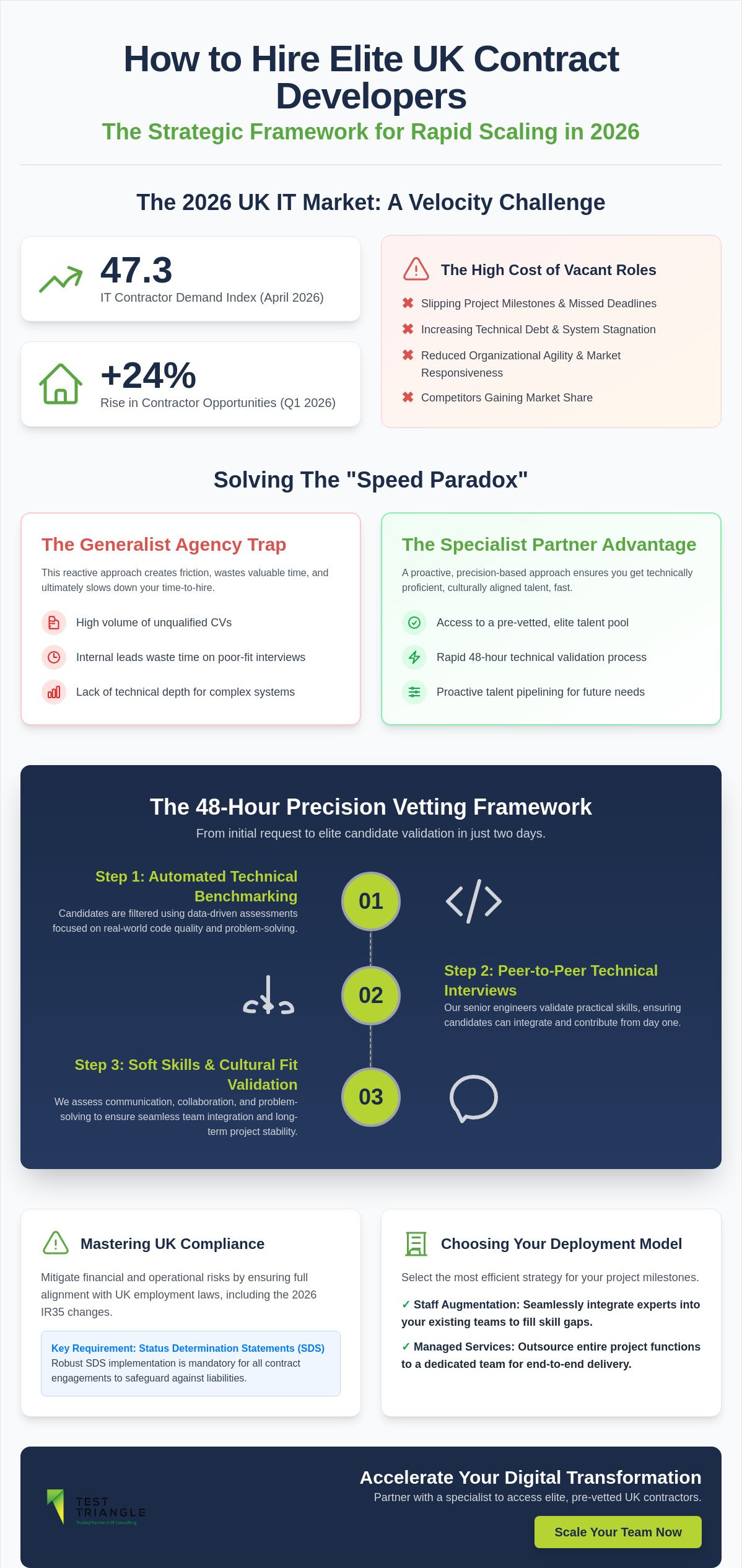

With ServiceNow implementation costs typically reaching three to five times the initial license fee, the strategic challenge for global organizations isn’t just the initial purchase; it’s the persistent governance of a rapidly evolving digital ecosystem. You’ve likely seen how unmanaged technical debt and CMDB inaccuracies can turn a transformative vision into a series of downstream failures. To solve this, sophisticated servicenow managed services for enterprises provide the technical rigor, strategic oversight, and specialized talent required to maintain platform integrity. We focus on delivering precision, performance, and progress through a methodology that connects architectural health to measurable business outcomes.

This guide offers a comprehensive 2026 roadmap designed to help you master the complexities of enterprise-scale deployments with a structured, risk-mitigated approach. You’ll learn how to align IT workflows with your broader corporate objectives while ensuring your platform remains scalable as you grow. We’ll preview the critical phases of the “Australia” release upgrade, the integration of the new Prime pricing tier capabilities, and the deployment of the AI Control Tower for secure, agentic automation. By the end of this article, you’ll have a clear path to achieve long-term operational stability and a platform that evolves alongside your enterprise.

Key Takeaways

  • Learn why a phased, risk-mitigated approach to deployment is essential for maintaining business continuity across global infrastructures, effectively neutralizing the risks associated with high-stakes “Big Bang” implementations.
  • Leverage specialized servicenow managed services for enterprises to navigate the 2026 strategic roadmap, ensuring that technical configurations remain precisely aligned with high-level corporate objectives and systemic growth.
  • Identify the optimal order of operations for module integration, prioritizing IT Service Management as the foundational layer to maximize immediate return on investment and long-term operational stability.
  • Solve the persistent talent gap by evaluating strategic staffing models that secure the certified expertise required to maintain platform integrity amidst a rapidly changing technological landscape.
  • Shift from a project-centric mindset to a model of continuous platform evolution, ensuring your organization is positioned to capitalize on the latest AI-driven features and version upgrades.

The Architecture of Success: Defining the ServiceNow Implementation Roadmap

The architecture of success in modern digital infrastructure isn’t built on static project plans; it’s forged through a living strategic document that synchronizes complex IT workflows with overarching corporate goals. For global organizations, the “Big Bang” deployment model often results in catastrophic operational friction, making a phased transition the superior choice for maintaining business continuity while scaling technical capabilities. Establishing a robust, multi-year roadmap serves as a definitive risk-mitigation tool for large-scale digital transformation. In 2026, the “Assess, Align, Accelerate” framework has become the industry benchmark, particularly as firms prepare for the “Australia” release production upgrades scheduled for June 18. By utilizing servicenow managed services for enterprises, leadership teams can ensure this framework isn’t just theoretical but translates into tangible platform stability, precision, and progress.

Strategic Alignment and Executive Buy-in

Successful platform adoption requires a shift from purely technical metrics to specific corporate KPIs. By mapping platform capabilities directly to business outcomes, such as reducing mean time to resolution or improving employee retention through seamless service delivery, IT leaders can secure sustained funding. We recommend establishing a Governance Council to oversee roadmap milestones, ensuring that every configuration choice supports the enterprise’s long-term vision. Identifying “Quick Wins” during the initial ninety days is essential to demonstrate immediate value to stakeholders, effectively justifying the implementation costs which typically range from three to five times the first-year license fee.

The 2026 Landscape: AI and Hyper-automation

Since its inception, ServiceNow has evolved from a ticketing tool into a comprehensive workflow engine that now prioritizes agentic AI. The 2026 roadmap must integrate GenAI and Now Assist into early phases, especially as these capabilities are now bundled within the Advanced and Prime pricing tiers. Preparing data structures for AI-driven incident management is no longer optional; it’s a foundational requirement for hyper-automation. Strategic servicenow managed services for enterprises focus on future-proofing the platform against evolving regulatory requirements, such as the June 2026 Chemical Regulatory framework, by ensuring that data governance and AI Control Tower protocols are embedded into the core architecture from day one. This proactive approach leads to a scalable, secure, and sophisticated digital environment that empowers the global workforce.

The 5-Phase Strategic Framework for Enterprise Deployment

Executing a global deployment requires more than just technical configuration; it demands a methodical progression that balances speed with architectural integrity. By adopting a five-phase framework, organizations can transform their digital infrastructure from a collection of siloed tools into a unified engine for growth. High-tier servicenow managed services for enterprises provide the necessary guardrails during this transition, ensuring that each phase builds upon a stable foundation rather than compounding technical debt. This disciplined approach allows leadership to maintain visibility while the platform scales across diverse business units.

Phase 1 focuses on Discovery and Foundation, where teams audit legacy processes to define the core Configuration Management Database (CMDB). This stage is critical because ServiceNow’s AI-driven strategy relies heavily on high-quality data to fuel automation and agentic AI. Phase 2 moves into Core ITSM Deployment, establishing incident, problem, and change management workflows that standardize service delivery. Once these essentials are in place, Phase 3 introduces IT Operations Management (ITOM) for full-stack observability. Phase 4 extends the platform’s reach into HR Service Delivery (HRSD) or Strategic Portfolio Management (SPM), aligning technical output with business value. Finally, Phase 5 centers on Continuous Optimization, where the platform is refined to meet shifting enterprise needs.

Phase 1: The Criticality of a Clean CMDB

The CMDB acts as the single source of truth for the entire roadmap. If the data within this database is fragmented or outdated, every downstream process, from automated ticket routing to AI-driven insights, will fail. Enterprises must decide between automated discovery tools and manual data entry, though automation is almost always preferred for maintaining accuracy at scale. Avoiding the “garbage in, garbage out” trap requires a disciplined approach to data governance that starts on day one. It’s the difference between a platform that provides clarity and one that creates confusion.

Scaling Through Managed Services

As the deployment matures, the focus shifts from initial setup to long-term operational health. Transitioning to professional Managed Service Provider (MSP) support through servicenow managed services for enterprises allows internal IT teams to focus on innovation while experts handle the complexities of platform maintenance. This model ensures stability through recurring optimization audits and dedicated helpdesk support that scales with your needs. To ensure your platform remains a high-performance asset, it’s vital to discuss your specific operational requirements with a strategic partner. This partnership provides the institutional maturity needed to manage the “Australia” release and future platform evolutions with precision.

Order of Operations: Prioritising Modules for Maximum ROI

Determining the precise sequence of module activation is a high-stakes decision that dictates the speed of realized value across the organization. While the platform’s versatility is vast, establishing IT Service Management (ITSM) as the foundational layer remains the strategic standard for 90% of enterprises. This preference isn’t merely traditional; it’s a structural necessity because ITSM provides the essential data taxonomies and service schemas required to support more advanced automation. By utilizing servicenow managed services for enterprises, leadership teams can navigate these priorities with a steady hand, ensuring that each new capability rests on a stable, high-performance base that supports systemic growth.

When comparing early ITOM (IT Operations Management) versus HRSD (HR Service Delivery) integration, the choice typically hinges on the organization’s most pressing operational friction. If the enterprise suffers from frequent service outages or lacks visibility into complex cloud infrastructures, ITOM offers the immediate benefit of full-stack observability. Conversely, if the primary goal is to centralize and automate employee requests across global offices, HRSD provides a more visible impact on internal productivity. A common objection arises regarding whether industry-specific modules should be implemented first to address niche requirements. While these modules offer deep functionality, deploying them before the core ITSM engine often creates architectural silos that are difficult to reconcile during later stages of the roadmap.

For organizations focused on technical agility, integrating ServiceNow with Atlassian ecosystems is a critical milestone for achieving DevOps synergy. This connection creates a seamless bridge between the service desk and the development pipeline, allowing for automated ticket synchronization and improved visibility. By aligning these industry-leading platforms, enterprises can achieve a level of speed, security, and scalability that traditional siloed approaches cannot match.

The ITSM-First Approach

Standardizing service desks through an ITSM-first strategy is the most effective way to reduce operational friction and create a unified user experience. By mapping incident management directly to business impact levels, IT teams can prioritize resources based on actual financial or operational risk. The minimum viable platform for a successful enterprise launch consists of a governed CMDB core, a functional incident management workflow, and a standardized service portal. This foundational setup allows the enterprise to capture clean data from day one, which is essential for fueling the AI-driven insights promised in the 2026 roadmap.

Expanding to ITOM and Beyond

Once the foundation is secure, leveraging AIOps within the ITOM module allows organizations to transition from reactive firefighting to proactive maintenance. This evolution is particularly powerful when integrating ServiceNow with AWS cloud environments, where automated discovery and event management can significantly reduce mean time to resolution. Linking your ServiceNow Implementation to broader DevOps Consulting goals ensures that your platform doesn’t just manage services but actively accelerates digital transformation. This strategic expansion transforms the platform into a versatile engine for enterprise-wide innovation and long-term stability.

ServiceNow Managed Services for Enterprises: The 2026 Strategic Roadmap

Overcoming the Talent Gap: Staffing Your Roadmap

The primary bottleneck for global organizations executing a 2026 roadmap isn’t the platform’s architecture; it’s the acute shortage of certified ServiceNow architects and developers. This talent gap often halts progress between the discovery and deployment phases, as enterprises struggle to secure specialists who understand the nuances of the “Australia” release and its bundled AI capabilities. The “Build vs. Buy” dilemma is a constant pressure for IT leadership. While training internal staff is a valuable long-term objective, the immediate requirements of a high-stakes rollout often demand the technical rigor and institutional maturity that only servicenow managed services for enterprises can provide. Specialized recruiters play a vital role here, sourcing hard-to-find talent that bridges the gap between technical execution and business strategy.

To maintain momentum without inflating permanent headcount, many organizations utilize IT Staffing Services to fill tactical gaps during the most labor-intensive milestones. This approach allows for a versatile staffing model that adjusts to the project’s pulse, ensuring that your roadmap doesn’t stall due to a lack of specialized human capital. If your organization is facing a critical expertise shortage, it is time to consult with our staffing experts to secure the certified talent necessary for a seamless deployment.

Hybrid Staffing Models for Global Rollouts

Balancing permanent on-site leadership with remote offshore resources is a proven strategy for maintaining 24/7 development cycles. Using contract specialists for high-intensity Phase 2 and 3 milestones allows enterprises to scale their technical capacity rapidly without the long-term burden of high overhead. This model frequently utilizes margin-based billing for temporary tech staff, providing a cost-effective way to access elite skills during critical transition periods. It’s a disciplined approach that prioritizes operational speed while maintaining strict budget control.

Quality Assurance and Testing Roles

Manual and Automation Testing are non-negotiable requirements for any enterprise roadmap. Integrating QA engineers early in the deployment process prevents the accumulation of technical debt that can cripple a platform’s performance over time. System Integration Testing (SIT) is particularly crucial in multi-platform environments where ServiceNow must communicate flawlessly with AWS, Atlassian, or legacy ERP systems. Following a structured testing guide ensures that every configuration is validated against rigorous security and performance standards before reaching production, safeguarding the integrity of your digital ecosystem.

The Final Milestone: Partnership and Long-Term Evolution

The final milestone in a successful enterprise deployment is the fundamental shift from a project-centric view to a platform-centric philosophy. While the initial go-live represents a significant achievement, the true value of servicenow managed services for enterprises is realized through continuous, incremental evolution. This “platform mindset” ensures that your digital infrastructure remains responsive to shifting market conditions rather than becoming a legacy burden. Precision drives progress. To maintain this momentum, regular version upgrades are essential. With the “Australia” release production upgrades scheduled for June 18, 2026, organizations must stay current to access critical innovations like the AI Control Tower or the bundled Now Assist capabilities now included in the Prime pricing tier. Neglecting these updates doesn’t just stall innovation; it increases security risks and technical debt.

As a seasoned expert in the field, Test Triangle acts as a steady hand in this fast-changing landscape, positioning itself as the strategic collaborator for your IT Service Management solutions. We focus on the peace of mind derived from risk reduction and the empowerment found in large-scale technological evolution. Stability requires constant motion. Transitioning to a managed model allows your internal leadership to focus on high-level strategy while we manage the technical rigor of platform health, ensuring your investment continues to deliver measurable ROI long after the initial implementation.

Measuring Roadmap Maturity

Determining the success of your deployment requires tracking key performance indicators (KPIs) that reflect real business impact. We recommend focusing on metrics such as the reduction in mean time to resolution (MTTR), the accuracy of CMDB data, and overall user adoption rates across different modules. Annual “Health Checks” are a non-negotiable part of this process. These audits identify system bloat and misconfigurations before they cause downstream failures. By leveraging the strategic trinity of Atlassian, ServiceNow, and AWS, organizations can achieve a level of enterprise-wide agility that ensures every workflow is optimized for speed and security.

Ready to Accelerate Your Transformation?

Our “Assess, Align, Accelerate” value proposition is designed to lead your organization from a general need for improvement to a specific, high-performance technical solution. This methodical approach ensures that your ServiceNow environment remains a scalable asset that grows alongside your enterprise. We invite you to explore Test Triangle’s comprehensive IT services to see how our versatile staffing and implementation models can support your long-term goals. Reviewing your strategic roadmap with a consultant today is the best way to ensure your digital infrastructure is prepared for the complexities of the 2026 landscape. Your roadmap is the bridge between technology and business outcome.

Mastering the Evolution of Enterprise Workflows

Achieving operational excellence at scale requires a transition from reactive maintenance to a disciplined, phased strategy that prioritizes architectural health and specialized expertise. By following a structured roadmap, organizations can ensure their digital infrastructure remains resilient while capitalizing on agentic AI and automated governance. Utilizing servicenow managed services for enterprises provides the institutional maturity needed to navigate complex version upgrades and talent shortages with confidence. We focus on delivering precision, performance, and progress through a methodology that transforms technical debt into a scalable engine for growth.

As a ServiceNow Authorized Partner with a global presence across Europe, North America, and Asia, Test Triangle is uniquely positioned to support high-compliance sectors like Finance and Pharma. We act as a reliable long-term collaborator, ensuring your platform aligns with both technical benchmarks and overarching business goals. It’s time to secure your digital future and eliminate the friction of unmanaged systems. Book a Strategic ServiceNow Roadmap Consultation with Test Triangle to refine your deployment strategy. Your journey toward a more efficient and empowered enterprise begins with a single, strategic step.

Frequently Asked Questions

What is the typical timeline for a ServiceNow enterprise implementation?

A standard enterprise-scale deployment typically spans six to twelve months, though the exact duration depends on the complexity of legacy integrations and the scope of the initial modules. While smaller organizations might achieve a go-live in a shorter window, global firms require a more methodical pace to ensure data integrity and user adoption across multiple business units. This timeline includes the critical discovery phase and the subsequent iterative testing cycles necessary for a risk-mitigated launch.

Should we start with ITSM or ITOM in our roadmap?

Enterprises should almost always prioritize IT Service Management (ITSM) as the foundational layer of their roadmap. Because ITSM establishes the core service taxonomies and incident workflows, it provides the essential data structure required for IT Operations Management (ITOM) to function effectively. Starting with ITSM allows teams to standardize the user experience before introducing the advanced observability and AIOps capabilities offered by ITOM.

How much does a ServiceNow implementation usually cost for a global firm?

Total investment for a global firm is determined by a combination of licensing tiers, implementation complexity, and ongoing support requirements. Since ServiceNow operates on a custom-quote basis, organizations must account for the fulfiller base size and the number of integrated business units when budgeting. Utilizing servicenow managed services for enterprises helps manage these costs by providing a predictable expenditure model for long-term maintenance and platform evolution.

What are the most common reasons for ServiceNow roadmap failure?

Roadmap failures most frequently stem from poor governance, inadequate data quality in the CMDB, and a lack of specialized technical talent. When organizations treat the platform as a one-time project rather than a living ecosystem, they often accumulate technical debt that hinders future upgrades. Success requires a disciplined approach that aligns technical configuration with high-level business objectives while maintaining a steady hand through continuous platform evolution.

How do we handle data migration from legacy systems to ServiceNow?

Handling data migration requires a rigorous “clean as you go” strategy to avoid transferring legacy inaccuracies into the new environment. Teams should utilize automated discovery tools to validate existing assets while manually auditing critical service relationships to ensure the CMDB remains a single source of truth. This process often involves a phased migration where data is mapped, transformed, and validated in a staging environment before the final production cutover.

What is the role of a ServiceNow Implementation Specialist versus a Generalist?

A ServiceNow Implementation Specialist possesses deep, certified expertise in specific modules like HRSD or ITOM, ensuring that complex configurations follow industry best practices. In contrast, a Generalist provides broader oversight of the platform’s daily operations and basic maintenance tasks. For global organizations, the strategic visionary role of a Specialist is essential during the high-intensity deployment phases to prevent architectural silos and ensure long-term scalability.

Can ServiceNow be integrated with Atlassian Jira for DevOps?

Integrating ServiceNow with Atlassian Jira is a standard practice for organizations seeking to achieve seamless ticket synchronization between service desks and development teams. This connection allows developers to remain within their preferred environment while IT managers maintain visibility and governance within the ServiceNow platform. By aligning these industry-leading tools, enterprises can accelerate delivery cycles while maintaining strict compliance and security standards.

How often should we update our ServiceNow roadmap?

Roadmaps should be reviewed and updated at least quarterly to account for platform release cycles and shifting business priorities. This methodical rhythm allows leadership to adjust the order of operations based on realized ROI and emerging operational needs. Regular updates ensure that your organization is prepared to leverage the latest innovations and bundled AI capabilities, keeping the platform aligned with your broader digital transformation goals.

Paul Guy

Article by

Paul Guy

Paul serves as the Marketing Director at Test Triangle, where he leads a global team in driving growth through strategic B2B marketing and brand communications. With a strong emphasis on measurable outcomes and sustainable performance, he plays a pivotal role in aligning marketing functions to enhance customer engagement and accelerate business impact. Under his leadership, marketing initiatives have consistently delivered significant returns on investment, elevated brand visibility, and strengthened the company's presence across key markets.


With 81% of organizations admitting they shipped code with known vulnerabilities into production last year, the margin for error in software delivery has effectively vanished. You’ve likely felt the mounting tension between the demand for rapid release cycles and the critical need to protect an infrastructure where global breach costs now average $4.44 million. Adopting sophisticated ci/cd pipeline security best practices is the only way to resolve this conflict, transforming your delivery chain from a potential liability into a resilient, strategic asset. This guide promises to equip you with a comprehensive framework to master modern delivery complexities, ensuring your organization stays ahead of the sophisticated threats emerging in 2026.

We’ll provide a methodical checklist that bridges the gap between high-level security policy and practical, automated execution. By examining the latest NIST DevSecOps practices and OWASP standards, we’ll show you how to eliminate secrets exposure and verify supply chain integrity without sacrificing momentum. You’ll discover how a disciplined approach to pipeline hardening results in both reduced risk and enhanced operational stability, positioning your enterprise as a leader in secure digital transformation.

Key Takeaways

  • Analyze the evolution of the 2026 threat landscape to transition from reactive patching toward a sophisticated, “Security-by-Design” architecture that protects against complex supply chain poisoning.
  • Establish a resilient foundation for your delivery infrastructure by centralizing identity management and implementing ci/cd pipeline security best practices that eliminate high-risk orphaned credentials.
  • Ensure continuous compliance and artifact integrity by integrating automated Software Bill of Materials (SBOM) generation and real-time dependency scanning into your existing workflows.
  • Execute a comprehensive hardening strategy using a tactical checklist that prioritizes mandatory peer reviews, signed commits, and the seamless integration of SAST and DAST tools.
  • Align your technical delivery with long-term business objectives by leveraging expert DevOps consulting to architect a secure, scalable framework that meets global security benchmarks.

Securing the Software Supply Chain: The 2026 CI/CD Threat Landscape

The digital perimeter has effectively dissolved, placing the software delivery engine at the center of the enterprise risk profile. In 2026, the sophistication of adversaries has reached a critical juncture where the integrity of the delivery process is as vital as the code itself. The evolution from simple code injection to complex supply chain poisoning reflects a maturation of cyber-adversaries who now target the build server and orchestration layers rather than just the application. Implementing robust ci/cd pipeline security best practices is no longer a tactical option but a strategic imperative for any organization aiming to maintain operational stability and customer trust.

Adopting a “Security-by-Design” approach is essential to counter these threats, moving beyond the era of reactive patching which often leaves systems exposed for critical windows. A 2025 survey revealed that 81% of organizations admitted to shipping code with known vulnerabilities, a statistic that underscores the failure of traditional perimeter-based defenses. By integrating security protocols directly into the continuous integration (CI) and continuous delivery (CD) workflow, enterprises can validate every artifact before it reaches production, thereby neutralizing threats at the source. This proactive posture is particularly vital as AI-generated code increases the volume and velocity of vulnerabilities, requiring automated, intelligent oversight to maintain a secure posture.

Identifying Vulnerabilities in Modern Pipelines

Modern delivery environments are often compromised by third-party plugins and automated integrations that lack rigorous security vetting. These tools, while enhancing productivity, frequently introduce unmanaged risks that bypass traditional firewalls. The rise of “Shadow DevOps”—where teams spin up unmanaged pipeline environments outside of official corporate governance—creates significant blind spots that attackers are eager to exploit. In 2026, a Supply Chain Attack is defined as a strategic compromise of third-party components or delivery infrastructure designed to inject malicious payloads into trusted downstream environments. Data from 2025 indicates that 1.6% of organizations using npm have already encountered at least one malicious dependency, proving that trust must be verified, not assumed.

The Shift from DevOps to DevSecOps

Transitioning from DevOps to DevSecOps requires a fundamental cultural and technical shift that prioritizes security, stability, and scalability. This evolution moves security from a final checkpoint to a continuous thread woven through the entire development lifecycle. Security automation is the primary driver of this change, as it reduces the friction between developers and security teams by providing real-time feedback within existing workflows. When security is automated, it becomes a facilitator of speed rather than a bottleneck. A unified, security-first delivery culture empowers teams to own the security of their code, ensuring that every release is backed by a strategic framework of automated controls and expert human oversight. This alignment provides the peace of mind necessary for large-scale technological evolution in a volatile threat environment.

Hardening the Pipeline: Identity and Secrets Management

Centralizing identity and access management (IAM) within the orchestration layer serves as the most effective method for eliminating orphaned credentials that frequently persist after organizational shifts. By integrating these identities with enterprise-wide directories, security teams maintain a single source of truth, ensuring that access is revoked instantly across all environments. Role-Based Access Control (RBAC) complements this by defining precise boundaries for what each user or service account can execute, which prevents unauthorized modifications to pipeline configurations. These ci/cd pipeline security best practices focus on reducing the blast radius of any potential compromise by ensuring that no single identity possesses excessive reach.

For high-risk deployment stages, strategic implementation of Just-in-Time (JIT) access provides a sophisticated layer of protection by granting elevated permissions only for the duration of a specific task. This approach, combined with the use of enterprise-grade secrets vaults rather than insecure environment variables, ensures that sensitive data like API keys and certificates are encrypted at rest and in transit. Unlike static environment variables, modern vaults offer dynamic secret generation and comprehensive audit logs, providing the transparency required for rigorous regulatory compliance. Organizations looking to integrate these rigorous controls into their existing workflows often find that consulting with strategic experts is the most efficient path to long-term operational stability.

Implementing Zero Trust and Least Privilege

A zero-trust architecture dictates that every service, runner, and user must be verified before interacting with the delivery pipeline. This methodology aligns with the NSA and CISA CI/CD Security Guidelines, which advocate for the continuous rotation of access keys and the strict limitation of runner permissions. By auditing these interactions in real-time, organizations can identify anomalous behavior before it escalates into a breach. Reducing the attack surface requires a disciplined commitment to the principle of least privilege, ensuring that pipeline runners only access the specific resources necessary for their immediate build tasks.

Eliminating Hardcoded Secrets and Credential Leaks

Despite the availability of advanced tools, credential leaks remain a primary vulnerability, with 2025 data showing that 32% of all scanner-detected repository secrets were tied directly to CI/CD systems. Implementing automated pre-commit hooks is a vital first step, as it prevents sensitive data from ever entering the version control system. Continuous scanning must extend beyond the code itself to include build logs and artifact metadata, where secrets often hide in plain sight. In 2026, a single leaked API key isn’t just a technical oversight; it’s a multi-million dollar invitation for automated adversaries to dismantle your entire digital infrastructure in seconds.

Integrity Assurance: Validating Code and Dependencies

Maintaining the absolute integrity of software components has become a primary challenge for the modern enterprise, particularly as the complexity of the dependency graph continues to expand. In an environment where 1.6% of organizations using npm have encountered at least one malicious dependency, verifying the provenance of every library is a non-negotiable pillar of ci/cd pipeline security best practices. Establishing a “Trusted Registry” for all container images and build artifacts ensures that only vetted, internal resources are utilized during the orchestration process, effectively neutralizing the risk of public repository poisoning. This strategic isolation allows organizations to solidify, secure, and scale their delivery pipelines with the confidence that their foundational components remain untainted by external adversaries.

Automating Software Composition Analysis (SCA) to identify known vulnerabilities (CVEs) in real-time provides a critical layer of defense that operates at the speed of modern development. By integrating these scans directly into the build cycle, teams can detect and remediate security flaws before they are baked into the final artifact. This proactive validation is further reinforced by implementing cryptographic code signing, which ensures artifact integrity from the moment of creation to the point of deployment. By enforcing signature verification at the production gate, enterprises can guarantee that the code running in their environments is exactly what was approved during the build phase, providing total transparency and operational stability.

Software Bill of Materials (SBOM) and Third-Party Risk

In 2026, the Software Bill of Materials (SBOM) has evolved from a static compliance requirement into a dynamic, real-time inventory that is essential for proactive risk management. Generating a comprehensive SBOM for every build cycle allows security teams to maintain a transparent view of all direct and transitive dependencies. This level of visibility is a cornerstone of Software and Digital Assurance Testing, ensuring that third-party risks are identified and mitigated with surgical precision. Linking SBOM analysis with global vulnerability databases enables a rapid response to emerging threats, transforming a complex supply chain into a manageable, secure asset.

Code Signing and Immutable Build Artifacts

Digital signatures serve as the definitive mechanism for verifying the origin and state of code, acting as a cryptographic seal that prevents unauthorized tampering. The use of immutable build artifacts is essential in this framework; once an artifact is signed and stored, it must never be modified, ensuring that what was tested is exactly what is deployed. Organizations should reference the OWASP CI/CD Security Cheat Sheet to refine their signature verification protocols and ensure that no unsigned or unverified code can bypass the final deployment gate. This disciplined approach to artifact management provides the precision, protection, and peace of mind required to navigate the volatile 2026 threat landscape.

The Enterprise CI/CD Security Best Practices Checklist

Transitioning from theoretical frameworks to operational excellence requires a disciplined application of technical controls across every stage of the delivery lifecycle. To achieve a resilient posture, organizations must move beyond generic security advice and implement a granular, multi-layered defense strategy. This checklist serves as a strategic roadmap for hardening your infrastructure, ensuring that ci/cd pipeline security best practices are embedded into the very fabric of your organizational workflows. By prioritizing these controls, enterprises can achieve a state of continuous compliance while maintaining the high-velocity delivery required by modern market demands.

A comprehensive security posture begins with these foundational pillars:

  • Secure Source Control: Enforce strict branch protection rules that mandate peer reviews for all changes and require cryptographically signed commits to verify author identity.
  • Automated Security Scanning: Integrate Static Application Security Testing (SAST), Dynamic Application Security Testing (DAST), and Software Composition Analysis (SCA) into every pipeline execution to identify vulnerabilities in real-time.
  • Environment Isolation: Utilize ephemeral build runners that are destroyed after each task and operate within isolated network segments to prevent lateral movement by adversaries.
  • Deployment Gates: Establish automated approval workflows that block deployments if security scan results exceed predefined risk thresholds.
  • Audit and Logging: Maintain immutable, centralized logs of all pipeline activities to provide a definitive trail for forensic analysis and regulatory reporting.

Pre-Build and Source Control Hardening

Securing the entry point of your pipeline is critical for preventing the injection of malicious code or unauthorized configuration changes. Mandating Multi-Factor Authentication (MFA) for all repository access is a baseline requirement that significantly reduces the risk of credential-based attacks. Enterprises must also restrict the use of unverified third-party GitHub Actions or GitLab runners, as these external components often bypass internal security vetting. Configuring real-time webhooks for alerting on suspicious configuration changes allows your security team to detect, defend, and decouple potential threats before they propagate through the build cycle.

Build and Test Stage Security Controls

Maintaining developer velocity while enforcing rigorous security standards requires a sophisticated approach to test execution. Running security scans in parallel with traditional functional tests ensures that identifying vulnerabilities doesn’t become a bottleneck for release cycles. Organizations should implement strict ‘fail-build’ thresholds for critical and high-severity issues, ensuring that no known high-risk code reaches production. Leveraging Software Test Automation Services allows for the seamless integration of these security checks into a broader quality assurance framework. For organizations ready to architect a more resilient delivery engine, speaking with a strategic consultant can provide the clarity needed to navigate these technical complexities.

CI/CD Pipeline Security Best Practices: The 2026 Strategic Enterprise Checklist

Strategic Implementation: Scaling Security with Expert Consulting

Scaling security across a fragmented enterprise infrastructure requires a departure from siloed tool implementation toward a unified, strategic technology roadmap. For global organizations, the challenge isn’t just identifying vulnerabilities but maintaining a consistent security posture across thousands of concurrent pipelines. Engaging in high-level DevOps Consulting allows enterprises to architect secure delivery pipelines that are resilient by design and compliant by default. This strategic oversight ensures that ci/cd pipeline security best practices are not merely local optimizations but are standardized across the entire digital estate, providing the institutional maturity necessary for long-term stability.

Managed services play a pivotal role in this evolution by providing continuous monitoring and governance that internal teams may struggle to maintain amidst rapid scaling. Bridging the persistent DevSecOps talent gap is another critical hurdle; for instance, Square Skills provides accredited IT training to help internal teams stay current, while specialized IT staffing services provide the human expertise required to implement complex security controls without slowing down the development engine. By combining expert consulting with dedicated technical talent, organizations can transform their delivery systems into secure, scalable, and sophisticated assets. This holistic approach ensures that your technological evolution is backed by both a practical framework and the specialized skills needed for execution.

Atlassian and ServiceNow Integration for Security Governance

True governance is achieved when security incidents are tracked and remediated with the same rigor as production bugs. Leveraging industry-standard platforms like Jira and ServiceNow for automated incident tracking ensures that every vulnerability identified in the pipeline is assigned, audited, and resolved within established SLAs. Optimizing these environments through expert Atlassian Implementation allows teams to create a unified dashboard for security compliance. This integration provides executive leadership with real-time visibility into the organization’s risk profile, bridging the gap between technical execution and business outcomes. When security data is centralized, it becomes a powerful tool for informed decision-making and operational efficiency.

Custom Security Roadmapping for Global Enterprises

Standardized security controls often fail to account for the unique regulatory pressures of industries such as finance or pharmaceuticals. A tailored security roadmap addresses these specific requirements by aligning technical delivery with global benchmarks and industry-specific mandates. Establishing a long-term strategic partnership ensures that your security posture evolves alongside the threat landscape, moving from basic hardening to advanced, predictive defense. Test Triangle serves as a steady, strategic, and secure partner, empowering enterprises to navigate the complexities of digital transformation with absolute confidence. This collaborative approach provides the peace of mind that comes from knowing your infrastructure is managed by a reliable long-term collaborator dedicated to your operational success.

Architecting Resilience in the 2026 Delivery Landscape

Mastering the complexities of modern software delivery requires a shift from fragmented toolsets to a unified, strategic framework of automated controls and expert oversight. By prioritizing the ci/cd pipeline security best practices outlined in this guide, including the rigorous validation of SBOMs and the centralization of identity management, your organization can effectively neutralize emerging supply chain threats. These technical measures provide the essential foundation for maintaining operational stability while accelerating the pace of digital innovation. Achieving this level of maturity demands a partner with a global presence and deep expertise in navigating highly regulated industries.

As an Atlassian Platinum Partner with a proven track record in complex digital transformations, Test Triangle acts as a reliable long-term collaborator for enterprises seeking to harden their infrastructure. Our approach ensures that security assurance is woven into every stage of the development lifecycle, providing the peace of mind necessary for large-scale technological evolution. We invite you to Secure Your Pipeline with Strategic DevOps Consulting and begin your journey toward a more stable, precise, and scalable future. Your organization’s progress is our primary objective, and we’re ready to help you build a delivery engine that is truly steady, strategic, and secure.

Frequently Asked Questions

What is the most critical stage to secure in a CI/CD pipeline?

The source control repository is the most critical stage to secure because it acts as the primary root of trust for the entire delivery ecosystem. If an adversary compromises the entry point through unauthorized code injection or credential theft, every subsequent stage of the pipeline becomes a vehicle for malicious propagation. Ensuring robust branch protections and mandatory peer reviews at this stage prevents vulnerabilities from entering the build cycle, which fundamentally protects the integrity of the downstream environment.

How can I integrate security without slowing down my deployment frequency?

Integrating security without sacrificing velocity requires the strategic parallelization of automated scanning tools within the orchestration layer. By running SAST and SCA scans alongside functional tests, teams identify critical flaws in real-time without blocking the main delivery path. This approach ensures that ci/cd pipeline security best practices become a facilitator of speed, as catching vulnerabilities early reduces the time-consuming remediation cycles typically required just before a production release.

Is it better to use open-source or commercial security scanning tools?

Enterprise environments generally benefit more from commercial security tools due to their advanced integration capabilities, comprehensive support, and alignment with global compliance standards. While open-source tools provide valuable baseline scanning, commercial platforms offer the sophisticated reporting and centralized governance required by large-scale organizations. Selecting a toolset that bridges the gap between technical execution and executive visibility ensures that security remains a manageable, strategic asset rather than a fragmented collection of scripts.

How does Zero Trust apply specifically to CI/CD workflows?

Zero Trust in CI/CD workflows dictates that every user, build runner, and service account must be explicitly verified before accessing pipeline resources. This methodology eliminates the concept of an “internal” trusted network, requiring continuous authentication and the strict application of the principle of least privilege. By ensuring that runners are ephemeral and have no persistent access to production environments, organizations significantly reduce the potential blast radius of a compromised identity or tool.

What are the most common mistakes in CI/CD secrets management?

The most frequent failures in secrets management include hardcoding credentials in version control and using static environment variables for sensitive data. Many organizations also struggle with long-lived API keys that lack automated rotation, creating a persistent attack surface for adversaries. Transitioning to dynamic secrets generated by enterprise-grade vaults ensures that credentials are short-lived and encrypted, providing the technical rigor necessary to prevent catastrophic data breaches in volatile environments.

How often should pipeline security configurations be audited?

Pipeline security configurations should be monitored in real-time through automated webhooks and audited formally at least once per quarter. Continuous monitoring allows security teams to detect and remediate drift in configuration settings before they can be exploited. These periodic deep dives ensure that your ci/cd pipeline security best practices remain aligned with evolving industry standards and internal compliance requirements, providing the institutional maturity needed for long-term operational stability.

Can automated security testing completely replace manual security reviews?

Automated security testing cannot completely replace manual reviews; instead, the two should function as complementary components of a comprehensive assurance strategy. Automation excels at identifying known vulnerabilities and pattern-based flaws at high velocity, while manual reviews are essential for uncovering complex logic errors and architectural weaknesses. A balanced approach leverages human expertise to interpret automated results, ensuring that the most critical risks are addressed with strategic precision and technical depth.

What role does an SBOM play in pipeline security?

A Software Bill of Materials (SBOM) acts as a definitive, transparent inventory of every component and dependency within a build artifact. In the context of 2026 security standards, the SBOM is vital for identifying transitive risks and ensuring compliance with third-party licensing requirements. By integrating dynamic SBOM generation into each build cycle, enterprises maintain the visibility required to respond instantly when new vulnerabilities are discovered in common libraries or upstream packages.

Paul Guy

Article by

Paul Guy

Paul serves as the Marketing Director at Test Triangle, where he leads a global team in driving growth through strategic B2B marketing and brand communications. With a strong emphasis on measurable outcomes and sustainable performance, he plays a pivotal role in aligning marketing functions to enhance customer engagement and accelerate business impact. Under his leadership, marketing initiatives have consistently delivered significant returns on investment, elevated brand visibility, and strengthened the company's presence across key markets.