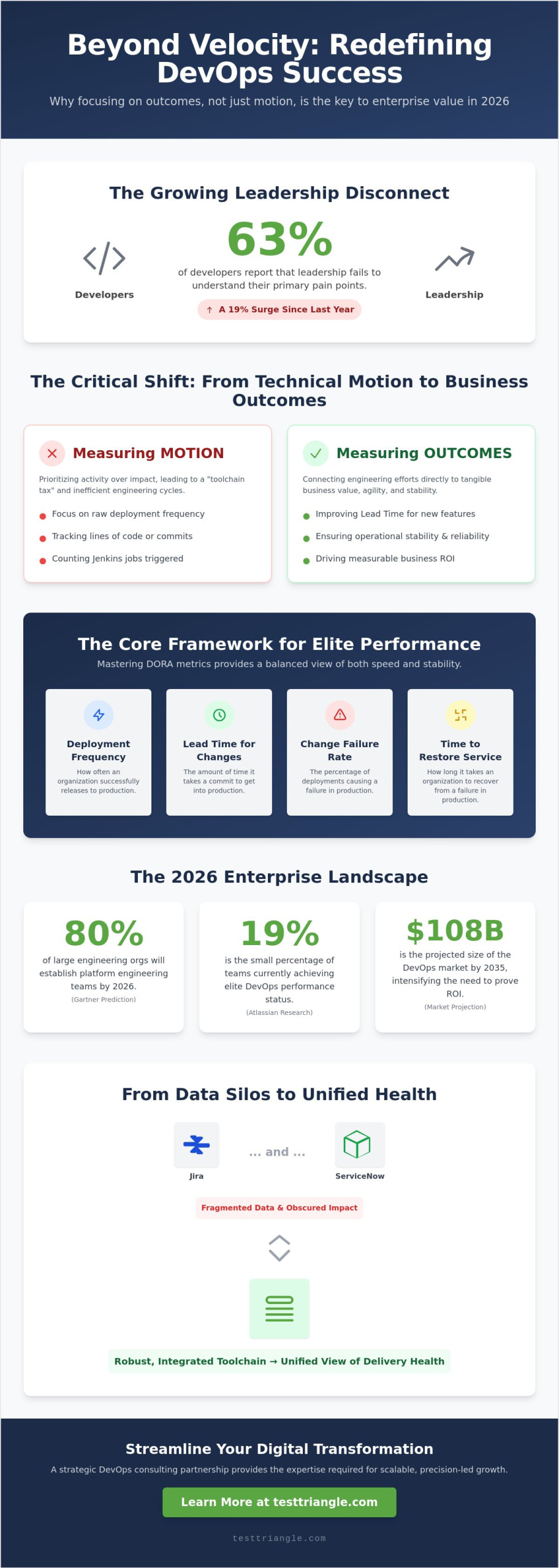
63% of developers report that leadership fails to understand their primary pain points, a figure that has surged by 19% since last year according to Atlassian research. This disconnect often stems from a focus on technical motion rather than meaningful progress, leaving organizations unable to translate rapid engineering cycles into tangible business value. If you’re managing complex digital infrastructures, you likely feel the strain of data silos between platforms like Jira and ServiceNow that obscure the true impact of your DevOps initiatives.
You can bridge this gap by mastering the strategic frameworks required for measuring devops success metrics and kpis to ensure your technical velocity drives real-world ROI. We’ll provide a clear roadmap for building an actionable KPI dashboard that aligns engineering output with executive expectations, moving beyond the 19% of teams currently reaching elite performance status. By the end of this guide, you’ll understand how to optimize deployment frequency and stability while maintaining the operational precision your enterprise demands.
Key Takeaways
- Understand why the shift from measuring motion to measuring outcomes is essential for maintaining a competitive edge in the 2026 enterprise landscape.
- Master the foundational DORA benchmarks to refine your approach to measuring devops success metrics and kpis, ensuring every code commit translates into reliable production value.
- Discover the methodology for converting engineering cycle times into measurable time-to-market advantages that resonate with executive leadership.
- Establish a robust, integrated toolchain across Atlassian and ServiceNow ecosystems to eliminate data silos and provide a unified view of your delivery health.
- Explore how a strategic partnership involving DevOps Consulting can streamline your digital transformation by providing the expertise required for scalable, precision-led growth.
Beyond Velocity: Redefining DevOps Success in 2026
Success in 2026 is no longer defined by how often you push code, but by the value that code generates for the end user. While early adoption focused on the raw mechanics of What is DevOps?, modern enterprises now face a “Measurement Gap” where technical velocity fails to move the needle on business ROI. This friction occurs when teams prioritize activity over outcomes. Effective measuring devops success metrics and kpis requires a transition from simply tracking deployment frequency to understanding how those deployments impact operational stability and market agility. It’s about ensuring that every sprint contributes to a more resilient and responsive digital infrastructure.
Executives don’t care about the number of Jenkins jobs triggered; they care about lead time for revenue-generating features. In a landscape where the DevOps market is projected to reach USD 108.26 billion by 2035, the pressure to prove ROI is immense. Organizations must bridge the disconnect between engineering speed and executive satisfaction by aligning technical milestones with strategic business goals. This involves a disciplined approach to systemic improvement where every metric serves as a proxy for customer value. Many teams currently struggle with a “toolchain tax,” spending excessive time maintaining fragmented systems rather than delivering features. Reducing this overhead is a primary goal of measuring devops success metrics and kpis in the modern era.
The Evolution of DevOps Performance Standards
Digital Transformation Services have fundamentally raised the bar for what constitutes “elite” performance. It’s no longer enough to be fast; you must be secure and scalable. In 2026, success is measured by the ability to maintain high-velocity output without compromising the integrity of complex, highly regulated digital infrastructures. This shift moves the focus from reactive incident monitoring to proactive strategic roadmapping. Gartner predicts that 80% of large engineering organizations will establish platform engineering teams by 2026. This evolution allows for a more focused measurement of developer experience and productivity, ensuring that human expertise is empowered by technical tools rather than hindered by them.
The Strategic Importance of Quality Assurance
While automation is a cornerstone of speed, Manual Testing remains a vital counter-metric for ensuring qualitative excellence. Pure velocity often creates “noise” through useless security alerts or unstable releases. Balancing speed with Digital Assurance ensures that brand protection is never sacrificed for a faster release cycle. High-standard software QA services provide the necessary oversight to translate technical execution into enduring business value. This balanced approach ensures that stability remains a constant even as deployment frequencies increase, providing the peace of mind that comes from reduced risk and enhanced operational reliability.
The Core Framework: Mastering DORA Metrics and Lead Time
Establishing a high-performance culture requires a shift from anecdotal evidence to empirical data. The DevOps Research and Assessment (DORA) metrics provide the foundational benchmark for this transition, offering a balanced view of both speed and stability. For global enterprises operating in highly regulated industries, the challenge lies in scaling these metrics across fragmented toolchains while maintaining strict compliance. Effective measuring devops success metrics and kpis depends on these four pillars to identify bottlenecks and ensure that engineering efforts align with strategic organizational growth.
Success in 2026 isn’t just about the metrics themselves, but the methodology used to capture them. Data silos between development and operations often lead to skewed results that don’t reflect reality. By implementing a unified framework, organizations can move beyond basic activity tracking to achieve a sophisticated understanding of their operational health. This disciplined approach provides the peace of mind that comes from knowing your infrastructure is both agile and resilient.
Deep Dive into Lead Time and Deployment Frequency
Lead Time for Changes is the primary indicator of pipeline efficiency, quantifying the journey from the initial code commit to a successful production release. High-performing organizations utilize Atlassian tools to automate the collection of these data points, ensuring that leadership has a transparent view of the delivery lifecycle. According to the 2024 DORA State of DevOps report, elite performers deploy 182 times more frequently than low performers. However, with only 19% of teams qualifying as elite, most organizations still face significant hurdles in achieving this level of agility. Strategic roadmapping helps bridge this gap by identifying exactly where manual handoffs are stalling the rhythm of your delivery pipeline.
Stability Metrics: MTTR and Change Failure Rate
Velocity must always be tempered by reliability to protect brand integrity and operational continuity. The Change Failure Rate serves as an essential metric for process quality, measuring the percentage of deployments that require immediate remediation. The integration of software test automation services provides the necessary safety net, allowing teams to accelerate without increasing risk. When incidents do occur, Mean Time to Recovery (MTTR) becomes the ultimate measure of resilience. A sophisticated ServiceNow implementation streamlines this response by connecting technical alerts to automated incident management workflows. This methodical approach ensures that stability remains a constant, even as your organization scales its digital infrastructure. To see how these frameworks can be tailored to your specific environment, consider how a strategic consultation can optimize your measurement strategy.
Bridging the Gap: Connecting Engineering KPIs to Business ROI
Engineering velocity lacks inherent value if it fails to translate into measurable business growth. For executive stakeholders, “Cycle Time” is often viewed as a technical abstraction, requiring a strategic translation into “Time to Market” to demonstrate economic impact. By measuring devops success metrics and kpis through the lens of revenue generation and market agility, organizations can justify the intensive capital required for large-scale technological evolution. A primary driver of this justification is the ROI of DevOps Consulting, which manifests in substantial cost-per-release reductions. These efficiencies are achieved by identifying systemic waste and automating manual bottlenecks that otherwise drain resources and delay profitability.
Beyond raw output, Developer Experience (DX) has emerged as a leading indicator of long-term productivity and talent retention. Atlassian research indicates that teams with easy access to self-serve information are 4.4 times more productive, yet many organizations continue to ignore the friction within their own toolchains. Improving DX reduces the cognitive load on engineers, allowing them to focus on innovation rather than infrastructure maintenance. This cultural shift is essential for maintaining the institutional maturity required to operate across diverse, highly regulated industries.
Strategic vs. Operational KPIs
Strategic KPIs focus on high-level outcomes such as revenue impact, customer satisfaction, and market agility; they provide the evidence executive leadership needs to support continued digital investment. Conversely, operational KPIs like sprint velocity, bug leakage, and infrastructure uptime offer the granular detail technical managers require to maintain stability. Creating a balanced scorecard that synthesizes these two perspectives ensures that both the CTO and CFO are aligned on the definition of success. This unified view fosters a spirit of partnership, ensuring that every deployment is a calculated step toward organizational progress.
The Role of Specialized Talent in Metric Success
The “Human Element” remains the most significant variable in achieving elite DevOps status. Access to specialized IT staffing directly influences an organization’s ability to meet complex KPI benchmarks, particularly in sectors with stringent compliance requirements. Pharmaceutical IT staffing, for example, provides the domain expertise necessary to ensure that security and regulatory KPIs are met without hindering delivery speed. Additionally, the strategic use of remote offshore resources can optimize cost-efficiency metrics when integrated into a disciplined, globally-minded framework. Positioning “Staffing as a Service” as a catalyst for growth allows enterprises to remain versatile while benefiting from a steady hand in a fast-changing landscape. Precision, Productivity, Profitability; these are the natural results of a well-staffed, data-driven DevOps culture.
Strategic Implementation: Building a Data-Driven DevOps Culture
The transition toward a data-driven DevOps culture requires a methodical approach that transcends simple tool adoption, beginning with a comprehensive audit to establish a clear baseline for current operational health. Without this foundational step, measuring devops success metrics and kpis becomes an exercise in tracking motion without direction. Once a baseline is established, organizations must move toward a strategic integration of their toolchain, ensuring that data flows seamlessly between Jira, Bitbucket, and ServiceNow. This connectivity allows leadership to define “North Star” metrics that align technical output with specific, high-level business objectives. Precision, Performance, Progress; these three pillars form the core of a mature implementation strategy.
Achieving this level of transparency often requires the expertise found in Atlassian Consulting to automate reporting and eliminate manual data entry. Automation ensures that the insights generated are both accurate and timely, providing executive stakeholders with the confidence needed to make informed investment decisions. The final stage of this implementation is iterative refinement, where continuous feedback loops allow teams to adjust their strategies based on real-world performance data. This disciplined cycle ensures that the DevOps framework remains adaptable and resilient in a fast-changing technological landscape.
Toolchain Integration for Holistic Visibility
Establishing a “Single Source of Truth” is critical for enterprise reporting, as fragmented data lead to conflicting interpretations of success. By leveraging sophisticated IT Service Management solutions, organizations can bridge the gap between development and operations, creating end-to-end visibility across the entire lifecycle. Data silos dissolve when tools connect. Automating KPI dashboards reduces manual reporting overhead, allowing engineers to focus on high-value tasks while providing leadership with real-time health indicators. This integration ensures that every stakeholder, from the developer to the CFO, is working from the same set of verified facts.
Fostering a Culture of Continuous Improvement
A data-driven culture thrives when organizations move away from a “Blame Culture” and embrace a “Learning Culture” rooted in empirical evidence. Using measuring devops success metrics and kpis to identify training gaps and staffing needs allows for more targeted professional development and resource allocation. Successful KPI adoption depends heavily on effective change management and ongoing training, ensuring that teams understand the “why” behind the metrics. When data are used as a tool for empowerment rather than a metric for punishment, organizational progress becomes a shared mission. To begin your journey toward a more transparent and efficient delivery model, consider scheduling a strategic roadmap session to align your toolchain with your business goals.
Optimising Delivery: The Test Triangle Strategic Partnership Model
Achieving peak delivery performance requires more than just a list of benchmarks; it demands a reliable long-term collaborator capable of aligning technical rigor with corporate strategy. Test Triangle positions itself as this steady hand, providing the institutional maturity necessary to manage large-scale technological shifts. By integrating our Managed Outsourcing Services, enterprises can remove the inherent friction of measuring devops success metrics and kpis, allowing internal teams to focus on core innovation while we handle the intricacies of data collection and analysis. Strategy, Stability, Success; these three pillars form the foundation of our integrated consulting approach. We combine industry-leading tools with specialized talent and proven techniques to ensure that your delivery pipeline remains both agile and resilient.
We recognize that a one-size-fits-all approach is insufficient for global enterprises operating in highly regulated sectors. Whether your organization is in finance, healthcare, or retail, our customized KPI frameworks are designed to address the specific regulatory and operational challenges of your industry. This sector-specific expertise ensures that your DevOps transformation isn’t just fast, but also compliant and secure. By bridging the gap between technical execution and business outcomes, we empower leadership to make data-driven decisions that foster sustainable, scalable growth.
Comprehensive DevOps and QA Support
A truly optimized delivery pipeline must account for qualitative excellence at every stage of the lifecycle. Integrating QA Outsourcing into your DevOps pipeline provides a critical layer of digital assurance, ensuring that brand protection is never sacrificed for the sake of velocity. Our global presence supports 24/7 delivery and monitoring, providing the infrastructure needed to maintain high-performance standards across diverse time zones. Beyond immediate technical support, we offer strategic technology roadmapping as a service, helping your organization anticipate future shifts in the landscape and adjust your measuring devops success metrics and kpis accordingly.
Next Steps for Enterprise Transformation
The journey toward elite performance begins with an objective evaluation of your current maturity level through a strategic audit. We identify existing bottlenecks and data silos that hinder your ability to translate engineering speed into ROI. We advocate for a phased implementation approach to DevOps metrics, which allows for the gradual adoption of sophisticated benchmarks without overwhelming your operational teams. This methodical progression ensures that each new KPI provides immediate value while building toward a comprehensive dashboard of delivery health. If you’re ready to master the frameworks required for 2026, Test Triangle is prepared to serve as your strategic partner. Reach out to our team today for a bespoke consultation on your DevOps roadmap and take the first step toward a more transparent, efficient, and profitable future.
Mastering the Future of DevOps Delivery
Navigating the complexities of modern digital infrastructure requires a shift from tracking simple activity to prioritizing high-impact business outcomes. By refining your approach to measuring devops success metrics and kpis, you ensure that every engineering sprint contributes directly to market agility and operational stability. Establishing a single source of truth across integrated toolchains isn’t just a technical goal; it’s a strategic necessity for enterprises seeking elite performance status. This alignment provides the transparency required to justify technological investments and drive sustainable growth.
As an Atlassian Platinum Solution Partner and ServiceNow Specialist Partner, Test Triangle provides a global delivery model infused with localized expertise to guide your digital evolution. We act as a reliable long-term collaborator, helping you bridge the gap between technical velocity and executive satisfaction through precision-led frameworks. Partner with Test Triangle to optimize your DevOps metrics and drive strategic growth. Together, we can transform your delivery pipeline into a powerful engine for innovation and profitability.
Frequently Asked Questions
What are the most important DevOps KPIs to track for executives?
Executives should prioritize high-level outcomes such as Time-to-Market, Customer Satisfaction Scores (CSAT), and the total cost of delivery per feature. These indicators translate technical motion into financial and market impact, allowing leadership to assess how digital transformation initiatives drive competitive advantage. By focusing on these strategic results, organizations can justify the capital investment required for large-scale infrastructure evolution.
How do DORA metrics help in measuring DevOps success?
DORA metrics provide a standardized, empirical framework for benchmarking your organization against industry-wide performance tiers. By tracking Deployment Frequency and Change Failure Rate, teams gain a balanced view of both agility and reliability. This disciplined approach is essential for measuring devops success metrics and kpis in a way that identifies specific process bottlenecks and guides systemic improvement.
Can DevOps metrics be used to improve developer experience?
Metrics like developer toil, build times, and documentation accessibility serve as direct indicators of the internal developer experience. High friction within the toolchain often leads to burnout and decreased productivity, which eventually impacts the bottom line. Organizations that prioritize these leading indicators typically see a strong correlation with improved talent retention and higher-quality code output.
How do I integrate Jira and ServiceNow for better DevOps visibility?
Integration is achieved by connecting development workflows in Jira with service management processes in ServiceNow to create a unified, end-to-end data stream. This connectivity ensures that incident data and change requests are automatically synchronized across the lifecycle. A successful ServiceNow implementation eliminates manual status updates and provides the “Single Source of Truth” required for accurate enterprise reporting.
What is the difference between leading and lagging indicators in DevOps?
Leading indicators, such as pull request review times or sprint velocity, predict future performance, while lagging indicators like monthly uptime or total revenue reflect past results. Both are necessary for a comprehensive balanced scorecard. Leading metrics allow for proactive adjustments to the pipeline, whereas lagging metrics confirm whether your long-term strategic objectives were actually met.
How often should we review our DevOps success metrics?
While operational dashboards should be monitored in real-time, strategic reviews of your overarching KPI framework should occur on a quarterly basis. This cadence allows sufficient time for systemic changes to manifest in the data without reacting to short-term noise. Regular audits ensure that your measurement strategy remains closely aligned with shifting business priorities and evolving market conditions.
What role does automation play in achieving elite DevOps metrics?
Automation acts as the primary catalyst for achieving elite performance by removing human error and accelerating the feedback loop. It’s particularly critical for measuring devops success metrics and kpis because it ensures that data are collected consistently and transparently across the entire pipeline. Without automated testing and deployment, maintaining high velocity while reducing operational risk is virtually impossible.
How can I justify the cost of DevOps consulting using KPIs?
You can justify the investment by demonstrating a clear reduction in the cost-per-release and a decrease in the financial impact of production outages. DevOps Consulting provides the specialized expertise required to identify and eliminate systemic waste that drains corporate resources. By linking these efficiency gains to improved time-to-market, you provide executive leadership with a compelling ROI case rooted in financial performance.

Article by
Paul Guy
Paul serves as the Marketing Director at Test Triangle, where he leads a global team in driving growth through strategic B2B marketing and brand communications. With a strong emphasis on measurable outcomes and sustainable performance, he plays a pivotal role in aligning marketing functions to enhance customer engagement and accelerate business impact. Under his leadership, marketing initiatives have consistently delivered significant returns on investment, elevated brand visibility, and strengthened the company's presence across key markets.